
AI in Manufacturing: The 5 Asset-Heavy Use Cases That Deliver Measurable Results
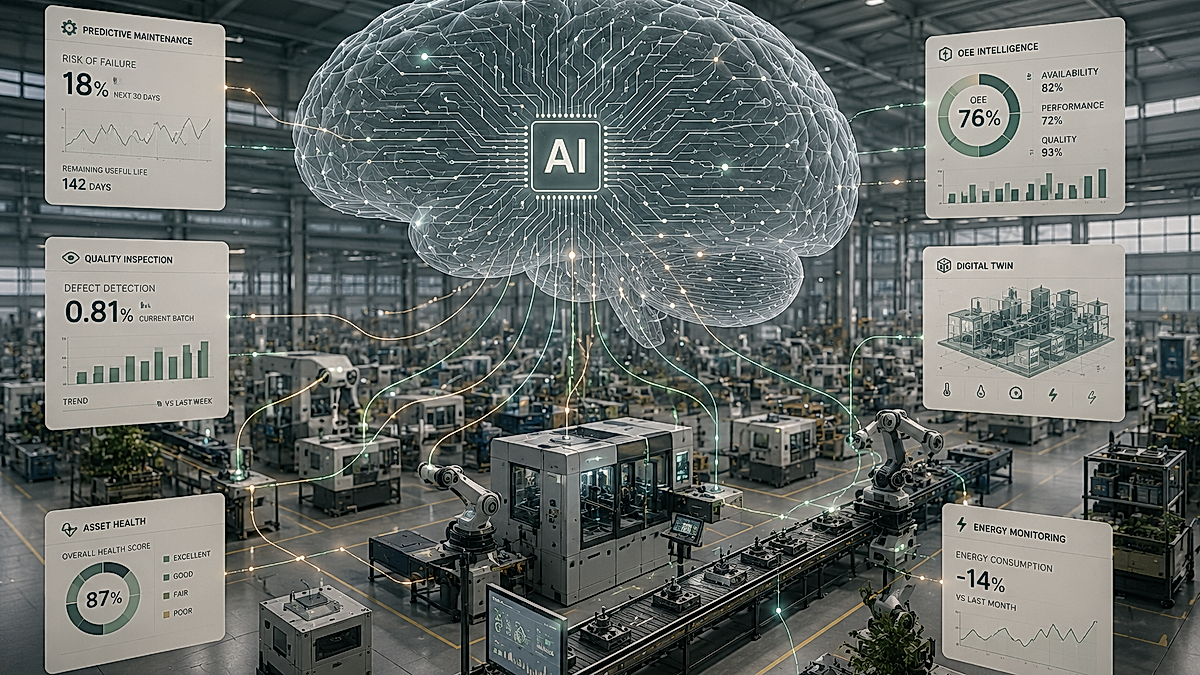
Artificial intelligence is becoming part of everyday manufacturing operations. Yet many manufacturers struggle to move beyond dashboards, pilots, and disconnected analytics. The challenge isn't access to AI—it's applying AI where operational data is complete, reliable, and connected to physical assets.
Machines already generate enormous volumes of information through PLCs, sensors, CMMS, ERP systems, MES platforms, and IoT devices. When these data sources remain isolated, AI models produce insights that rarely translate into operational improvements.
The manufacturers seeing measurable outcomes are focusing on asset-heavy workflows where AI supports maintenance, production, quality, and decision-making using trusted operational data.
This article explores five manufacturing use cases where AI consistently delivers value—and why success depends on integrating AI with enterprise asset management rather than treating it as another reporting layer.
Why Manufacturing Is an Ideal Environment for AI
Manufacturing operations produce structured, repeatable processes backed by historical operational data.
Examples include:
- Machine runtime
- Maintenance history
- Sensor readings
- Inspection results
- Production output
- Downtime events
- Spare parts consumption
- Asset lifecycle records
These datasets allow AI models to recognize patterns, detect anomalies, predict failures, and recommend actions before issues affect production.
However, AI performs only as well as the operational data behind it. Missing maintenance history, inaccurate asset hierarchies, duplicate equipment records, or incomplete inspections reduce model accuracy and trust. Operational visibility must come before automation.
Artificial intelligence doesn't replace operational discipline—it amplifies it. Reliable outcomes begin with reliable asset data.
1. Predictive Maintenance That Goes Beyond Scheduled Servicing
Traditional preventive maintenance follows fixed intervals. A machine may receive maintenance every 30 days regardless of whether components require attention. This often creates two problems:
- Equipment is serviced too early, increasing maintenance costs.
- Equipment fails before the next scheduled inspection.
AI changes this approach by continuously analyzing equipment behaviour instead of relying only on calendar schedules.
Typical data sources include:
- Vibration sensors
- Temperature trends
- Oil analysis
- Motor current
- Maintenance history
- Failure records
The AI identifies subtle changes that indicate wear before operators notice symptoms.
Instead of simply generating alerts, modern systems prioritize assets according to operational risk, production impact, and historical failure patterns.
Business outcomes
- Reduced unplanned downtime
- Longer equipment life
- Better maintenance planning
- Lower emergency repair costs
- Improved spare parts forecasting
For organizations managing hundreds or thousands of production assets, predictive maintenance becomes significantly more valuable when linked directly to work orders and asset histories.
2. AI-Powered Quality Inspection Using Computer Vision
Manual inspection remains one of the most time-consuming activities in manufacturing.Even experienced inspectors may miss small defects during repetitive visual checks. Computer vision systems use AI to inspect products continuously throughout production.
Applications include:
- Surface defect detection
- Assembly verification
- Dimension checking
- Weld inspection
- Packaging validation
- Label verification
Unlike traditional rule-based vision systems, AI learns from thousands of examples and improves detection accuracy over time. The result is faster inspection without increasing inspection staff.
Operational advantages
- Faster defect detection
- Reduced product waste
- Higher first-pass yield
- Improved production consistency
- Better customer quality performance
When integrated with manufacturing execution systems, quality events can automatically trigger corrective actions or maintenance requests.
3. OEE Intelligence Instead of Static Dashboards
Most manufacturers already calculate Overall Equipment Effectiveness (OEE). The problem isn't measuring OEE. The problem is understanding why OEE changes. Traditional dashboards report metrics such as:
- Availability
- Performance
- Quality
Operators then investigate production records manually. AI accelerates this analysis by identifying relationships across multiple operational variables simultaneously.
Examples include:
- Machine configuration changes
- Operator shifts
- Maintenance activities
- Environmental conditions
- Product mix
- Material quality
- Equipment age
Instead of asking operators to investigate dozens of dashboards, AI identifies the most probable root causes affecting production efficiency.
Rather than saying: OEE dropped by 8%.
The system explains: OEE decreased because Machine A experienced recurring micro-stoppages following tooling replacement during the second shift.
Benefits
- Faster root-cause analysis
- Reduced production losses
- Better scheduling decisions
- Improved production planning
- More effective continuous improvement programs
4. Intelligent Root Cause Analysis Across Operations
Manufacturing disruptions rarely result from a single event. A production delay may involve:
- Equipment condition
- Maintenance timing
- Material quality
- Supplier delays
- Operator actions
- Environmental changes
Traditional investigations require multiple departments to manually assemble information from different systems. AI can analyze these datasets together. Instead of reviewing maintenance logs, inspection reports, ERP transactions, and production events separately, AI identifies patterns connecting them.
For example:
A recurring bearing failure may consistently occur after a specific production schedule combined with elevated operating temperatures and delayed lubrication. Without AI, these relationships may remain hidden for months.
Operational improvements
- Faster incident investigations
- Reduced repeat failures
- Better engineering decisions
- Stronger reliability programs
- Continuous operational learning
This is particularly valuable in large manufacturing plants where thousands of operational events occur every day.
5. Complete Asset Visibility Across the Manufacturing Lifecycle
Many manufacturers operate with incomplete asset visibility. Information exists across multiple systems:
- ERP
- CMMS
- IoT platforms
- Production systems
- Excel spreadsheets
- Paper inspections
As a result:
Maintenance teams cannot see complete equipment history. Production teams lack maintenance context. Management receives fragmented reports. AI becomes far more valuable when asset information is unified.
Instead of searching across disconnected applications, engineers receive a complete operational picture. For every asset, AI can understand:
- Installation history
- Maintenance records
- Inspection results
- Failure history
- Spare parts usage
- Sensor behaviour
- Operational performance
- Warranty status
This enables better recommendations because decisions are based on complete lifecycle information rather than isolated datasets.
Business value
- Improved maintenance decisions
- Better capital planning
- Reduced duplicate assets
- Higher data quality
- Faster operational response
The value of AI in manufacturing isn't measured by the number of dashboards it creates, but by the operational decisions it helps teams make with confidence.
Why Many AI Manufacturing Projects Fail
Despite growing investment, many AI initiatives never reach production scale. The most common reasons include:
Poor Data Quality
Missing maintenance records and inconsistent asset information reduce prediction accuracy.
Disconnected Systems
AI cannot generate reliable insights when production, maintenance, and inspection data remain isolated.
Dashboard Overload
Organizations often deploy more analytics without improving operational workflows. Insights remain unused because they are not connected to day-to-day actions.
Lack of Operational Context
AI can detect anomalies, but it cannot recommend practical actions without understanding asset hierarchy, maintenance history, and operational constraints.
What Separates Successful AI Programs from the Dashboard Graveyard?
The difference isn't the AI model. It's the operational foundation underneath it.
Successful manufacturers typically follow this sequence:
Step 1: Build a complete asset inventory.
Step 2: Standardize maintenance and inspection processes.
Step 3: Capture consistent operational data.
Step 4: Integrate production, maintenance, and asset information.
Step 5: Apply AI to operational workflows—not isolated reports.
When AI recommendations automatically generate maintenance work orders, trigger inspections, or notify engineers, organizations begin seeing measurable operational improvements.
Where Enterprise Asset Management Fits In
AI requires structured operational data.
Enterprise Asset Management (EAM) provides that operational foundation.
An EAM platform connects:
- Assets
- Maintenance
- Inspections
- Work orders
- Spare parts
- Asset history
- Compliance records
- Operational events
When AI operates on this connected dataset, recommendations become more accurate, explainable, and actionable. Instead of isolated predictions, organizations receive operational intelligence linked directly to maintenance and production activities. This allows maintenance teams to move from reacting to failures toward planning interventions with confidence.
Building AI Around Operational Reality
Manufacturing teams don't need more dashboards. They need faster decisions backed by trustworthy operational data. The strongest AI implementations focus on improving existing workflows rather than replacing them.
Whether predicting failures, identifying quality defects, explaining production losses, or improving asset visibility, AI creates the greatest value when it works alongside maintenance, operations, and engineering teams—not separately from them.
Organizations that invest first in connected asset information, disciplined maintenance practices, and reliable operational records create the conditions where AI can consistently improve production performance.
Final Thoughts
AI in manufacturing is no longer about experimentation. It is becoming part of how modern plants improve reliability, quality, and operational efficiency.
The organizations seeing sustained results are not deploying AI in isolation. They are combining it with structured asset data, integrated maintenance processes, and connected operational workflows.
For manufacturers managing critical equipment, the opportunity isn't simply to predict failures or automate inspections—it's to build an operational environment where every asset, event, and maintenance activity contributes to better decisions.
With the right enterprise asset management foundation, AI becomes more than analytics. It becomes a practical decision-support layer that helps teams reduce downtime, improve quality, and keep operations running with greater confidence.