
Why enterprise predictive maintenance fails before deployment

Dhananjay Chandra Kulal
Author
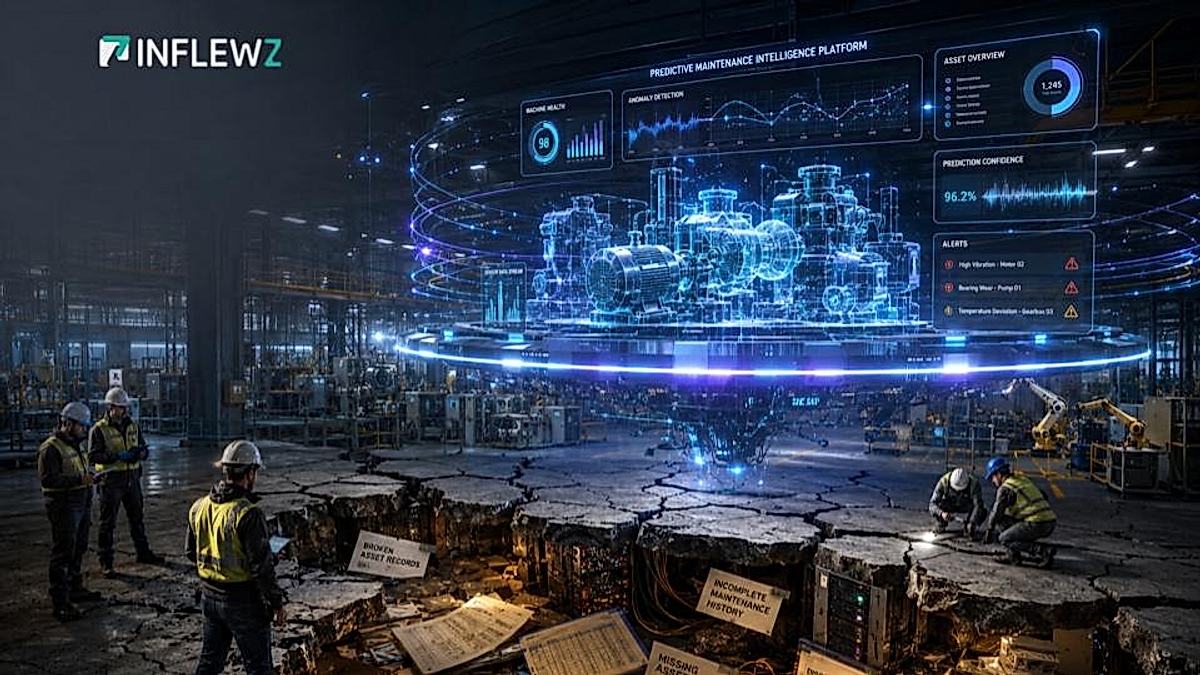
A Maintenance Head at a manufacturing facility recently described a familiar situation. The organization had invested heavily in sensors, subscribed to a predictive maintenance software platform, and launched dashboards across multiple production lines. Six months later, technicians were ignoring alerts, managers questioned the value of the system, and downtime remained largely unchanged. The problem was not the technology. It was everything that came before it.
Most predictive maintenance enterprise initiatives fail long before machine learning models enter production. Failure typically originates in poor asset data, weak sensor strategy, undefined failure modes, disconnected workflows, and fragmented operational systems.
The industry often treats predictive maintenance as an analytics challenge. In reality, it is an operations challenge first.
Why predictive maintenance projects stall before deployment
Enterprise enthusiasm for predictive maintenance has never been higher. Leadership teams want fewer breakdowns, lower maintenance costs, and better asset reliability. Vendors respond with dashboards, analytics engines, and promises of early failure detection.Unfortunately, many organizations buy technology before defining operational objectives.
The first question becomes: "What sensors should we install?"
The correct question is:"What failure are we trying to prevent?"
This distinction matters because predictive maintenance programs often start with data collection rather than maintenance outcomes. Sensors are deployed. Dashboards are configured. Alerts begin flowing. Yet nobody has clearly defined:
- Which assets are critical
- Which failures matter most
- Which teams will respond to alerts
- How success will be measured
As a result, many projects never move beyond proof-of-concept. Maintenance teams already manage work orders, inspections, shutdown planning, and recurring failures. Adding hundreds of alerts without redesigning operational workflows simply creates additional workload.
Most predictive maintenance failures are not prediction failures. They are operational design failures.
The organizations that succeed begin with maintenance objectives. The organizations that fail begin with technology.
Sensor strategy is more important than model accuracy
A predictive model cannot discover signals that were never captured. That single fact explains why many predictive maintenance programs underperform. Every sensor deployment is a hypothesis about how an asset fails. If the hypothesis is wrong, no amount of analytics can compensate.
Consider a pump. Different failure mechanisms require different monitoring approaches:
- Bearing degradation → vibration monitoring
- Overheating → temperature monitoring
- Hydraulic issues → pressure monitoring
- Electrical faults → electrical signature analysis
- Excessive wear → runtime and utilization monitoring
The challenge is that many organizations collect data without connecting it to a maintenance use case. This creates two common problems.
Oversensoring
Teams install large numbers of industrial IoT sensors because more data appears beneficial. The result:
- Higher costs
- More noise
- Alert fatigue
- Limited operational insight
Undersensoring
Critical failure modes remain invisible because the required signals were never captured. The goal is not maximum instrumentation. The goal is purposeful instrumentation. Every sensor should support a maintenance decision.
The most expensive sensor network in the world cannot predict a failure mode it was never designed to observe.
Failure-mode taxonomy: the foundation most teams skip
Before sensors are deployed, maintenance teams must understand how assets actually fail. This is where many predictive maintenance initiatives go wrong. They collect data first and study failure mechanisms later. The correct sequence is the opposite.
Failure Mode and Effects Analysis (FMEA) should guide every predictive maintenance strategy. A bearing does not fail like a transformer. A transformer does not fail like a diagnostic imaging system. A diagnostic imaging system does not fail like a centrifugal pump. Each asset follows different degradation patterns.
Manufacturing
For motors, bearings, and pumps, common failure modes include:
- Bearing wear
- Misalignment
- Lubrication degradation
- Vibration-induced damage
- Electrical imbalance
Healthcare
For diagnostic and calibration-sensitive equipment:
- Calibration drift
- Sensor degradation
- Environmental instability
- Component aging
Utilities
For transformers and distribution infrastructure:
- Insulation breakdown
- Thermal stress
- Load-related degradation
- Environmental exposure
Without a failure-mode taxonomy:
- Data becomes noise
- Alerts become meaningless
- Maintenance teams lose trust
- Adoption collapses
The strongest predictive maintenance programs are built by reliability engineers who understand failure behavior before they understand analytics.
If you cannot explain how an asset fails, you cannot predict when it will fail.
Data quality and integration are where predictive maintenance breaks
Many organizations assume predictive maintenance requires better algorithms. More often, it requires better data. Most enterprise asset data is not prediction-ready.
Common problems include:
- Missing asset records
- Incomplete maintenance history
- Poor work-order discipline
- Duplicate assets
- Inconsistent naming conventions
- Asset register drift
Even when sensors generate valuable signals, those signals rarely exist in isolation. A vibration spike on a motor is simply a number unless maintenance teams can see:
- Maintenance history
- Previous inspections
- Asset criticality
- Work-order records
- Operating conditions
This is why predictive maintenance depends on integration. Relevant systems often include:
- CMMS
- EAM
- ERP
- SCADA
- IoT gateways
- Maintenance workflows
Without operational context, predictive maintenance becomes disconnected analytics. With operational context, it becomes actionable maintenance intelligence.
Bad data does not create bad predictions. It creates false confidence.
What successful predictive maintenance programs do differently
Organizations that scale predictive maintenance follow a predictable pattern.
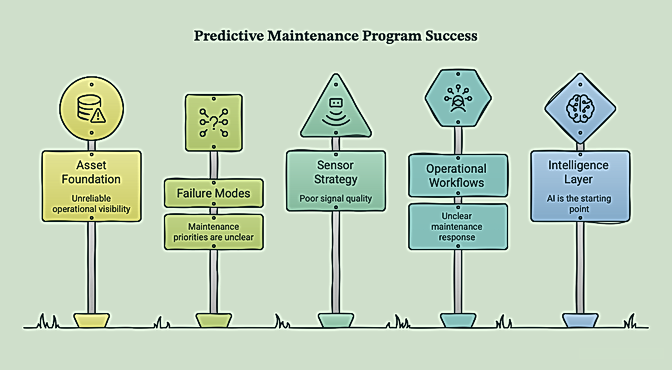
1. Build the asset foundation first: They establish a clean asset registry, ownership structure, and complete maintenance history.
Result: reliable operational visibility.
2. Define failure modes: They perform FMEA and criticality mapping before deploying sensors.
Result: monitoring focuses on meaningful risks.
3. Design the sensor strategy: Instrumentation is selected based on known degradation patterns.
Result: higher signal quality and fewer unnecessary alerts.
4. Establish operational workflows: Alert routing, escalation paths, approvals, and work-order generation are clearly defined.
Result: maintenance teams know exactly how to respond.
5. Add intelligence last: Only after operational foundations exist do organizations implement anomaly detection, predictive models, and advanced analytics.
Result: insights become actionable rather than theoretical.
Two approaches to predictive maintenance
Approach A
- Sensor vendor
- Data platform
- Analytics dashboard
- No operational backbone
Result:
- Alert fatigue
- Poor adoption
- Pilot failure
- Isolated insights
Approach B
- Asset intelligence
- Maintenance workflows
- Compliance records
- Operational visibility
- Audit-ready history
- Predictive insights
Result:
- Scalable predictive maintenance
- Organizational adoption
- Measurable operational outcomes
This is where the distinction between technology and operations becomes clear. Predictive maintenance does not succeed because organizations collect more data. It succeeds because they create operational context around that data.
Inflewz provides the operational system of record that connects asset intelligence, maintenance management, audit-ready history, operational visibility, and traceable workflows into a single operational foundation.
Prestine AI sits above that foundation, analyzing operational signals, identifying anomalies, and supporting predictive decision-making.
Predictive maintenance succeeds when intelligence sits on top of operational truth.
The future of predictive maintenance will not be won by the company with the most sophisticated model.
It will be won by the company with the cleanest asset foundation, the clearest failure-mode understanding, and the strongest operational visibility.
If your team is still piecing asset operations together with spreadsheets, WhatsApp, and paper logs, a 30-minute technical walkthrough is the fastest way to see what changes.