
Why Your CMMS Is Not Talking to Your IoT — and How to Fix It

Dhananjay Chandra Kulal
Author
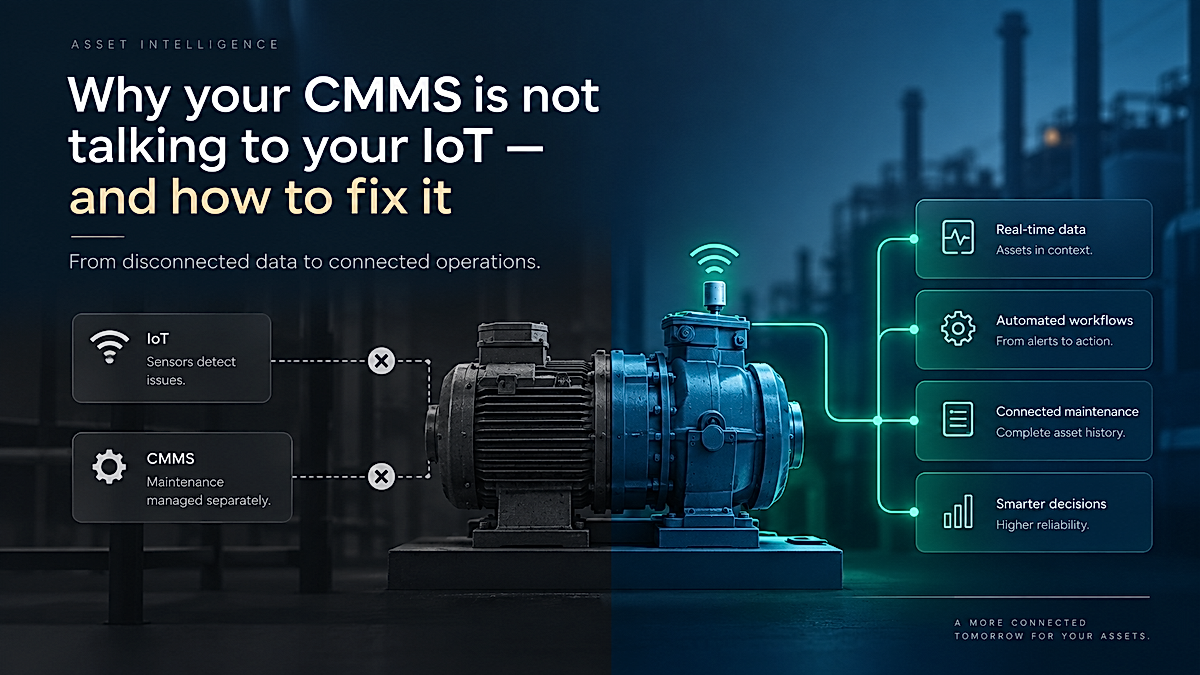
A sensor can tell you that a motor is vibrating more than usual.
A CMMS can tell you that the motor is scheduled for maintenance next month.
But if those two systems do not communicate, your maintenance team is still working with two separate versions of reality.
That is the central problem with many CMMS IoT integration projects.
The challenge is rarely the absence of data. Modern industrial environments already generate enormous amounts of it through sensors, PLCs, SCADA systems, GPS devices, BLE tags, ERP platforms, inspection applications, and maintenance systems.
The challenge is getting that data into the right operational context.
An IoT platform may know that a machine crossed a temperature threshold. A CMMS may know the machine's maintenance history. An ERP may contain its procurement and financial information. A document system may contain its warranty and service records.
If these systems remain disconnected, someone still has to interpret the signal, identify the asset, decide what action is required, create a work order, assign it, and document the result.
That is not connected maintenance.
It is manual reconciliation between connected technologies.
A practical CMMS IoT integration should do more than move sensor data from one database to another. It should connect asset identity → condition → maintenance rule → work order → execution → history.
That is where the architecture matters.
Why CMMS and IoT systems often remain disconnected
A CMMS is fundamentally designed around maintenance management.
It answers questions such as:
- Which assets require maintenance?
- When is preventive maintenance due?
- Who is responsible for the work?
- What was repaired previously?
- Which spare parts were used?
- What is the maintenance history of an asset?
IoT systems operate differently.
They focus on signals and events:
- Temperature
- Vibration
- Pressure
- Runtime
- Location
- Movement
- Energy consumption
- Equipment status
- Sensor anomalies
Both systems are valuable.
The problem appears when the IoT event cannot reliably connect to the corresponding asset and maintenance process.
For example:
Sensor: Vibration above threshold.
IoT platform: Alert generated.
CMMS: No corresponding maintenance action.
Engineer: Receives an email or message and investigates manually.
Result: Another system, spreadsheet, phone call, or human decision becomes the integration layer.
At enterprise scale, this approach becomes difficult to control.
Inflewz approaches asset operations as a connected lifecycle rather than isolated maintenance tickets. Its platform brings asset management, maintenance, calibration, documents, workflows, and IoT tracking into one environment, with REST APIs and webhooks available for enterprise integration.
The objective is not simply to collect more data. It is to make the data operational.
What a good CMMS IoT integration actually needs to solve
Before discussing integration patterns, it helps to define the actual problem. A successful integration needs to answer five questions.
1. What asset generated the data?
A sensor reading without reliable asset identity has limited operational value.
The system needs to know whether the signal belongs to:
- Motor MTR-104
- Pump P-208
- Compressor C-17
- HVAC Unit A12
- Transformer T-04
Asset identity is the bridge between IoT data and maintenance.
2. What does the signal mean?
Not every sensor event requires a work order.
A temperature reading might be:
- Normal
- Elevated
- Critical
- Part of a known operating condition
- A temporary anomaly
The integration needs rules and context rather than blindly creating tickets.
3. What action should happen?
A useful integration converts meaningful conditions into operational actions.
For example:
Vibration anomaly → inspect bearing → assign technician → complete checklist → record finding.
4. Where does the result go?
The maintenance action should update the asset's history.
The original IoT event, maintenance response, technician findings, parts used, approval, and closure should remain connected.
5. Can the organization prove what happened?
For asset-intensive and regulated environments, the answer needs to be traceable.
- Who detected the issue?
- When?
- Which asset?
- What action was taken?
- Who approved it?
- What was the outcome?
This is where integration becomes an operational architecture rather than an IT connection.
The 3 CMMS IoT integration patterns that actually work
There is no single integration pattern for every organization. The right approach depends on existing systems, data maturity, asset criticality, and how much automation is required.
Three patterns are particularly practical.
1. Event-to-work-order integration
This is the most direct pattern.
An IoT system detects a meaningful condition and sends an event to the maintenance platform.
Example
A pump has a vibration sensor.
The sensor continuously sends readings to the IoT layer. A rule identifies a sustained abnormal vibration level.
Instead of simply displaying another dashboard alert, the integration sends the relevant event to the maintenance system.
The workflow becomes:
Sensor → IoT event → Asset identification → Maintenance rule → Work order → Technician → Closure
The work order can contain the relevant asset, priority, condition, instructions, and supporting information. This is significantly different from simply forwarding an alert. The objective is to create an actionable maintenance event.
Inflewz supports preventive, corrective, and condition-based maintenance workflows, with maintenance rules that can be based on time, usage, condition, or regulatory requirements. Its maintenance architecture is designed to connect asset information with work orders and maintenance history.
When this pattern works best
Use event-to-work-order integration when:
- Equipment condition directly determines maintenance action.
- Sensors generate reliable alerts.
- Maintenance teams need rapid response.
- Assets have meaningful failure consequences.
- You want to reduce manual intervention.
The important design decision
Do not create a work order for every sensor event.That creates alert fatigue.
The integration should distinguish between a signal and an actionable condition.
One sensor can generate thousands of readings. The maintenance system may only need to receive a handful of meaningful events.
2. Shared asset identity and lifecycle integration
The second pattern focuses on the asset itself.
Instead of treating IoT and CMMS as two independent databases, establish a common asset identity. Consider an industrial pump.
Its information may exist across:
- ERP
- CMMS
- IoT platform
- Calibration system
- Document repository
- Inspection system
The same pump could have different IDs in each system.
That creates one of the most common integration problems: data does not agree on what the asset actually is.
A stronger architecture establishes a controlled asset record.
For example:
Asset ID: P-204
Then connect:
- Asset specifications
- Location
- Ownership
- Sensor identity
- Maintenance history
- Calibration records
- Warranty
- Manuals
- Inspection records
- IoT events
- Work orders
Now an IoT event does not simply say:
Sensor 7384 detected abnormal vibration.
It can say:
Pump P-204 at Plant 2 generated a sustained vibration anomaly.
That difference is operationally significant.
Inflewz positions asset management as the foundation layer connecting asset records with maintenance, calibration, documents, tasks, and IoT tracking.
Why this pattern matters
Without a common asset identity, integrations become fragile.
With one, different systems can continue doing what they are designed to do while sharing a consistent operational reference.
This is particularly important for organizations managing thousands of assets across multiple sites.
3. Closed-loop integration
The third pattern goes beyond sending information into the CMMS.It connects the entire operational loop.
Consider this sequence:
IoT detects condition
↓
Asset is identified
↓
Maintenance rule evaluates condition
↓
Work order is created
↓
Technician receives assignment
↓
Inspection is performed
↓
Finding is recorded
↓
Repair is completed
↓
Approval is captured
↓
Asset history is updated
↓
Data becomes available for future analysis
That is a closed-loop architecture. The IoT system does not merely produce an alert. The maintenance platform does not merely produce a ticket. The completed maintenance action becomes part of the asset's lifecycle record.
This creates a feedback loop between operational data and maintenance history.
Over time, that history can support better maintenance planning, reliability analysis, lifecycle decisions, and predictive insights.
Inflewz's platform connects asset tracking, maintenance, documents, calibration, tasks, and AI-powered asset intelligence, including capabilities for identifying maintenance risks and recommending operational actions.
The real value of closed-loop integration
The objective is not automation for its own sake. The objective is reducing the distance between:
something happening to an asset
and
the organization responding correctly.
The 2 CMMS IoT integration anti-patterns to avoid
Integration projects can fail even when the technology technically works. Two patterns create problems repeatedly.
Anti-pattern 1: Treating IoT as an alert pipe
A common implementation looks like this:
Sensor → Alert → CMMS ticket
It sounds simple. But scale exposes the weakness.
If 10,000 sensors generate frequent events, the maintenance team can quickly receive thousands of alerts. The result is not predictive maintenance. It is a larger inbox.
The integration should understand:
- Thresholds
- Duration
- Severity
- Asset criticality
- Existing work orders
- Maintenance state
- Operating context
For example, a temperature spike lasting five seconds may require no action.
The same temperature condition sustained for 30 minutes on a critical asset may justify immediate inspection. The difference is context.
A useful architecture therefore separates data collection from decision logic.
Anti-pattern 2: Building point-to-point integrations everywhere
Another common approach is connecting every system directly to every other system.
For example:
IoT → CMMS
IoT → ERP
ERP → CMMS
CMMS → Document System
IoT → Dashboard
ERP → Dashboard
As systems increase, integration complexity increases with them. A new platform can require several new connections.
A better approach is to establish controlled interfaces and common data structures.
APIs and webhooks can provide structured integration points, while the asset record acts as a consistent operational reference.
Inflewz identifies REST APIs and webhooks as part of its enterprise integration capabilities, while its maintenance platform is positioned as API-first and IoT-ready.
The goal is not to eliminate every existing system. It is to prevent those systems from becoming disconnected islands.
Where Inflewz fits into the architecture
Inflewz is designed around the idea that maintenance should not exist separately from the asset lifecycle.
The platform connects:
Assets
→ IoT tracking
→ Maintenance
→ Calibration
→ Documents
→ Tasks & workflows
→ Compliance
→ Asset intelligence
This matters because an IoT event rarely exists in isolationA sensor reading may affect maintenance.
Maintenance may require a calibrated instrument. The repair may require a document. The task may require approval.
The completed work becomes part of the asset history. And that history can contribute to future operational decisions.
Inflewz's platform describes this lifecycle from onboarding and verification through operation, maintenance, calibration, insights, optimization, and retirement. (Inflewz)
That provides a more useful model for CMMS IoT integration:
Don't connect systems because they have data to exchange. Connect them because an operational process needs to move from one step to another.
What this looks like on the shop floor
Consider a manufacturing plant with 500 critical machines. One motor begins showing abnormal vibration.
Traditional setup
- The sensor produces an alert.
- An operator notices it.
- The maintenance engineer investigates.
- A CMMS ticket is created manually.
- The technician visits the machine.
- The technician discovers the bearing is degrading.
- A repair is completed.
- Someone updates the CMMS.
- The IoT alert and maintenance record remain largely separate.
Connected setup
- The sensor detects the anomaly.
- The asset is identified automatically.
- The condition is evaluated against configured rules.
- A maintenance action is triggered.
- A work order is assigned.
- The technician receives the asset's maintenance context.
- The inspection is completed digitally.
- The result is recorded against the asset.
- The maintenance history is updated.
The organization now has a connected record of:
condition → decision → action → result.
That is the difference between having IoT data and using IoT data operationally.
Integration should be designed around the asset, not the software
A useful way to evaluate a CMMS IoT integration is to stop asking:
“Can these two systems connect?”
Instead ask:
“What should happen when an asset changes condition?”
That question produces a much better architecture.
Start with the asset.
Then define:
- What data describes its condition?
- Which system owns that data?
- What constitutes an actionable event?
- Which maintenance rule applies?
- Who should receive the task?
- What evidence is required?
- How is completion verified?
- Where is the result stored?
- How does the history influence future decisions?
This approach prevents integration from becoming a collection of technical connections without operational purpose.
From connected data to asset intelligence
CMMS IoT integration is ultimately not about IoT. It is about shortening the path from information to action.
- IoT provides the signals.
- A CMMS provides maintenance structure.
- Asset management provides identity and lifecycle context.
- Workflows provide accountability.
- Documents provide evidence.
Analytics and AI provide decision support.
When these layers operate together, organizations can move beyond reactive maintenance toward condition-based and predictive approaches.
Inflewz is built around this connected model: real-time asset tracking, maintenance workflows, calibration, documents, tasks, and AI-powered asset intelligence operating around a unified asset lifecycle.
The result is not simply another integration dashboard. It is an operational system where an asset can tell its story continuously:
Where it is.
How it is performing.
What has happened to it.
What maintenance it needs.
Who is responsible.
What evidence exists.
And what should happen next.
The practical checklist for a CMMS IoT integration
Before connecting your systems, validate these areas:
Asset identity
Can every IoT device reliably map to the correct asset?
Data quality
Are sensor readings accurate, consistent, and usable?
Event logic
Which events actually require maintenance action?
Integration method
Will the connection use APIs, webhooks, scheduled synchronization, or another controlled mechanism?
Workflow
What happens after an event is received?
Duplicate prevention
Can the system prevent multiple alerts from generating unnecessary work orders?
Maintenance context
Can technicians see relevant asset history when responding?
Traceability
Can the organization prove what happened from detection to closure?
Scalability
Will the architecture work when the number of assets and sensors increases?
Lifecycle continuity
Does the resulting information become part of the asset's long-term history?
If these questions are answered before implementation, the integration becomes much more than a technical project.
It becomes an operational improvement project.
The goal is not more connected systems. It is connected operations.
A CMMS does not become intelligent simply because it receives IoT data. IoT does not create value simply because sensors are installed.
The value appears when the two systems understand the same asset, interpret the same operational context, and trigger the right action at the right time.
The strongest integration architecture therefore connects three things:
Real-world asset condition
↓
Operational decision
↓
Verified maintenance action
That is the foundation for moving from reactive maintenance toward connected, condition-based, and increasingly predictive asset operations.
For organizations already running CMMS, ERP, IoT, SCADA, or other enterprise systems, the answer is not necessarily another isolated tool.
It is a connected asset lifecycle architecture.
Inflewz brings that architecture together — connecting assets, IoT tracking, maintenance, calibration, documents, workflows, and intelligence around a single operational view.
Because the real objective of CMMS IoT integration is simple:
Don't just know that something is happening to an asset. Know what it means, what needs to happen next, and prove that it happened.