
Audit-Ready Should Be a Byproduct, Not a Project

Dhananjay Chandra Kulal
Author
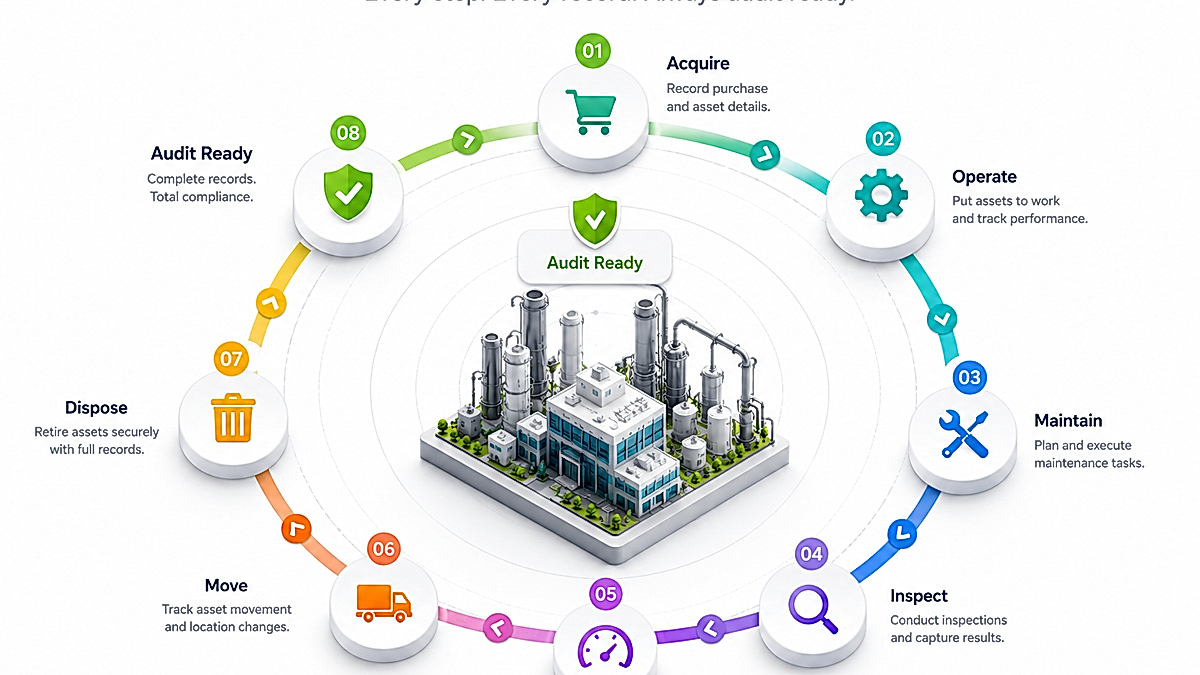
Every organization wants to be audit-ready. Yet for many businesses, audit preparation still begins only after an audit notice arrives. Teams rush to gather documents, search through spreadsheets, verify maintenance records, track calibration certificates, and collect inspection reports scattered across departments. What should be a routine compliance activity turns into weeks of stress, manual effort, and operational disruption.
The problem isn't the audit itself. The problem is visibility.
Organizations often believe they have the required information. The challenge is that it lives in multiple systems, paper files, email threads, shared drives, or even individual employees' knowledge. When auditors request evidence, teams spend more time finding information than demonstrating compliance.
This is why audit-ready asset management should never be treated as a special project that starts before an audit. Instead, it should become the natural outcome of everyday asset operations.
When asset information is continuously captured, linked, and maintained, audits become significantly faster because the evidence already exists.
Why audit preparation becomes so difficult
Most audit delays happen because organizations rely on reactive documentation rather than operational records. Common situations include:
- Maintenance teams storing service records in spreadsheets.
- Calibration certificates saved in different folders.
- Inspection reports maintained on paper.
- Asset movement tracked manually.
- Operator training records managed separately by HR.
- Compliance documents disconnected from the assets they belong to.
Individually, each system may work. Collectively, they create information silos.
During an audit, teams must manually connect these disconnected records to prove compliance. This process consumes valuable time while increasing the possibility of missing documents, outdated records, or inconsistent information.
The objective of audit-ready asset management is not simply storing more data. It is creating complete traceability across the asset lifecycle.
Audit Readiness Starts Long Before the Audit
Organizations with mature asset management practices don't prepare differently for audits. They operate differently every day. Every maintenance activity, inspection, calibration, movement, document upload, and approval becomes part of the asset's operational history.
As a result:
- Evidence already exists.
- Records are already organized.
- Documents remain linked.
- Compliance becomes continuous instead of reactive.
This shift changes audit preparation from a documentation exercise into a simple verification process.
The Five Capabilities That Make Audits Easier
Building audit-ready asset management requires operational visibility rather than additional paperwork.
1. Calibration Logs That Never Go Missing
For regulated industries, calibration history is one of the most frequently requested audit records.
Auditors often ask:
- When was this asset calibrated?
- Who performed the calibration?
- Was it completed on schedule?
- Were any deviations recorded?
- Is the calibration certificate available?
If calibration records are stored manually, locating complete evidence becomes time-consuming. A centralized calibration log automatically maintains:
- Calibration schedules
- Due dates
- Completion dates
- Technician details
- Certificate attachments
- Historical calibration records
Instead of searching through multiple folders, organizations can immediately retrieve the complete calibration history of any asset.
2. Inspection Trails That Demonstrate Compliance
Routine inspections verify that assets continue operating safely and efficiently. However, inspection evidence often becomes fragmented across paper checklists, spreadsheets, or isolated reports.
An inspection trail should capture:
- Inspection date
- Inspector information
- Inspection checklist
- Observations
- Photographic evidence
- Corrective actions
- Closure records
This creates a complete inspection history rather than isolated reports. When auditors request evidence, organizations can demonstrate that inspections were performed consistently according to established procedures.
3. Complete Asset Movement History
Many audits require organizations to prove where assets have been throughout their operational life. Without movement tracking, organizations struggle to answer questions like:
- Which department used this equipment?
- When was it relocated?
- Who approved the transfer?
- Which facility currently owns it?
- Was it temporarily assigned elsewhere?
Manual asset registers rarely maintain this level of historical accuracy. Movement history automatically records:
- Location changes
- Department transfers
- Custodian assignments
- Storage records
- Operational status changes
- Time-stamped movement events
This provides a complete chain of custody throughout the asset lifecycle.
4. Document Linkage That Eliminates Searching
Documentation is rarely the problem. Finding the correct version is. Organizations often maintain thousands of documents including:
- Purchase records
- Warranty documents
- Maintenance manuals
- Standard operating procedures
- Safety instructions
- Inspection reports
- Calibration certificates
- Vendor invoices
- Service contracts
When these documents exist independently from the assets they support, retrieval becomes difficult. Document linkage connects every relevant file directly to the corresponding asset. Instead of searching across multiple folders, users access all supporting documentation from a single asset record.
This significantly reduces audit preparation time while improving documentation accuracy.
5. Operator Training Records That Support Compliance
Compliance extends beyond equipment. Auditors also verify whether qualified personnel are operating and maintaining assets.
Typical questions include:
- Has the operator completed mandatory training?
- Is certification still valid?
- When was refresher training completed?
- Which employees are authorized to use this equipment?
When training information exists separately from operational systems, verification becomes slow. Connecting operator training records with asset information creates a complete operational picture. Organizations can quickly demonstrate that equipment is being handled by trained and authorized personnel.
Audit Readiness Is Really About Traceability
Auditors don't simply verify whether maintenance occurred. They verify whether organizations can prove it. Every asset should provide answers to questions such as:
- What maintenance has been completed?
- When was the last inspection?
- Which documents apply to this equipment?
- Where has this asset been used?
- Who currently owns it?
- Which operator performed the work?
- Were all required procedures followed?
When this information is continuously maintained, traceability becomes automatic. This is the foundation of audit-ready asset management.
The Cost of Reactive Audit Preparation
Treating audits as occasional projects creates unnecessary costs across the organization. These costs include:
- Lost productivity during audit preparation
- Delayed maintenance work
- Increased administrative effort
- Duplicate documentation
- Higher compliance risks
- Missing records
- Inconsistent reporting
- Greater dependence on individual employees
Operational teams spend valuable time reconstructing history instead of managing assets. The longer organizations rely on manual record collection, the more expensive every audit becomes.
Everyday Operations Should Generate Audit Evidence
The most effective organizations don't create documentation specifically for auditors. They create documentation because good operations naturally require it.
Every completed maintenance task.
Every inspection.
Every calibration.
Every asset transfer.
Every uploaded certificate.
Every training record.
Together, these activities continuously generate audit evidence without additional effort. When the audit finally arrives, organizations simply retrieve information that already exists.
Building a Culture of Continuous Compliance
Technology alone cannot create audit readiness. Organizations also need consistent operational processes.
This includes:
- Standardized maintenance workflows
- Timely inspection completion
- Regular calibration schedules
- Centralized document management
- Accurate asset records
- Clear ownership responsibilities
- Routine data validation
When these practices become part of daily operations, compliance evolves from a periodic activity into an operational discipline.
Audit-Ready Asset Management Is an Operational Advantage
Organizations often view audit readiness as a compliance requirement. In reality, it improves operational efficiency far beyond audits. Better visibility enables faster maintenance decisions. Centralized records reduce information loss. Complete asset histories improve planning. Accurate documentation supports regulatory compliance. Connected operational data strengthens decision-making across departments.
The same capabilities that simplify audits also improve maintenance performance, asset reliability, and operational accountability.
Conclusion
Audit preparation should never begin when an auditor sends a notification. By that stage, the most important work should already be complete.
Organizations that embrace audit-ready asset management treat documentation, inspections, calibration, asset movement, and operator records as part of everyday operations—not as last-minute compliance tasks.
The result is simple: audits become verification exercises instead of organizational emergencies.
When calibration logs, inspection trails, movement history, document linkage, and operator training records are continuously maintained, audit readiness becomes a byproduct of operational excellence rather than a project that consumes weeks of effort.
The organizations that perform best during audits are not necessarily those that work harder before the audit—they are the ones that maintain visibility every single day.