
Enterprise Asset Onboarding at Scale

Dhananjay Chandra Kulal
Author
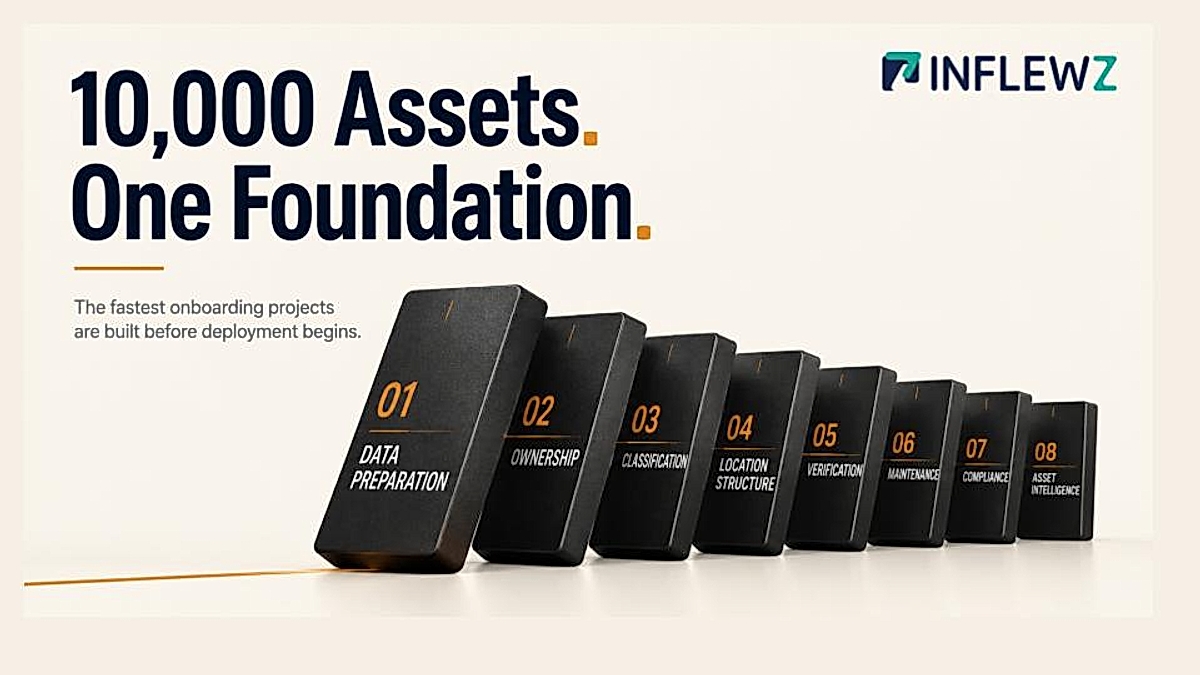
An operations director at a multi-site enterprise faced a familiar problem. The organization had accumulated more than 10,000 assets across offices, warehouses, production facilities, and service locations. The asset register existed, but only partially. Some assets appeared twice. Others had no ownership records. Thousands had inconsistent naming conventions. An upcoming audit forced a decision: either spend months cleaning data manually or complete a structured onboarding exercise at scale.
The organizations that onboard thousands of assets successfully are not faster at tagging assets. They are better at preparing data, controlling workflows, and maintaining operational discipline.
The workflow described below comes from a real enterprise onboarding project and demonstrates how more than 10,000 assets can be onboarded within a single operational cycle.
The real bottleneck is not tagging assets
The biggest misconception in asset onboarding is that QR code application is the hard part. In reality, most onboarding projects fail before the first asset tag is printed.
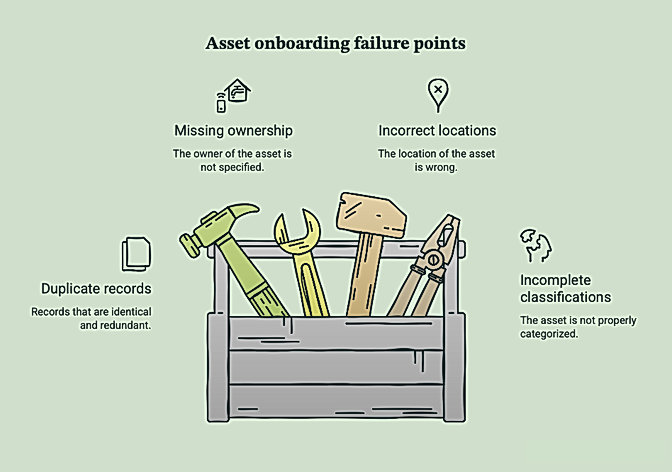
Organizations typically focus on physical activities while ignoring data quality. Teams debate QR code materials, scanning devices, and labeling strategies while their asset register contains duplicate records, missing ownership information, inconsistent location structures, and incomplete classifications.The result is predictable.
Thousands of assets get tagged quickly. Six months later, the organization still cannot answer basic questions:
- Which department owns the asset?
- Where is it supposed to be located?
- What maintenance schedule applies?
- Which vendor supports it?
- Is the asset active, retired, or transferred?
The physical tag exists. The operational intelligence does not.
In one onboarding engagement, nearly 18% of imported records contained duplicate naming structures. Multiple assets shared identical descriptions. Several hundred records referenced locations that no longer existed. Had onboarding started immediately, the organization would have created thousands of inaccurate digital records.
The objective is not simply to create asset records. The objective is to create an authoritative operational system that maintenance teams, audit teams, compliance teams, and operations leaders can trust.
The reframe: onboarding is an operational migration project
Most organizations approach onboarding as inventory collection. The more accurate framing is operational migration. Every asset onboarding project moves an organization from fragmented information to operational visibility. That means the onboarding workflow must establish four foundations simultaneously:
- Asset identity
- Asset ownership
- Asset location
- Asset lifecycle context
If any one of these is missing, the onboarding project creates technical records rather than operational records.
Consider a manufacturing facility onboarding 8,000 assets. A motor tagged with a QR code is useful. A motor tagged with a QR code, assigned to Line 4, linked to a maintenance schedule, mapped to a responsible department, and connected to service history becomes operationally valuable.
The distinction matters because onboarding projects often optimize for speed alone. Speed creates impressive deployment metrics. Operational completeness creates long-term value.
Another misconception is that onboarding requires months of disruption. In practice, most enterprise projects can accelerate dramatically when preparation happens before physical deployment. Once asset structures, ownership models, naming conventions, and location hierarchies are standardized, field teams can execute onboarding at scale.
Organizations that achieve high-volume onboarding consistently follow the same pattern: Prepare centrally, Execute locally, Verify continuously.
The four-step workflow for onboarding 10,000 assets
The onboarding framework below was refined through enterprise deployment projects involving manufacturing plants, warehouses, healthcare facilities, and distributed operational environments. The goal is straightforward: create a trusted asset register while minimizing operational disruption.
1. Data preparation
Before generating a single QR code, build the master onboarding dataset.This stage typically determines the success or failure of the entire project. The preparation process includes:
- Removing duplicate records
- Standardizing asset names
- Defining asset categories
- Assigning ownership
- Validating location structures
- Identifying missing records
In one deployment, three weeks of historical spreadsheets were consolidated into a single asset register. More than 1,200 duplicate records were removed before onboarding began.
Every duplicate eliminated before deployment prevents future operational confusion.
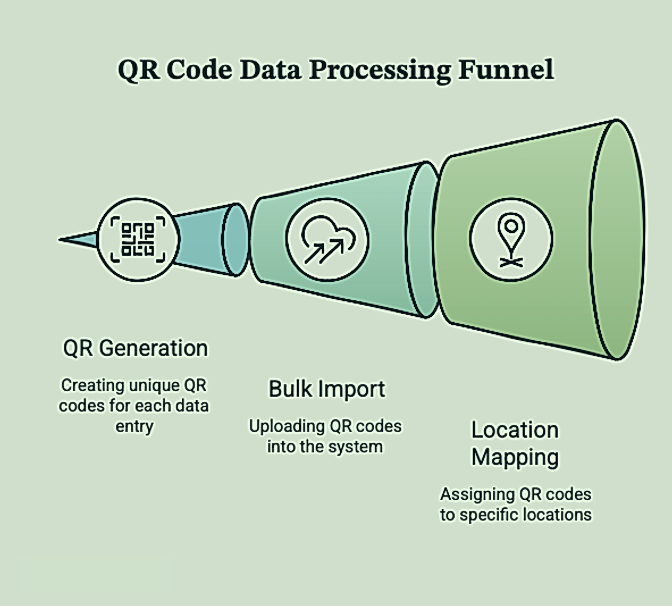
2. QR generation and asset identity creation
Once the master dataset is approved, unique identifiers are generated. Each asset receives:
- Asset ID
- QR code
- Category information
- Ownership reference
- Lifecycle status
The QR code itself is not the system. The QR code is simply the physical entry point into the asset record.
One logistics operator generated and printed more than 12,000 asset labels before deployment day. Because identity creation was completed beforehand, field teams focused entirely on verification and placement. This reduced onboarding time significantly.
3. Bulk asset import
The next step is importing approved records into the operational platform. Manual creation is impractical at enterprise scale. Bulk imports should include:
- Asset details
- Department assignments
- Vendor information
- Maintenance schedules
- Compliance requirements
- Ownership structures
During one multi-site onboarding initiative, over 10,000 records were imported within hours because validation rules were established before migration. Without validation controls, bulk imports simply move bad data into a new system.
4. Location mapping and field verification
This is where digital records meet physical reality. Every imported asset must be associated with its operational context. That includes:
- Facility
- Building
- Floor
- Zone
- Department
- Operational area
Field teams then verify assets physically. The objective is not to discover assets. The objective is to confirm that the imported record matches reality. Several organizations uncover previously unknown assets during this stage. Others discover assets that exist digitally but not physically. Both findings improve asset intelligence.
When completed correctly, location mapping creates the operational visibility needed for maintenance planning, audits, utilization tracking, and lifecycle management.
Common onboarding mistakes that create problems later
Not every onboarding failure looks like a failure initially. Some of the most expensive mistakes only become visible months later. The first is importing unverified spreadsheets. Organizations often assume existing records are accurate.
The second is skipping ownership assignments. Assets without accountable owners quickly become invisible operationally.
The third is treating locations as free-text fields. "Warehouse," "Main Warehouse," and "WH-01" eventually become three different locations.
The fourth is onboarding assets without lifecycle classification. Assets should be clearly identified as active, spare, under maintenance, retired, or pending disposal.
The fifth is prioritizing deployment speed over verification. A one-day onboarding exercise that creates years of inaccurate records is not efficient.
A structured verification process always costs less than future data correction projects.
A real onboarding example
A diversified enterprise operating across manufacturing, warehousing, and administrative facilities needed to establish a single source of truth for approximately 10,000 assets. The starting environment was typical. Asset records existed across spreadsheets, departmental databases, procurement files, maintenance logs, and manually maintained registers. Ownership was inconsistent. Location references varied between sites. Several asset categories used different naming standards.
The project began with centralized data preparation. Records were consolidated, standardized, and validated. Duplicate assets were removed. Ownership structures were defined. Location hierarchies were approved by operational leaders. QR identities were generated before deployment. Bulk imports populated the platform with validated records.
Field teams then conducted verification activities across facilities, confirming physical assets against imported records and mapping them to approved operational locations. The onboarding cycle was completed within a tightly controlled deployment window.The most significant outcome was not deployment speed.
The organization gained a trusted asset register capable of supporting maintenance planning, audit readiness, compliance workflows, utilization analysis, and future asset intelligence initiatives. The onboarding exercise became the foundation for every operational workflow that followed.
Asset intelligence starts before the first asset is tagged
Organizations rarely struggle to onboard assets because they lack technology. They struggle because onboarding is approached as a tagging exercise rather than an operational migration project. The enterprises that successfully onboard 10,000 assets in a day focus on preparation, structure, ownership, and verification before deployment begins.
Asset intelligence starts with trusted records. Everything else—maintenance, compliance, audits, utilization, and lifecycle management—depends on that foundation.
If your team is still piecing asset operations together with spreadsheets, WhatsApp, and paper logs, a 30-minute technical walkthrough is the fastest way to see what changes.