
How QR Verification Helps Brands Fight Counterfeits

Dhananjay Chandra Kulal
Author
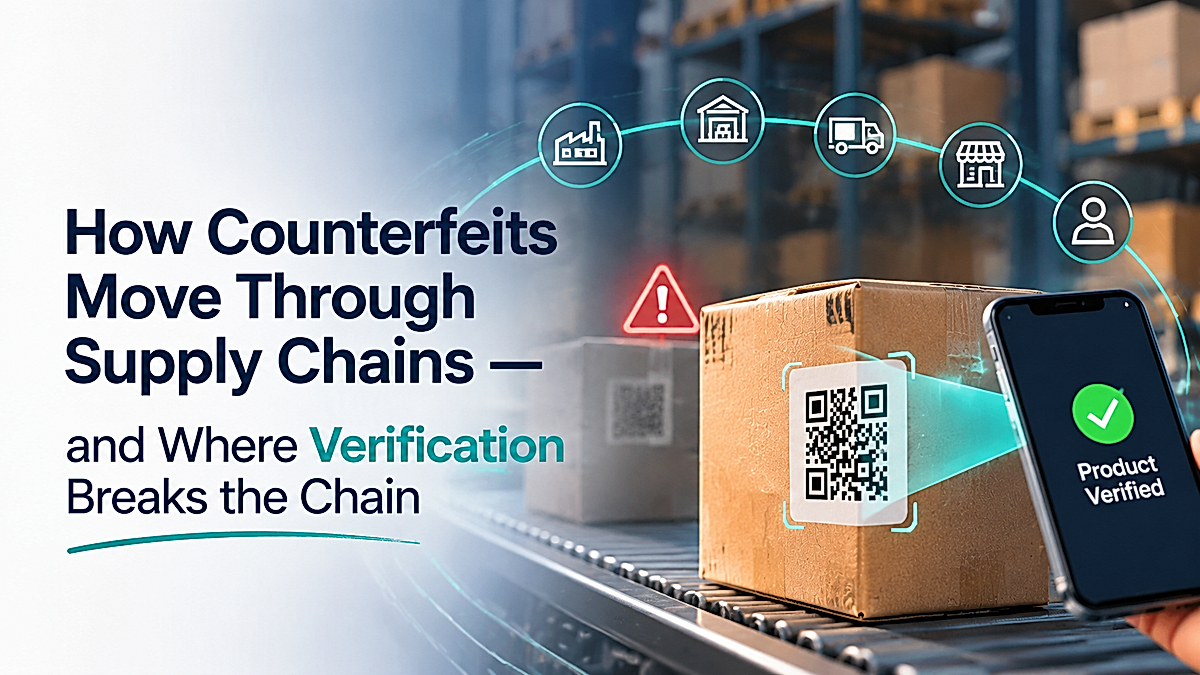
A counterfeit product does not always enter the market through an obviously suspicious transaction. It can appear in a familiar marketplace, arrive through an established distributor, or carry packaging that looks almost identical to the genuine article.
For brand owners, this creates a difficult problem. Counterfeiting is not simply a packaging issue or a retail enforcement challenge. It is a supply-chain visibility problem.
Products pass through multiple parties before reaching the end customer. Manufacturers, packaging vendors, warehouses, distributors, logistics providers, retailers and resellers may each handle a product or its associated documentation. Every transfer introduces another point at which product identity, ownership or provenance can become difficult to verify.
When verification depends primarily on paperwork, visual inspection or trust between business partners, counterfeit goods can exploit the gaps between these controls.
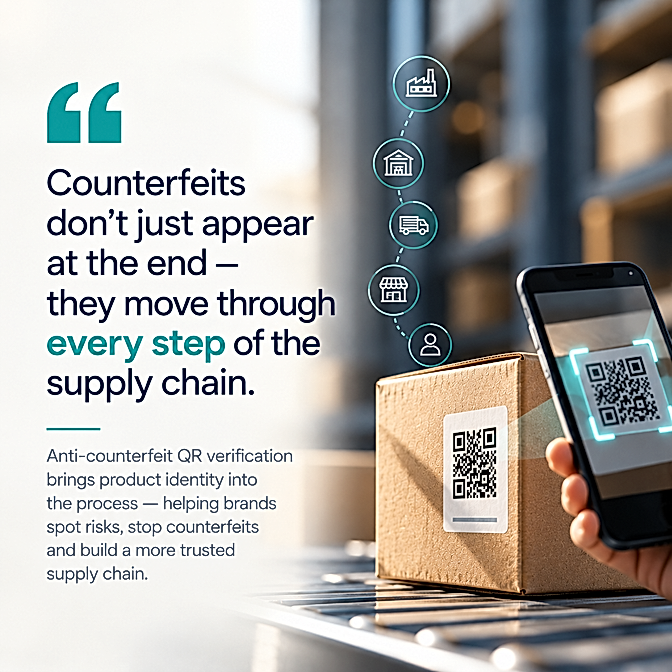
Anti-counterfeit QR verification offers a way to bring product identity into the verification process at the point where it matters. When supported by appropriate product records, authentication logic and operational controls, QR-based verification can help brands check product information, improve visibility and identify suspicious verification patterns.
The objective is not to assume that a QR code makes a product genuine. It is to build a verification process that makes product identity easier to check and potential anomalies harder to overlook.
1. How Counterfeits Move Through a Supply Chain
To understand where verification breaks down, brand owners must first understand how counterfeit products can enter legitimate distribution channels.
There is no single route. Different products, markets and distribution models create different vulnerabilities. However, several recurring patterns deserve attention.
1.1 Counterfeit products enter through unauthorised production
Some counterfeit goods are manufactured outside the brand owner's authorised production network. They may imitate the appearance, packaging or labelling of genuine products without meeting the brand's production standards.
The challenge is that appearance is not proof of origin.
A well-made counterfeit can reproduce a product label, copy a barcode or imitate packaging closely enough to pass a basic visual inspection. If downstream partners rely on appearance alone, they may have limited ability to establish whether the product originated from an authorised source.
Brands need a verification method that connects the physical product to trustworthy product information, rather than relying exclusively on how the product looks.
1.2 Packaging becomes a point of exploitation
Packaging plays an important role in product identification, but it can also be copied.
Counterfeiters may reproduce labels, logos, serial numbers and other visible identifiers. In some cases, copied identifiers may even correspond to information associated with genuine products.
This creates a critical distinction: a recognisable identifier is not necessarily an authenticated product identity.
A conventional barcode, for example, may identify a product type or stock-keeping unit without uniquely establishing the authenticity of an individual unit. A copied QR code can create a similar problem if the verification process does not account for duplication, reuse or suspicious scanning activity.
Brands therefore need to consider both the identifier placed on a product and the system used to validate it.
1.3 Products move through multiple intermediaries
After production, goods may pass through distributors, regional warehouses, wholesalers, retailers and other channel partners.
Each handoff creates an opportunity for discrepancies to emerge. Products may be mixed across batches, documentation may become separated from physical inventory, or goods may enter channels that the brand does not recognise.
Not every discrepancy indicates counterfeiting. Some arise from ordinary operational mistakes, unauthorised resale or incomplete records. Nevertheless, poor visibility makes it harder to distinguish legitimate exceptions from genuine threats.
When a product's identity cannot be checked consistently across these touchpoints, suspicious inventory may remain undetected for longer.
1.4 Counterfeits reach the market through legitimate-looking channels
The final stage may involve online marketplaces, independent retailers, parallel distribution channels or other routes to customers.
At this point, the brand owner may discover the issue through a customer complaint, an unusual product return, inconsistent packaging or a report of a suspected counterfeit.
By then, the product may already have travelled through several organisations, making it difficult to establish where the problem originated.
The operational lesson is straightforward: counterfeit detection should not begin only when a customer raises a concern. Verification needs to be considered throughout the product journey.
2. Where Traditional Verification Breaks Down
Many brands already use controls intended to protect product integrity. These may include supplier approvals, purchase documentation, batch records, inventory systems, barcodes, packaging checks and periodic channel audits.
These measures remain valuable. The problem arises when they operate independently or cannot establish a reliable connection between the physical product and its recorded identity.
2.1 Paperwork verifies a transaction, not always the product
Invoices, delivery notes and purchase orders help establish that a transaction occurred between particular parties.
However, a document associated with a legitimate transaction does not automatically prove that every item in a shipment is genuine. If counterfeit products are introduced into a mixed shipment, the surrounding paperwork may still appear consistent.
Transaction records and product authentication serve different purposes. A stronger control environment recognises the distinction.
2.2 Visual inspection has practical limits
Visual checks can identify obvious inconsistencies, including misspellings, poor print quality, incorrect packaging and mismatched labels.
However, sophisticated counterfeits may closely imitate genuine products. Visual inspection also depends on employee training, product familiarity, inspection conditions and the time available.
It remains a useful layer of defence, but it should not be the sole basis for authenticity decisions when the consequences of counterfeit distribution are significant.
2.3 Standard identifiers may be copied
Product barcodes and QR codes can make identification more convenient. Yet a code that merely displays a product name or opens a webpage may provide little evidence that the physical item is genuine.
If the same identifier can be copied onto multiple items without detection, the verification process may confirm the information associated with the code rather than establish the identity of the specific product being checked.
An effective anti-counterfeit QR verification process must therefore consider how identifiers are issued, registered, validated and monitored.
2.4 Fragmented systems obscure the wider picture
Product data, warehouse records, distributor information and customer interactions may sit in separate systems.
Even when each system contains useful information, the absence of a connected verification process can make anomalies difficult to recognise.
For example, repeated scans of the same identifier across distant locations, unexpected verification activity or inconsistencies between product records and channel information may warrant investigation. If the relevant data is fragmented, these signals can be harder to assess.
2.5 Detection often happens too late
Reactive investigations are necessary, but they can be expensive and time-consuming.
A brand may need to examine distribution records, contact channel partners, investigate complaints, assess potentially affected inventory and determine whether further action is justified.
Verification earlier in the product journey can help surface potential issues sooner. The aim is to reduce dependence on downstream discovery and give teams better information for deciding what to investigate.
3. What Anti-Counterfeit QR Verification Actually Needs to Do
QR-based verification can support product authentication, but its effectiveness depends on the process behind the code.
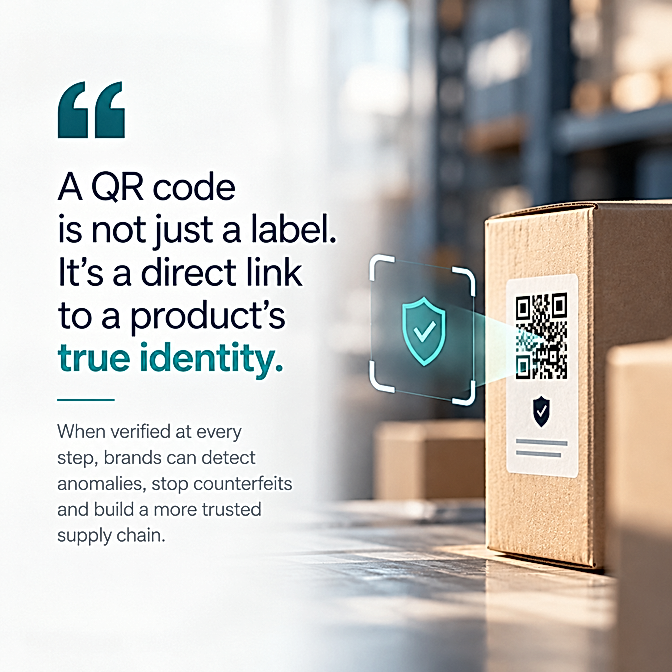
A QR code is an access mechanism. The verification system determines what the scan means.
For brand owners evaluating an anti-counterfeit QR verification solution, five capabilities deserve particular attention.
3.1 Connect the identifier to a trusted product record
The first requirement is a reliable relationship between the identifier and the product information maintained by the brand.
Depending on the implementation, this may involve a unique identifier for an individual item, a registered product record or another controlled identification structure.
The verification experience should return information based on the relevant system record rather than simply displaying text embedded in the code.
This gives the brand a foundation for checking whether an identifier is recognised and whether its associated information is consistent with the expected product.
3.2 Make verification accessible at the point of need
A verification process is useful only if the intended user can access it when needed.
Depending on the business model, that user could be a distributor, retailer, field representative, service technician or end customer.
QR-based access can reduce the friction associated with locating product information. A scan can initiate the relevant verification flow without requiring a user to manually search through lengthy product codes or documentation.
For businesses, the design challenge is to make the process simple enough for routine use while ensuring that the underlying verification is meaningful.
3.3 Distinguish successful checks from suspicious activity
A recognised code should not automatically be treated as conclusive proof of authenticity in every circumstance.
A code may be copied, reused or presented in an unexpected context. Depending on the implementation, the system may need to evaluate scan history, identifier status, duplicate activity and other available signals.
For example, repeated scans of one identifier from geographically distant locations within an implausibly short period could justify further review.
Such activity is not conclusive proof of counterfeiting. Shared devices, network routing, customer behaviour and other legitimate factors may explain unusual patterns.
The value lies in identifying exceptions that deserve attention, not treating every anomaly as evidence of fraud.
3.4 Support investigation with useful records
Verification becomes more actionable when the brand can review what happened and when.
Relevant records may include identifier status, verification outcomes, timestamps and other information captured by the system, subject to its configuration and applicable privacy requirements.
These records can help teams investigate recurring issues, compare reports across distribution channels and determine whether an isolated discrepancy warrants broader action.
The goal is to move from an individual scan result to a more informed operational decision.
3.5 Fit into the wider supply-chain control environment
QR verification should complement, not replace, existing controls.
Supplier qualification, inventory management, authorised distribution, quality assurance and channel audits remain important. Verification works best when its results can inform these processes.
For example, a suspicious product check could trigger a review of a shipment, a distributor record or a product batch. The precise workflow will depend on the brand's operating model and the capabilities of its verification system.
The objective is a connected control environment in which product identity, supply-chain records and investigation processes reinforce one another.
4. Where Verified by Inflewz Fits
Verified by Inflewz can be positioned as a product-verification layer within a broader anti-counterfeiting strategy.
For brand owners, the central question is not simply whether a product carries a QR code. It is whether the verification experience helps establish a meaningful connection between the product being checked and the information the brand trusts.
A practical deployment should begin with a clearly defined product group, a documented identification approach and an agreed process for handling verification outcomes.
From code scanning to product verification
A QR-based workflow can provide an accessible entry point for checking product information.
The value depends on how the code connects to the product's registered identity and how the system handles recognised, unrecognised or potentially suspicious identifiers.
Brands should validate these behaviours during implementation rather than assume that every QR-based solution provides the same authentication capabilities.
From individual checks to actionable visibility
A single verification result addresses one interaction. A broader view of verification activity can help a brand understand where questions are emerging.
Depending on the capabilities deployed, records of verification activity may support the identification of unusual patterns, help prioritise investigations and provide evidence for reviewing distribution controls.
This is particularly relevant for brands with multiple distributors or geographically dispersed markets, where direct observation of every retail transaction is impractical.
From reactive investigation to a repeatable process
A verification system should have a clear operational purpose beyond displaying a result.
Brand teams need to determine what happens when an identifier is not recognised, when activity appears unusual or when a customer reports a suspected counterfeit.
That means defining responsibility for review, escalation, communication and corrective action.
Verified by Inflewz should be evaluated in this context: as part of a repeatable product-verification workflow that supports the brand's wider supply-chain controls.
Specific capabilities, integrations and monitoring options should be confirmed against the proposed implementation before deployment.
5. How Brand Owners Can Implement Verification Without Disrupting Operations
Introducing a new verification process across an entire product portfolio may be unnecessary as a first step.
A focused pilot gives the brand an opportunity to assess operational fit, user adoption and the quality of the information produced before expanding the programme.
Step 1: Identify the highest-priority products
Start with products or categories where counterfeit exposure, channel complexity or the consequences of product substitution justify additional verification.
The selection should be based on the brand's own risk assessment, distribution model and available evidence rather than assumptions that every product faces identical risks.
Step 2: Map the product journey
Document the main stages between production and the end customer.
Identify where product identity is recorded, which parties handle the goods, how identifiers are applied and where verification currently occurs.
This mapping helps reveal whether the primary gap concerns product identification, distribution visibility, record consistency or the response to suspicious activity.
Step 3: Define the verification rules
Agree on what constitutes a recognised identifier, what information a user should receive and which outcomes require further review.
The brand should also determine how copied identifiers, repeated scans, inactive records and exceptions will be handled where these scenarios are relevant to the implementation.
Clear rules reduce ambiguity for both users and the teams responsible for investigating exceptions.
Step 4: Run a controlled pilot
Deploy the verification process for a limited product range, batch or distribution channel.
Include the users who will interact with the system in day-to-day operations. Their feedback can reveal practical issues that may not be obvious during planning, such as unclear instructions, scanning difficulties or uncertainty about what to do after a failed check.
A pilot should test the complete workflow, not merely whether a QR code opens successfully.
Step 5: Measure operational outcomes
Before the pilot begins, establish a baseline and agree on how success will be evaluated.
Useful measures may include:
- Verification coverage: the proportion of eligible products or interactions checked.
- Verification completion: the proportion of initiated checks that produce a usable result.
- Exception rate: the proportion of checks that require additional review.
- Investigation time: the time required to assess a reported or flagged issue.
- Response consistency: whether teams follow the defined escalation process.
- User adoption: whether intended users can complete verification reliably.
These metrics should be interpreted in context. A higher exception rate does not automatically mean counterfeiting has increased, and a low exception rate does not prove that counterfeits are absent.
Step 6: Review and expand selectively
At the end of the pilot, compare the results with the agreed objectives.
Document the issues identified, the operational effort required, the limitations observed and the changes needed before wider deployment.
Expand only when the evidence supports doing so and the organisation has a workable process for managing verification outcomes.
This approach allows brands to evaluate the practical contribution of verification before committing to a broader rollout.
6. Common Mistakes to Avoid
Even a well-intentioned anti-counterfeiting initiative can underperform if the verification process is poorly designed.
Treating every QR scan as proof of authenticity. A scan is an interaction, not a guarantee. The strength of the conclusion depends on the identifier, the system's validation logic and the available evidence.
Applying codes without controlling their registration. If identifiers are not managed consistently, the verification process may reproduce existing data-quality problems rather than solve them.
Ignoring the human response. Flagging an anomaly is only the beginning. Teams need clear guidance on investigation, escalation and communication.
Deploying without a baseline. Without defined objectives and comparable measurements, it becomes difficult to distinguish operational improvement from activity that simply generates more data.
Expecting technology to eliminate every counterfeit. No single control can guarantee that counterfeit products will never enter a supply chain. QR-based verification is one layer in a wider strategy involving sourcing, distribution, quality, monitoring and enforcement.
The strongest programmes are designed around these limitations from the beginning.
Conclusion: Make Product Identity Easier to Verify
Counterfeits exploit weaknesses that appear between supply-chain stages: copied packaging, incomplete records, unverified intermediaries and inconsistent checks. These weaknesses become harder to address when product identity cannot be reliably connected to the information used by the brand.
Anti-counterfeit QR verification can help close part of this gap by making product checks more accessible and connecting users to a controlled verification process.
However, the QR code itself is not the solution. The underlying product records, identifier controls, validation rules, monitoring capabilities and response workflows determine how useful the process becomes.
For brand owners, the practical next step is to identify where verification currently breaks down, select a suitable product group and test a measurable approach through a controlled pilot.
Verified by Inflewz provides a starting point for evaluating how product verification can fit into that process. The objective is to give brands a clearer way to check product identity, investigate anomalies and strengthen the controls that protect their distribution channels.
Start with one product category. Establish what needs to be verified. Measure what changes. Then build on the evidence.
Explore a Verified by Inflewz Pilot
Want to assess how QR-based product verification could fit into your supply chain?
Start a pilot with a defined product group, clear verification objectives and measurable success criteria. Evaluate how the workflow performs in real operating conditions before deciding how to expand it.
Contact Inflewz to discuss a Verified by Inflewz pilot for your products.
Protecting product integrity starts with making verification part of the process, not an afterthought.