
QR vs RFID vs BLE: Choosing the Right Asset Tag for the Right Job

Dhananjay Chandra Kulal
Author
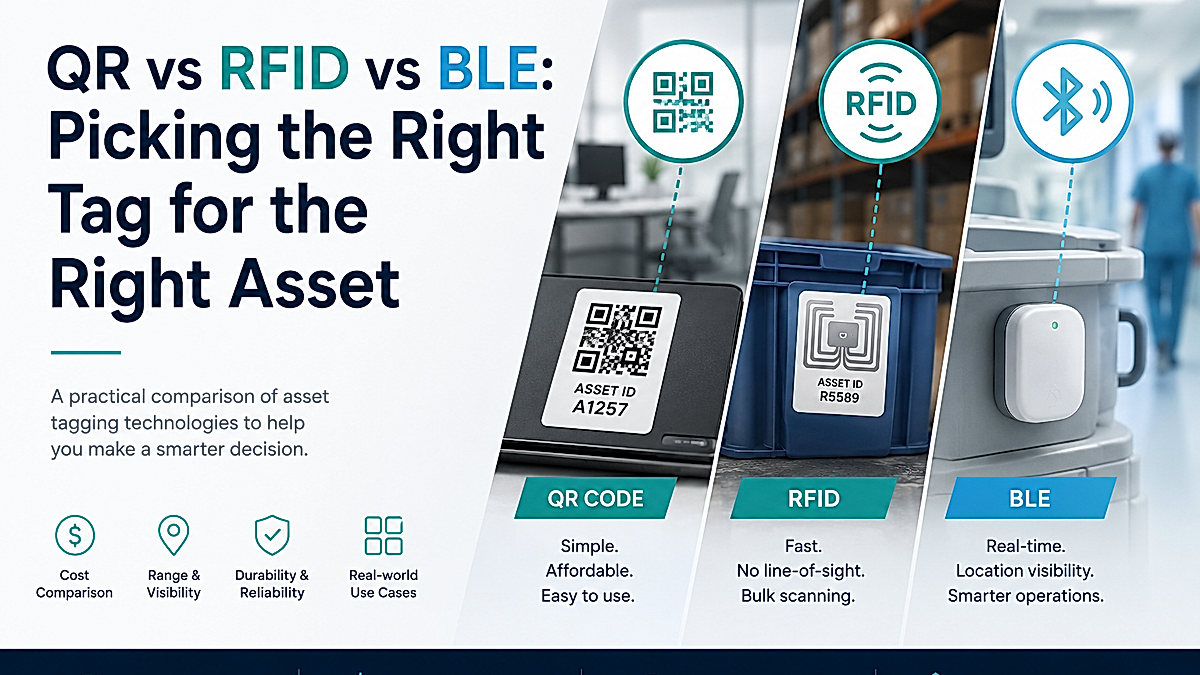
Asset tracking has evolved far beyond spreadsheets and barcode stickers. Modern organizations need accurate, real-time visibility into thousands of assets spread across warehouses, factories, hospitals, offices, campuses, and field locations.
One of the biggest decisions in any asset tracking project is selecting the right tagging technology.
Should you use QR codes, RFID tags, or Bluetooth Low Energy (BLE) beacons?There isn't a universal answer.
The right technology depends on factors like asset value, tracking frequency, operating environment, infrastructure, compliance requirements, and budget. Many organizations assume they must choose only one technology. In reality, mature Enterprise Asset Management (EAM) systems often support all three because different assets have different operational requirements.
This guide compares QR, RFID, and BLE across cost, range, durability, deployment complexity, and real-world applications to help you make the right decision.
Why Asset Tag Selection Matters
An asset tag is more than an identification label.
It determines:
- How quickly assets are found
- How accurately audits are completed
- Whether assets can be tracked automatically
- The total cost of ownership
- Maintenance efficiency
- Inventory accuracy
- Regulatory compliance
Choosing the wrong technology can lead to:
- Higher deployment costs
- Manual processes
- Poor user adoption
- Missing assets
- Longer audit cycles
- Limited scalability
Selecting the appropriate technology from the beginning avoids expensive redesigns later.
Understanding the Three Technologies
1. QR Codes
QR (Quick Response) codes are two-dimensional barcodes that store asset information. A smartphone or handheld scanner reads the code when someone physically scans the asset.
How it works
- QR code printed on label
- User opens mobile app
- Camera scans code
- Asset record opens instantly
Every scan creates a digital activity record including:
- User
- Time
- Asset ID
- Maintenance history
- Current status
- Assigned owner
Advantages of QR Codes
Lowest deployment cost
Printing QR labels is inexpensive. No batteries. No readers. No infrastructure.
Organizations can begin tracking immediately using smartphones.
Easy implementation
Most employees already know how to scan QR codes. Training requirements are minimal.
Excellent for audits
During physical verification, users simply walk through the site scanning each asset. The software updates audit records instantly.
Flexible labeling
QR labels can include:
- Asset ID
- Serial number
- Department
- Location
- Equipment details
Limitations
QR codes require line-of-sight. Someone must physically locate the asset before scanning it. They cannot automatically detect movement or provide real-time location updates. Damaged labels may also become unreadable if not protected properly.
Best Use Cases for QR Codes
QR codes work well for:
- Office furniture
- Laptops
- Desktop computers
- Monitors
- Printers
- Classroom equipment
- Laboratory assets
- Facility equipment
- Government inventory
- School assets
Whenever periodic verification is sufficient, QR codes provide excellent value.
2. RFID (Radio Frequency Identification)
RFID uses radio waves instead of visual scanning. Assets contain RFID tags that communicate with RFID readers. Unlike QR codes, RFID does not require direct line-of-sight.
Types of RFID
Passive RFID
- No battery
- Powered by reader signal
- Lower cost
- Common for inventory
Active RFID
- Battery powered
- Longer range
- More expensive
- Continuous broadcasting
Most enterprise asset tracking deployments use passive RFID.
Advantages of RFID
Faster inventory
Instead of scanning one asset at a time, hundreds of assets can be detected within seconds. This dramatically reduces audit time.
No direct visibility required
Assets inside:
- Cabinets
- Storage racks
- Boxes
- Containers
High-volume environments
Warehouses and manufacturing facilities benefit from RFID because multiple assets can be scanned simultaneously.
Improved operational efficiency
RFID reduces:
- Manual counting
- Human error
- Duplicate records
- Missing inventory
Limitations
RFID infrastructure increases project costs.
Organizations require:
- RFID readers
- Antennas
- Gateways
- Integration
Metal surfaces and liquids can also interfere with radio signals unless specialized RFID tags are used.
Best Use Cases for RFID
RFID performs well in:
- Manufacturing
- Warehouses
- Distribution centers
- Logistics hubs
- Tool rooms
- Medical equipment storage
- High-volume inventory environments
It is particularly valuable where inventory speed matters more than precise location.
3. Bluetooth Low Energy (BLE)
BLE beacons continuously broadcast Bluetooth signals. Nearby gateways or smartphones detect these signals and estimate asset locations. Unlike QR codes and passive RFID, BLE supports ongoing location visibility.
How BLE Works
Each beacon periodically transmits an identifier. Nearby receivers capture the signal and determine:
- Which room
- Which floor
- Which zone
- Approximate position
This enables continuous monitoring without manual scanning.
Advantages of BLE
Real-time asset visibility
Organizations know where assets are throughout the day. This significantly reduces search time.
Indoor positioning
GPS performs poorly indoors. BLE fills this gap by enabling room-level or zone-level tracking.
Movement history
BLE systems can record:
- Entry
- Exit
- Location changes
- Utilization trends
- Idle assets
Better asset utilization
Organizations often discover they own enough equipment but cannot locate it efficiently. BLE helps identify underutilized assets.
Limitations
BLE tags contain batteries. Battery replacement becomes part of maintenance planning.
Infrastructure is also required:
- BLE gateways
- Receivers
- Network connectivity
The initial investment is generally higher than QR and may exceed passive RFID depending on deployment size.
Best Use Cases for BLE
BLE is ideal for:
- Hospitals
- Wheelchairs
- Medical devices
- Diagnostic equipment
- Forklifts
- Airport equipment
- Campus assets
- Manufacturing tools
- Rental equipment
- High-value portable assets
Comparing QR vs RFID vs BLE
| Feature | QR Code | RFID | BLE |
| Initial Cost | Very Low | Medium | High |
| Infrastructure | None | RFID Readers | BLE Gateways |
| Battery Required | No | Passive: No / Active: Yes | Yes |
| Scan Method | Manual | Automatic | Continuous |
| Line of Sight | Yes | No | No |
| Real-Time Tracking | No | Limited | Yes |
| Inventory Speed | Medium | Very Fast | Continuous |
| Indoor Location | No | Limited | Excellent |
| Maintenance | Very Low | Low | Battery Replacement |
| Best For | Audits | Inventory | Live Tracking |
Decision Matrix: Which Technology Should You Choose?
Choose QR Codes If:
- Budget is limited
- Manual audits are acceptable
- Assets remain in fixed locations
- You need simple deployment
- Infrastructure costs must stay low
Choose RFID If:
- Inventory involves thousands of assets
- Audit speed is critical
- Warehouses require bulk scanning
- Manual scanning is too slow
- Operational efficiency is a priority
Choose BLE If:
- Assets move frequently
- Real-time location matters
- Searching for equipment wastes time
- Utilization data is important
- High-value assets require continuous visibility
Industry Examples
Manufacturing
Manufacturers often combine technologies. Production machines may use QR labels for maintenance records. Tools may use RFID for inventory. Mobile equipment such as forklifts can use BLE for location tracking.
Healthcare
Hospitals frequently deploy:
- BLE for infusion pumps
- BLE for wheelchairs
- RFID for inventory rooms
- QR codes for fixed assets
Each technology solves a different operational challenge.
Corporate Offices
Office environments often rely primarily on QR codes because:
- Furniture rarely moves
- Laptop audits are periodic
- Cost efficiency matters
Meeting room equipment, however, may benefit from BLE if frequently relocated.
Warehousing
Warehouses prioritize RFID because inventory speed directly impacts operations. BLE may supplement RFID for tracking expensive forklifts or specialized machinery.
Can You Use Multiple Technologies Together?
Yes and many organizations do. A hybrid approach allows businesses to match the technology to the asset rather than forcing one solution across the entire inventory.
For example:
| Asset Type | Recommended Tag |
| Office Furniture | QR |
| Laptops | QR |
| IT Equipment | QR or RFID |
| Warehouse Inventory | RFID |
| Manufacturing Tools | RFID |
| Medical Equipment | BLE |
| Forklifts | BLE |
| Rental Assets | BLE |
Key Factors Before Choosing
Before selecting a tagging technology, ask:
How often do assets move?
Frequent movement favors BLE. Static assets work well with QR.
How often are audits performed?
Annual or quarterly audits may only require QR codes. Daily inventory counts may justify RFID.
Is real-time location necessary?
If employees spend significant time searching for equipment, BLE can provide measurable productivity gains.
What is the value of the asset?
Low-value assets rarely justify expensive tracking hardware. High-value assets often do.
What is the operating environment?
Metal-heavy industrial environments may require specialized RFID tags. Outdoor assets may need weather-resistant labels or rugged BLE devices.
The Role of Enterprise Asset Management Software.
Tagging technology alone does not solve asset management challenges. The real value comes from connecting asset tags to a centralized Enterprise Asset Management (EAM) platform that maintains:
- Asset register
- Ownership records
- Maintenance schedules
- Audit history
- Compliance documentation
- Work orders
- Location history
- Lifecycle information
Whether an asset is identified using QR, RFID, or BLE, all tracking data should flow into a single source of truth. This enables maintenance teams, operations managers, auditors, and compliance officers to work from the same, up-to-date information without switching between systems.
Conclusion
There is no single "best" asset tagging technology. The right choice depends on your assets, operational workflows, and visibility requirements.
- QR codes are simple, affordable, and ideal for manual audits and fixed assets.
- RFID accelerates inventory processes by enabling fast, bulk identification without line-of-sight.
- BLE provides continuous indoor visibility for mobile, high-value assets that require real-time location awareness.
Many organizations achieve the best results by combining these technologies. A flexible Enterprise Asset Management platform that supports QR, RFID, and BLE allows you to apply the most suitable tracking method to each asset category improving accuracy, reducing operational effort, and scaling with your business as tracking needs evolve.