
What an Asset Visibility Audit Reveals: A Practical 4-Step Walkthrough

Dhananjay Chandra Kulal
Author

Your factory may know what it owns. Does it know what is happening to every asset?
Walk through a manufacturing facility, and you will see machines operating, maintenance teams at work, production lines moving and equipment spread across departments.
Ask a simple question: Can you identify every critical asset, verify its current status and locate its latest record?
The answer may be less straightforward than expected.
An asset might exist on the shop floor but be missing from the asset register. Another might be recorded as operational even though it has been awaiting maintenance for days. A third could have moved between departments without its location being updated in the system.
Individually, these issues may appear manageable. Collectively, they create blind spots that affect maintenance planning, asset utilisation, operational accountability and decision-making.
This is where an asset visibility audit becomes valuable.
An asset visibility audit examines how reliably an organisation can identify, locate, verify and understand the status of its physical assets. It compares what the organisation's records say with what is actually happening on the ground.
The objective is not simply to find missing information. It is to identify where asset information becomes unreliable, why those gaps exist and what needs to change.
For manufacturing businesses managing large asset inventories across multiple locations, an audit can provide a practical starting point for better asset intelligence.
Here is how to conduct one.
What is an asset visibility audit?
An asset visibility audit is a structured assessment of the accuracy, completeness, accessibility and consistency of asset information across an organisation.
It compares physical assets with the records maintained in spreadsheets, enterprise systems, maintenance platforms or other operational tools.
A typical audit examines five areas:
- Asset identification: Can every relevant asset be uniquely identified?
- Location accuracy: Does the recorded location match the asset's actual location?
- Status visibility: Is the asset operational, under maintenance, idle, decommissioned or awaiting inspection?
- Record completeness: Are essential details, such as asset IDs, specifications, ownership and maintenance history, available?
- Information consistency: Do different departments rely on the same accurate information?
The audit also examines how asset information is updated, who is responsible for maintaining it and how discrepancies are resolved.
This distinction matters. An organisation can have thousands of asset records and still lack reliable visibility if those records are outdated, duplicated or disconnected from operational activity.
The real measure of visibility is not how much information exists. It is whether people can trust and act on it.
Why asset visibility gaps are easy to miss
Asset information rarely becomes unreliable overnight. Gaps typically emerge through routine operational changes.
A machine is transferred to another production line. A maintenance team replaces a component. Equipment is temporarily moved for servicing. A department purchases a new asset, but the central register is updated weeks later.
When updates depend on manual communication, different records can gradually tell different stories.
For example, the maintenance team may know that a machine is unavailable, while the operations team sees it listed as available in a spreadsheet. The procurement team may have records of a replacement component, but the maintenance history may not reflect the change.
None of these situations necessarily indicates a major system failure. They reveal a gap between operational reality and recorded information.
An asset visibility audit helps uncover these discrepancies before they become recurring sources of confusion, avoidable work or poor decisions.

The four-step asset visibility audit
A useful audit should produce more than a list of discrepancies. It should establish what is wrong, where the problem occurs, how significant it is and what action is required.
The following four-step approach provides a practical framework.
Step 1: Establish the asset baseline
Before checking asset visibility, establish what the organisation believes it owns and manages.
Start by collecting the available asset registers and records. Depending on the facility, these may include spreadsheets, maintenance management systems, enterprise resource planning platforms, equipment registers and departmental records.
Consolidate the available information into a working baseline.
At a minimum, capture:
- Asset ID or unique reference
- Asset name and category
- Recorded location
- Department or responsible owner
- Current operational status
- Relevant maintenance or inspection information
- Last recorded update, where available
Next, examine the quality of the records.
Look for duplicate asset IDs, missing fields, inconsistent naming conventions, incomplete locations and records that have not been updated for an extended period.
For example, the same machine might appear as “CNC Machine 04” in one register and “CNC-04” in another. Without a consistent identifier, matching records becomes more difficult.
Similarly, a record that lists an asset's location as “Production” may be insufficient when a facility has several production lines or buildings.
What this step reveals: The completeness and reliability of the asset information the organisation currently uses.
Illustrative finding: A facility discovers that several departments maintain separate registers, with inconsistent naming conventions and no clearly defined process for reconciling their records.
The issue is not necessarily a lack of information. It is the absence of a dependable, shared baseline.
Step 2: Verify assets on the ground
Once the baseline is established, compare the records with physical reality.
This is the verification stage, where the audit moves beyond what the system says and checks what is actually present.
Begin with a defined scope. Depending on the size and risk profile of the facility, this could include all assets or a representative sample of critical equipment, high-value machinery and frequently relocated items.
For each selected asset, verify its identity, physical location and observable condition or operational status, as appropriate.
Use the asset register to locate the equipment, then compare the physical findings with the recorded information.
Classify discrepancies into clear categories:
- Unlocated asset: The record exists, but the asset cannot be found at the recorded location.
- Unregistered asset: The physical asset exists, but no matching record can be identified.
- Location mismatch: The asset is present, but its recorded location is incorrect.
- Status mismatch: The recorded operational status does not match the verified status.
- Identification mismatch: The asset's tag, label or reference does not match the register.
Not every discrepancy means that an asset is missing or incorrectly managed. Equipment may be undergoing authorised maintenance, temporarily relocated or awaiting documentation.
The audit should therefore record evidence, seek clarification and distinguish confirmed discrepancies from unresolved cases.
What this step reveals: The difference between recorded asset information and the actual situation on the shop floor.
Illustrative finding: A maintenance register lists a critical pump at its original installation point. Physical verification finds that the pump was moved during a production-line modification, but its location was never updated.
The equipment is accounted for, yet the record is no longer reliable.
That distinction is important. Visibility problems can exist even when no physical asset has been lost.
Step 3: Trace the information gaps
Identifying a discrepancy is only part of the audit. The next step is understanding why it occurred.
For every significant finding, trace the process through which the asset information was created, changed and maintained.
Ask practical questions:
- Who is responsible for updating the asset record?
- What happens when an asset is transferred between departments?
- How are new assets registered after procurement?
- How are maintenance activities reflected in the asset's status?
- Are updates recorded immediately or entered later?
- Do teams maintain separate versions of the same information?
- Is there a defined process for checking and resolving discrepancies?
Consider the relocated pump from the previous example.
The immediate problem is an incorrect location. The underlying cause could be a missing transfer procedure, unclear ownership, a delayed update or an information system that does not support the existing workflow.
Each cause requires a different corrective action.
Updating the pump's location resolves the individual record. Establishing a reliable asset-transfer process helps prevent the same problem from recurring.
This is why the audit should distinguish between record-level issues and process-level issues.
Record-level issues include missing fields, incorrect locations and duplicate entries.
Process-level issues include unclear responsibilities, inconsistent update procedures, disconnected systems and the absence of regular verification.
What this step reveals: The operational processes that allow asset visibility gaps to develop and persist.
Illustrative finding: A facility discovers that location updates depend on informal communication between maintenance and operations teams. No single role is accountable for confirming that the central register reflects a completed transfer.
The corrective action is therefore not just a data correction. It also requires a defined handover and record-update responsibility.
Step 4: Prioritise corrective action
The final step is converting audit findings into an actionable improvement plan.
Not every discrepancy carries the same operational significance. A missing field on a low-risk asset may be less urgent than an unresolved status discrepancy involving equipment essential to production.
Prioritise findings using criteria such as:
- Operational criticality
- Safety or compliance implications
- Financial exposure
- Frequency of recurring discrepancies
- Impact on maintenance and planning
- Effort required to resolve the issue
Where relevant, distinguish immediate corrections from longer-term process improvements.
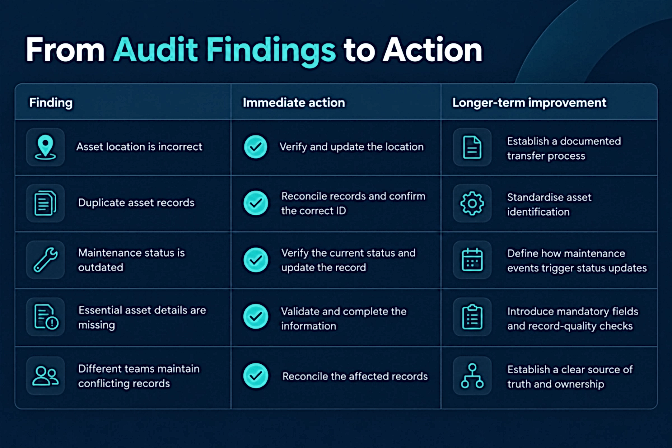
Assign an owner to each corrective action, define a completion date and establish how the result will be verified.
Then repeat the relevant checks to confirm that the correction has worked.
An audit becomes useful when findings lead to measurable improvements, not when they remain in a report.
What this step reveals: Which visibility gaps deserve immediate attention, which require process changes and how progress can be verified.
The resulting action plan should give management a clear view of current weaknesses, their operational relevance and the steps needed to address them.
What an asset visibility audit can reveal: An illustrative example
Consider a hypothetical manufacturing facility with several production areas, a central maintenance team and multiple asset registers.
The initial review identifies three issues:
1. Inconsistent asset records
Different departments use different naming conventions. Matching an asset across records requires manual checking, increasing the effort needed to validate information.
2. Outdated location and status information
Some records do not reflect recent equipment movements or maintenance activities. Teams cannot always rely on the register to determine where an asset is or whether it is available for use.
3. Unclear update responsibilities
The organisation has no consistent process for ensuring that asset information is updated after transfers, repairs or other operational changes.
These findings point to three distinct improvement areas: data standardisation, operational verification and process accountability.
A practical response would begin by reconciling critical asset records, correcting verified discrepancies and defining who updates and approves asset information.
The facility could then introduce periodic verification and track indicators such as record completeness, location accuracy and unresolved discrepancies.
The figures and findings in this example are illustrative, not results from an actual Inflewz customer audit. Actual findings will depend on the organisation's asset inventory, existing systems and audit scope.
The central lesson is straightforward: an audit can reveal whether the primary problem lies in the records themselves, the processes that maintain them or the way teams access and use asset information.
How should you measure asset visibility?
An asset visibility audit should establish a baseline that can be measured again after corrective actions.
The following indicators can help organisations assess progress.
Asset record completeness
The proportion of in-scope asset records containing all required information.
Location accuracy
The proportion of verified assets whose recorded locations match their actual locations.
Asset identification accuracy
The proportion of checked assets that can be matched confidently to their corresponding records.
Status accuracy
The proportion of verified assets whose recorded status agrees with the confirmed operational status.
Unresolved discrepancy rate
The number or proportion of identified discrepancies that remain open at the end of the audit or review period.
These indicators should be calculated against a clearly defined scope, with consistent verification rules. If an audit covers only selected critical assets, its results should not be presented as representative of the entire asset inventory without justification.
It is also important to interpret the metrics together. A high level of record completeness does not automatically mean that asset locations and statuses are accurate.
The purpose of measurement is to establish a reliable baseline, identify improvement opportunities and determine whether corrective actions are working.
From asset visibility to asset intelligence
An asset visibility audit establishes whether an organisation can trust its asset information today. Sustained visibility requires processes that keep that information reliable as assets move through their lifecycle.
This includes consistent identification, controlled updates, clear ownership, appropriate verification and access to current information.
Technology can support these activities, but introducing another system will not automatically resolve unclear responsibilities or inconsistent workflows. The organisation must first understand how its asset information is created, maintained and used.
Once the underlying gaps are understood, asset management platforms and connected workflows can help teams centralise records, coordinate updates and improve access to relevant asset information, depending on the capabilities implemented.
The objective is to move from periodically discovering discrepancies to managing asset information through repeatable processes.
That shift supports better-informed maintenance planning, more dependable operational coordination and greater confidence in asset-related decisions.
Start with visibility. Build from evidence.
An asset register is a starting point, not proof that asset information is accurate.
The more useful questions are whether the records match physical reality, whether teams can rely on the information and whether discrepancies are resolved through consistent processes.
A structured asset visibility audit helps answer those questions.
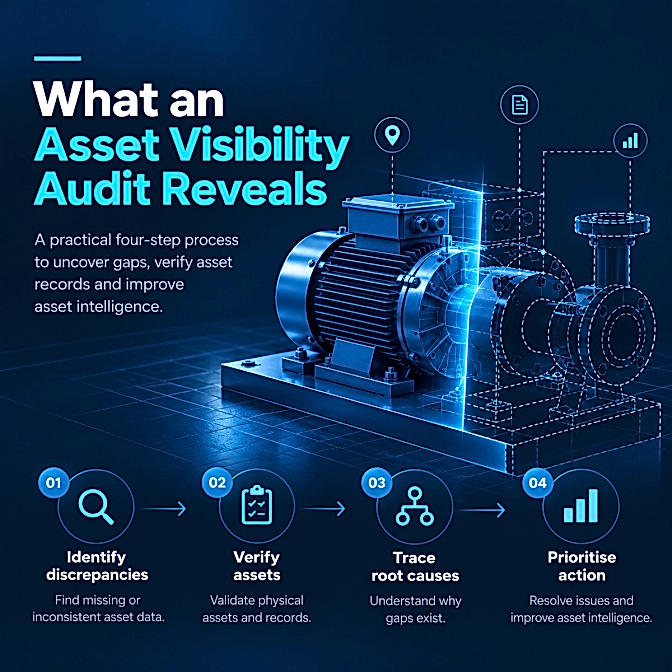
By establishing a baseline, verifying assets, tracing information gaps and prioritising corrective actions, organisations can turn scattered observations into a practical improvement plan.
For manufacturing teams managing complex asset inventories, the first step towards better asset intelligence is understanding where visibility stands today.
Book your free asset visibility audit this month.
Identify the gaps in your current asset information, understand what needs attention and establish a clearer path towards reliable asset visibility.
Inflewz — Asset Lifecycle, Engineered.