
Introduction
Every business depends on assets to keep its operations running. From manufacturing equipment and IT infrastructure to vehicles, medical devices, and industrial machinery, assets play a direct role in productivity, operational costs, and service delivery.
However, knowing what assets an organisation owns is only the starting point. Businesses also need to understand where assets are located, how they are performing, when they require maintenance, and whether they are delivering the expected value.
This is where asset intelligence becomes important.
Asset intelligence helps organisations turn asset-related data into actionable operational insights. By bringing together information about asset location, condition, usage, maintenance history, and lifecycle costs, businesses can make more informed decisions throughout the asset lifecycle.
For organisations managing large or distributed asset portfolios, asset intelligence provides a structured approach to improving visibility, reducing avoidable downtime, and planning maintenance and replacements more effectively.
This guide explains what asset intelligence is, how it works, its key components, business benefits, technologies, implementation challenges, and how organisations can build a practical asset intelligence strategy.
What Is Asset Intelligence?
Asset intelligence is the process of collecting, connecting, analysing, and using asset-related data to understand the status, performance, condition, utilisation, and lifecycle requirements of physical or digital assets.
Rather than treating asset records, maintenance logs, inventory lists, and equipment performance data as separate sources of information, asset intelligence brings relevant data together to support operational and strategic decisions.
For example, a manufacturing company may use asset intelligence to identify equipment that experiences repeated failures, determine which machines are underutilised, compare maintenance costs across facilities, and prioritise assets that require inspection or replacement.
The objective is not simply to collect more data. It is to make asset information reliable, accessible, and useful for the people responsible for managing assets.
Asset intelligence in simple terms
Asset intelligence helps answer five essential questions:
- What assets do we have? Maintain an accurate inventory of equipment, components, devices, and infrastructure.
- Where are our assets? Establish their locations, ownership, assignments, and movement history.
- What condition are they in? Understand asset health through inspections, maintenance records, and available sensor data.
- How effectively are they being used? Evaluate utilisation, performance, availability, and operational demand.
- What action should we take next? Prioritise maintenance, repairs, redeployment, upgrades, or replacement decisions.
When these questions can be answered using consistent and current information, asset management becomes more proactive and measurable.
Why Asset Intelligence Matters
Asset-intensive organisations often manage thousands of assets across different locations, departments, and operational environments. The information needed to manage these assets may be spread across spreadsheets, enterprise systems, maintenance applications, and disconnected databases.
This fragmentation creates operational blind spots.
A maintenance team might not know that an asset has repeatedly failed. A procurement team might purchase new equipment without knowing that suitable assets are available elsewhere. A finance team might struggle to estimate the remaining useful life of ageing equipment.
Asset intelligence helps reduce these information gaps by connecting asset data with operational requirements.
Its importance is increasing as organisations face pressure to improve productivity, control operating expenditure, maintain service availability, and demonstrate compliance with internal and external requirements.
Common challenges asset intelligence addresses
1. Incomplete asset visibility
Missing records, inconsistent asset identifiers, and outdated location details make it difficult to establish an accurate view of the asset portfolio.
2. Reactive maintenance
When maintenance decisions rely primarily on breakdown reports, organisations may incur avoidable downtime, emergency repair costs, and production interruptions.
3. Underutilised assets
Equipment can remain idle in one department while another department purchases additional capacity. Limited visibility makes redeployment difficult.
4. Unplanned expenditure
Without reliable information about condition, maintenance history, and lifecycle costs, repair and replacement decisions may be delayed or made without sufficient evidence.
5. Disconnected operational information
When asset data is spread across multiple systems, teams may work with conflicting records and spend unnecessary time reconciling information.
Asset intelligence provides a foundation for addressing these challenges through better data quality, stronger visibility, and more consistent decision-making.
How Does Asset Intelligence Work?
Asset intelligence combines asset identification, data collection, information integration, analysis, and operational action.
The exact architecture varies by organisation, but a typical process includes the following stages.
1. Establish a reliable asset register
The first step is to identify the assets within the organisation and create a consistent record for each one.
An asset register may include:
- Unique asset identification number
- Asset category, model, and manufacturer
- Location and assigned department
- Purchase date and acquisition cost
- Warranty and service information
- Maintenance and inspection history
- Current status and condition
- Expected useful life and replacement requirements
A reliable asset register creates the foundation for every subsequent analysis. If asset records are incomplete or inaccurate, even sophisticated analytics may produce misleading results.
2. Collect asset data
Asset data can come from multiple sources, depending on the type of equipment and the organisation's operational needs.
Common sources include maintenance work orders, manual inspections, inventory systems, enterprise resource planning platforms, IoT sensors, equipment controllers, and asset tracking technologies.
For example, a warehouse may use barcode or QR code scans to update asset identification and movement records. A manufacturing facility may collect temperature, vibration, and operating-hour data from connected equipment.
Not every asset requires continuous monitoring. Data collection should be proportionate to the asset's operational importance, risk, and cost.
3. Connect data from different systems
Information is more useful when teams can interpret it in context.
Connecting asset records with maintenance, procurement, inventory, production, and financial information can help organisations understand how equipment condition relates to operating costs and business performance.
Integration can take place through APIs, scheduled data transfers, enterprise platforms, or a central asset management system.
The objective is to establish consistent identifiers, standardise important fields, and reduce unnecessary duplication.
4. Analyse asset performance and condition
Once relevant data is available, organisations can use reports, dashboards, rules, statistical analysis, and machine learning where appropriate.
Analysis may reveal recurring equipment failures, increasing maintenance expenditure, declining utilisation, abnormal operating conditions, or assets approaching the end of their expected service life.
The depth of analysis depends on data availability and operational requirements. Basic reporting can deliver meaningful value before an organisation invests in advanced predictive analytics.
5. Turn insights into action
Asset intelligence delivers operational value when findings lead to appropriate decisions.
A maintenance manager may schedule an inspection. An operations manager may redeploy underused equipment. A procurement team may postpone a purchase after identifying available capacity. A finance team may use lifecycle information to prepare a replacement budget.
These actions should be recorded and evaluated so that organisations can determine whether the decisions improved performance.
Key Components of Asset Intelligence
Asset intelligence is not a single technology. It is a combination of data, processes, systems, and decision-making capabilities.
Asset identification and tracking
Organisations need a dependable way to identify assets and maintain accurate information about their locations and status.
Technologies such as barcodes, QR codes, RFID, GPS, and IoT devices can support identification or tracking, depending on the asset and operating environment.
The appropriate method depends on factors such as tracking frequency, environmental conditions, infrastructure, security requirements, and cost.
Asset lifecycle management
Assets move through several stages, including planning, acquisition, deployment, operation, maintenance, renewal, and disposal.
Asset lifecycle management provides a structured way to manage these stages and understand the implications of decisions made at each point.
Asset intelligence strengthens lifecycle management by connecting operational records with maintenance requirements, costs, utilisation, and replacement planning.
Maintenance intelligence
Maintenance intelligence uses work orders, failure records, inspection findings, service intervals, and condition data to support maintenance planning.
It can help teams identify recurring problems, understand equipment reliability, and prioritise maintenance according to operational risk.
Where sufficient data and suitable models are available, predictive methods can provide additional insight into the likelihood of equipment failure.
Utilisation and performance analysis
Asset utilisation analysis helps organisations determine whether assets are being used effectively.
Depending on the industry, relevant measures may include operating hours, idle time, availability, throughput, capacity utilisation, and downtime.
These measures help distinguish between assets that are genuinely required for operations and assets that could be redeployed, shared, or retired.
Lifecycle cost visibility
The acquisition price represents only one part of the cost of owning an asset.
Lifecycle costs can include installation, energy consumption, inspections, maintenance, spare parts, repairs, downtime, upgrades, and disposal.
Understanding these costs helps organisations compare alternatives and make better-informed decisions about repair, replacement, and total cost of ownership.
Reporting and decision support
Dashboards and reports translate asset data into information that different teams can use.
Maintenance teams may need overdue work orders and failure trends. Operations teams may focus on availability and utilisation. Finance teams may require expenditure, depreciation, and replacement forecasts.
Effective reporting connects these views while maintaining consistent underlying asset records.
Asset Intelligence vs. Asset Management
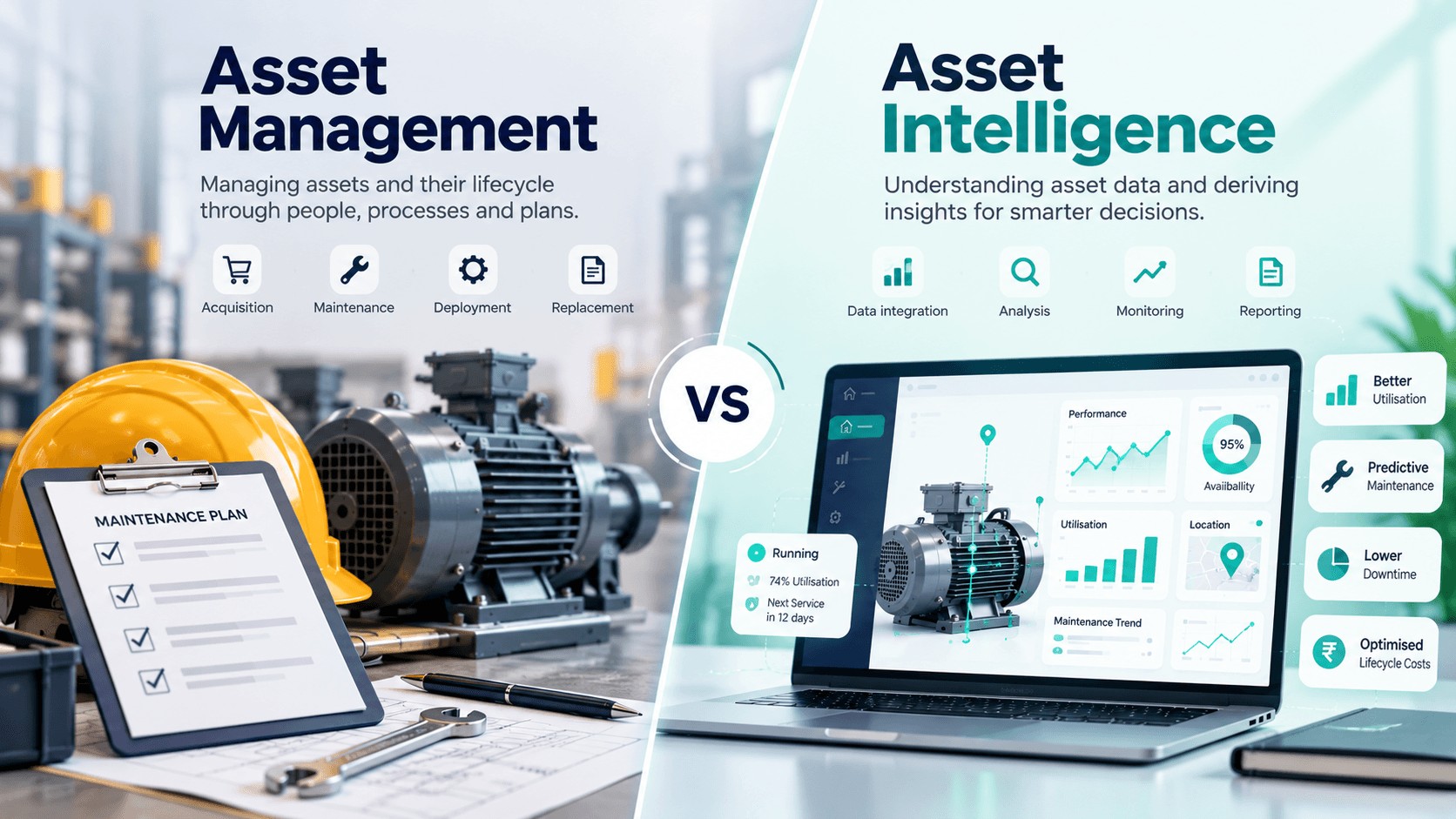
Asset intelligence and asset management are closely related, but they are not interchangeable.
Asset management refers to the broader activities, policies, responsibilities, and processes used to manage assets throughout their lifecycle. Asset intelligence focuses on generating useful insight from the data associated with those assets.

For example, an asset management team may establish a maintenance schedule for production equipment. Asset intelligence can help the team evaluate failure patterns and maintenance records to determine whether that schedule should be reviewed.
The two disciplines work best together. Intelligence informs decisions, while asset management processes ensure those decisions are implemented.
Asset Intelligence vs. Asset Tracking
Asset tracking focuses primarily on identifying assets and determining their location or movement.
Asset intelligence uses tracking information alongside other asset data to support broader operational decisions.
Consider a company managing equipment across several warehouses.
An asset tracking system may show where each item is located. An asset intelligence approach can combine that information with usage, maintenance, condition, and availability data to identify equipment that can be redeployed or requires inspection.
Tracking can therefore be an important input into asset intelligence, but location data alone does not provide a complete understanding of asset performance.
Asset Intelligence vs. Predictive Maintenance
Predictive maintenance uses data and analytical methods to estimate when equipment may require maintenance or experience a failure.
Asset intelligence has a broader scope. It can include predictive maintenance, but it also addresses asset inventory, location, utilisation, lifecycle costs, condition, and replacement planning.
For example, a predictive maintenance model might flag unusual vibration in a motor. An asset intelligence process can combine that alert with the motor's maintenance history, production criticality, available spare parts, and replacement cost to help determine the appropriate response.
Predictive maintenance is therefore one possible application of asset intelligence rather than a substitute for it.
Technologies That Enable Asset Intelligence
Several technologies can support asset intelligence. Organisations should select them according to their operational needs rather than adopting every available technology.
Internet of Things (IoT)
IoT sensors can capture information such as temperature, vibration, pressure, energy consumption, and operating hours.
When connected equipment produces reliable data, teams can identify abnormal operating conditions and monitor performance more frequently than manual inspections alone may allow.
IoT is particularly useful where equipment condition changes frequently or unexpected failures have significant operational consequences.
Artificial intelligence and machine learning
AI and machine learning can help identify patterns in large datasets, detect anomalies, estimate failure risks, and support maintenance forecasting.
However, model quality depends on the quality and relevance of the underlying data. Organisations should validate predictions, monitor false alarms, and retain human oversight for consequential maintenance and safety decisions.
QR codes, barcodes, and RFID
Identification technologies help connect physical assets with digital records.
QR codes and barcodes can support inspections, inventory verification, maintenance reporting, and asset handovers. RFID may be suitable where multiple tagged items need to be identified efficiently. Selection depends on the environment, read distance, infrastructure, and operating workflow.
Cloud platforms and system integration
Cloud platforms can make asset information accessible across facilities and teams, subject to appropriate access controls.
Integrations with ERP, maintenance management, inventory, and procurement systems can reduce data silos and help teams work from more consistent information.
Digital twins
A digital twin is a digital representation of a physical asset or system that can be updated using relevant operational data.
In suitable applications, digital twins can support simulation, performance analysis, and scenario planning. Their usefulness depends on the fidelity of the model, the availability of current data, and the decisions the organisation intends to improve.
Benefits of Asset Intelligence
The benefits of asset intelligence depend on the quality of implementation, the assets involved, and the organisation's existing processes.
1. Improved asset visibility
Centralised, consistently maintained information helps teams understand what assets exist, where they are, and what status they are in.
This can reduce the time spent searching for equipment, reconciling records, or confirming asset availability.
2. Better maintenance planning
Maintenance teams can use failure history, inspection data, and condition information to identify assets that need attention.
More informed planning can help reduce avoidable breakdowns and improve coordination between maintenance and operations.
3. Reduced avoidable costs
Asset intelligence can reveal unnecessary purchases, repeated repairs, poor utilisation, and rising lifecycle costs.
The resulting insights can help organisations prioritise expenditure and use existing resources more effectively. Savings should be measured against a defined baseline rather than assumed.
4. Higher asset utilisation
Visibility into location, availability, and usage helps organisations identify assets that could be shared or redeployed.
This is particularly relevant for businesses operating across multiple sites or departments.
5. Stronger lifecycle decisions
Condition, maintenance history, operating costs, and expected remaining life provide useful evidence for deciding whether to repair, upgrade, replace, or retire an asset.
These decisions can be evaluated against operational risk and long-term cost, rather than acquisition price alone.
6. More consistent compliance records
Reliable asset records and traceable maintenance histories can support inspections, audits, warranty management, and internal controls.
The specific compliance benefits depend on the industry's requirements and the controls implemented by the organisation.
7. Better cross-functional decisions
When operations, maintenance, procurement, and finance teams use consistent asset information, they can coordinate planning more effectively.
A shared understanding of asset condition and availability can reduce conflicting decisions and improve accountability.
Real-World Applications of Asset Intelligence
Asset intelligence can be applied in industries where equipment availability, location, condition, and lifecycle costs affect performance.
Manufacturing
Manufacturers can combine machine operating data, maintenance records, and production information to identify recurring downtime and prioritise critical equipment.
For example, repeated failures in a production line may justify a deeper investigation into maintenance practices, operating conditions, or component quality.
Warehousing and logistics
Warehouses and logistics operators manage handling equipment, vehicles, scanners, storage systems, and other operational assets.
Asset intelligence can help teams locate equipment, monitor utilisation, plan servicing, and identify opportunities to rebalance resources between locations.
Healthcare
Hospitals and healthcare facilities depend on medical equipment that must be available, maintained, and appropriately documented.
Asset intelligence can support equipment inventory, maintenance scheduling, service history tracking, and availability planning. Safety-critical decisions must remain subject to applicable clinical, engineering, and regulatory controls.
Energy and utilities
Energy and utility operators manage distributed infrastructure, including transformers, pumps, pipelines, meters, and other critical equipment.
Condition monitoring and lifecycle analysis can help prioritise inspections and maintenance according to asset criticality and operational risk.
Construction and infrastructure
Construction companies often move equipment between project sites and manage assets with different usage patterns.
Combining location, utilisation, maintenance, and project information can help reduce idle time and improve equipment allocation.
IT and enterprise infrastructure
Organisations also manage digital and technology assets, including servers, network equipment, endpoints, and software-related inventory.
Asset intelligence can support inventory accuracy, lifecycle planning, capacity visibility, and maintenance or refresh decisions. Software asset management may additionally require licence and entitlement data.
How to Implement an Asset Intelligence Strategy
A successful implementation does not need to begin with a complex analytics platform. A phased approach allows organisations to establish reliable data and demonstrate value before expanding the programme.
Step 1: Define the business problem
Start by identifying the decisions that need to improve.
Examples include reducing equipment downtime, improving inventory accuracy, increasing utilisation, controlling maintenance costs, or strengthening replacement planning.
Define a measurable objective and establish a baseline wherever possible.
Step 2: Identify critical assets
Not all assets require the same level of monitoring or analysis.
Prioritise assets according to operational criticality, failure consequences, replacement cost, maintenance burden, and regulatory requirements.
This approach helps allocate resources where better information is likely to provide the greatest value.
Step 3: Assess existing asset data
Review the current asset register, maintenance history, location records, and systems that store asset information.
Identify missing fields, duplicate records, inconsistent identifiers, outdated locations, and unclear data ownership.
Resolve high-impact data issues before building advanced analytics.
Step 4: Establish data ownership and standards
Define who is responsible for creating, validating, and updating asset records.
Standardise important fields such as asset identifiers, categories, locations, condition codes, and maintenance status. Establish clear processes for acquisitions, transfers, repairs, and disposals.
Data governance should also address access permissions, retention, security, and auditability.
Step 5: Choose suitable technologies
Select systems that meet the defined operational requirements.
Some organisations may need an asset management platform and QR code identification. Others may benefit from maintenance system integration, IoT monitoring, or advanced analytics.
Evaluate integration capabilities, scalability, usability, security, implementation effort, and total cost of ownership.
Step 6: Run a focused pilot
Choose a facility, asset category, or operational process where the problem is clear and the results can be measured.
Establish baseline metrics, implement the necessary data and workflow changes, and monitor results over a defined period.
A pilot should test both technology and working practices. A dashboard alone will not improve performance if staff do not trust or act on its information.
Step 7: Connect insights to workflows
Determine how an insight becomes an operational action.
For example, a condition alert might create an inspection task, while a utilisation report might trigger an asset redeployment review.
Assign owners, define escalation procedures, and record the outcome of important decisions.
Step 8: Measure results and expand
Compare performance against the original baseline.
Review the quality of asset records, response times, maintenance outcomes, utilisation, and relevant costs. Use these findings to refine the process before expanding to additional sites or asset categories.
Key Metrics for Measuring Asset Intelligence
Measurement helps organisations determine whether asset intelligence is improving business performance.
The most useful metrics depend on the operational objective.

Metrics require clear definitions. For example, utilisation should specify whether it is calculated using operating hours, output, or another measure. Downtime and availability calculations should also use consistent reporting periods and agreed rules.
Organisations should avoid relying on a single metric. A maintenance strategy that reduces expenditure but increases safety risk or production losses is not necessarily an improvement.
Common Challenges in Asset Intelligence
Despite its benefits, asset intelligence can be difficult to implement when underlying data, processes, and responsibilities are unclear.
Poor data quality
Incomplete or inconsistent asset records can undermine analysis.
Practical response: Establish data standards, validate records, assign data owners, and introduce routine verification processes.
Fragmented systems
Different departments may maintain separate asset records, creating conflicting versions of the same information.
Practical response: Identify the authoritative source for each data field and establish appropriate integrations or controlled data exchange.
Limited adoption
Employees may continue using spreadsheets or informal processes if new systems add work without solving practical problems.
Practical response: Involve users early, simplify data entry, provide training, and demonstrate how the new process supports their daily responsibilities.
High implementation costs
Sensors, integrations, software subscriptions, and process changes can increase implementation costs.
Practical response: Prioritise critical assets, start with a defined use case, and assess the expected benefits against the full cost of ownership.
Cybersecurity and access risks
Connected assets and integrated systems may introduce additional security requirements.
Practical response: Apply role-based access controls, secure integrations, appropriate network protections, regular updates, and monitoring. Consider data sensitivity and operational consequences when designing access policies.
Overreliance on advanced analytics
Machine learning and predictive models may receive attention before an organisation has reliable asset records or sufficient historical data.
Practical response: Establish accurate records and basic reporting first. Introduce advanced analytics when the data, expertise, and operational use case justify it.
The Future of Asset Intelligence
Asset intelligence is evolving as organisations connect more equipment, integrate more operational data, and adopt increasingly capable analytical tools.
Several developments are shaping this evolution.
More condition-based and predictive decisions
Organisations are increasingly able to combine equipment condition, usage patterns, and maintenance records to inform intervention timing.
The practical objective is to select maintenance actions that balance reliability, cost, safety, and operational demand.
Greater integration across the asset lifecycle
Connecting acquisition, maintenance, inventory, operations, and replacement planning can improve visibility beyond individual departments.
This can help organisations evaluate assets from both operational and financial perspectives.
More accessible analytics
Modern reporting tools and AI-assisted analysis may help users identify trends and investigate asset-related questions without requiring every user to be a data specialist.
The quality of the underlying records and the validation of generated insights remain essential.
Greater emphasis on lifecycle value
Organisations are increasingly evaluating asset decisions in terms of long-term operating costs, resource efficiency, reliability, and replacement requirements.
Better lifecycle information can support more disciplined investment planning.
These developments do not remove the need for sound maintenance practices, clear accountability, and reliable data. Technology creates opportunities, but operational processes determine whether those opportunities translate into measurable results.
How Inflewz Fits Into the Asset Intelligence Journey
Building asset intelligence requires more than collecting asset information. Organisations need reliable records, consistent processes, accessible data, and workflows that turn information into action.
Inflewz can position its asset lifecycle capabilities around this operational requirement: helping organisations establish better visibility and control over asset-related information and processes.
Depending on the solutions deployed, an asset lifecycle platform can support activities such as asset verification, record management, maintenance coordination, and workflow execution. These capabilities can contribute to the broader foundation required for asset intelligence.
A practical starting point is to identify where asset information becomes difficult to maintain, where operational handovers create gaps, and where teams lack the information needed to make timely decisions.
From there, organisations can prioritise improvements, standardise workflows, and evaluate whether the resulting visibility improves operational outcomes.
For Inflewz customers, the relevant question is not simply how much asset data can be collected. It is how effectively that information supports day-to-day execution and long-term asset decisions.
Frequently Asked Questions About Asset Intelligence
What is asset intelligence in simple terms?
Asset intelligence is the process of using asset-related information to understand asset location, condition, performance, utilisation, costs, and lifecycle requirements. It helps organisations make better-informed operational decisions.
What is the difference between asset intelligence and asset management?
Asset management covers the policies, processes, and activities involved in managing assets throughout their lifecycle. Asset intelligence focuses on analysing asset data to improve decisions within those processes.
What technologies are used in asset intelligence?
Common technologies include asset management software, QR codes, barcodes, RFID, IoT sensors, cloud platforms, system integrations, analytics tools, AI, and digital twins. The right combination depends on the organisation's needs.
How does asset intelligence improve maintenance?
It connects maintenance history, inspections, operating conditions, and asset criticality to help teams identify recurring problems, prioritise work, and evaluate maintenance strategies. Predictive maintenance may be one application when suitable data is available.
Is asset intelligence suitable for small businesses?
Yes. Small businesses can begin with a reliable asset register, standardised records, QR code identification, and basic reporting. Advanced monitoring can be introduced as operational needs and budgets justify it.
How do you measure the ROI of asset intelligence?
Compare implementation and operating costs with measurable changes in areas such as downtime, maintenance expenditure, asset utilisation, emergency purchases, and record accuracy. Use a defined baseline and avoid attributing every improvement to the technology alone.
Is asset intelligence the same as IoT asset monitoring?
No. IoT asset monitoring captures information from connected assets. Asset intelligence can use IoT data alongside maintenance, location, inventory, operational, and financial information to support broader decisions.
What is the first step towards implementing asset intelligence?
Start by defining a specific business problem and reviewing the quality of existing asset records. A focused pilot involving critical assets is often more practical than attempting to implement advanced analytics across the entire organisation immediately.
Conclusion
Asset intelligence helps organisations move from fragmented asset records to a more connected understanding of asset condition, performance, utilisation, and lifecycle requirements.
Its value comes from combining reliable information with clear operational processes. Accurate asset registers, suitable tracking technologies, connected systems, useful analytics, and accountable workflows create the foundation for better decisions.
Organisations do not need to adopt every available technology at once. They can begin with critical assets, resolve data quality issues, establish measurable objectives, and expand based on demonstrated results.
For businesses seeking stronger asset visibility and more disciplined lifecycle decisions, asset intelligence provides a practical framework for connecting asset information with operational performance.
Inflewz — Asset Lifecycle, Engineered.