
How to Cut a 6-Week Audit Prep to 3 Days

Dhananjay Chandra Kulal
Author
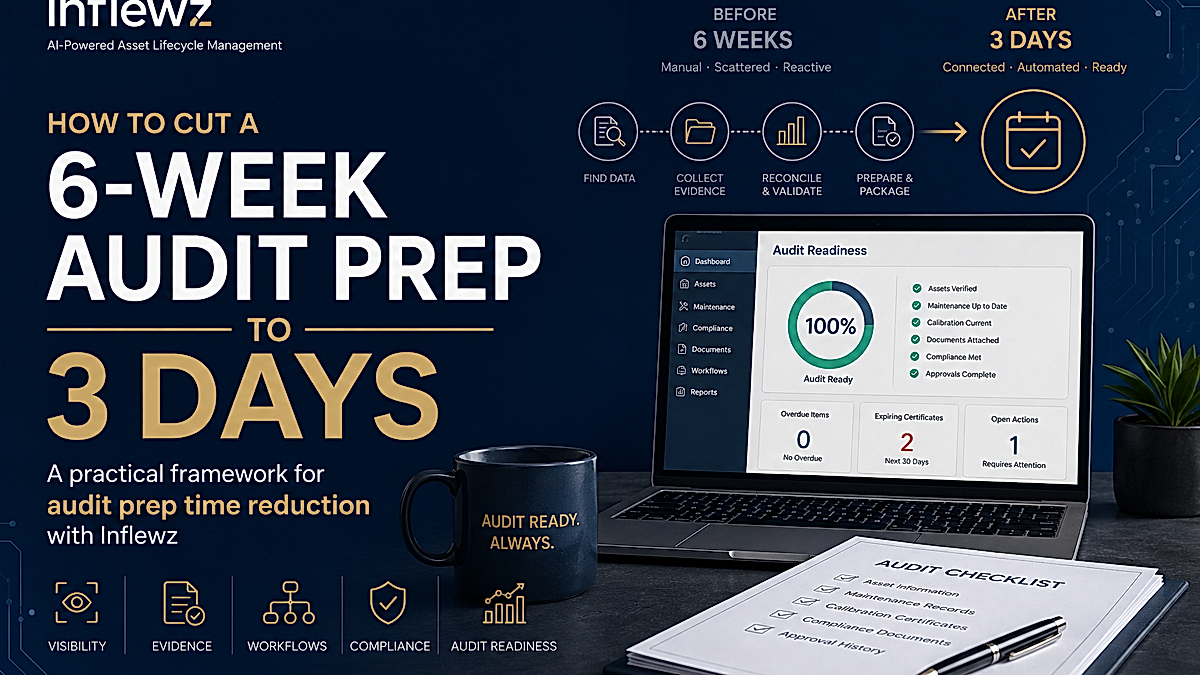
Audit preparation has a reputation for being slow, disruptive, and painful.
The audit itself may take only a few days, but preparing for it can consume weeks. Teams search through spreadsheets, emails, maintenance records, calibration certificates, inspection reports, work orders, asset registers, approvals, and historical documentation just to answer one basic question:
“Can you prove that this was done?”
For asset-intensive organizations, the problem becomes even bigger. Audit evidence is often connected to physical assets, maintenance activities, inspections, calibration schedules, ownership records, locations, certificates, and compliance workflows.
When that information is scattered, audit preparation becomes a project.
But it doesn't have to be.
A structured approach to audit prep time reduction can turn a six-week preparation cycle into a focused three-day verification exercise—not by cutting corners, but by changing how operational data and evidence are managed throughout the asset lifecycle.
Inflewz approaches this problem by connecting asset information, maintenance, compliance, documentation, workflows, and traceability into one operational environment. Its positioning as an AI-powered Asset Lifecycle Management platform is built around exactly this challenge: creating a single source of truth and maintaining audit-ready traceability across the asset lifecycle.
Why Audit Preparation Takes Six Weeks
Consider a typical organization preparing for an upcoming compliance or operational audit.
The audit team sends a request list.
At first, the requirements seem straightforward:
- Current asset register
- Preventive maintenance records
- Inspection history
- Calibration certificates
- Maintenance work orders
- Equipment ownership
- Location records
- Compliance documentation
- Approval records
- Corrective action history
- Evidence of completed activities
The problem begins when someone tries to collect them. The asset register is in Excel. Maintenance records are in a CMMS. Calibration certificates are stored in folders. Inspection reports are PDFs. Approvals are sitting in email threads. Some equipment has changed locations. Some assets have been retired but still appear on old spreadsheets.
And nobody is completely sure which document belongs to which asset. This is where audit preparation becomes slow.
Modern audit-readiness guidance increasingly emphasizes that the challenge isn't simply knowing what evidence is required. The real bottleneck is coordinating evidence, owners, systems, deadlines, and validation across the organization.
The result is a familiar six-week cycle:
Week 1–2: Find the data
Week 3: Reconcile discrepancies
Week 4: Chase missing evidence
Week 5: Validate and organize documents
Week 6: Review everything again
By the time the audit starts, teams may have spent weeks doing administrative work instead of improving operations.
The Real Bottleneck Isn't the Audit
The biggest mistake organizations make is treating audit preparation as a documentation exercise.
It isn't. It's a visibility problem.
If you don't know where an asset is, who owns it, what maintenance it received, whether its calibration is current, or which compliance documents belong to it, producing audit evidence will always be difficult.
An auditor may ask:
“Show me the maintenance history for this equipment.”
If the answer requires searching three systems and contacting two people, your audit process has a visibility problem.
Now imagine the opposite.
You select the asset and immediately see:
- Asset identity
- Location
- Department
- Responsible owner
- Maintenance history
- Inspection records
- Calibration status
- Certificates
- Work orders
- Compliance requirements
- Approval history
- Supporting documentation
The audit request hasn't changed.
Your ability to answer it has.
Inflewz's approach is designed around this connected asset view, bringing asset management, maintenance, calibration, compliance, document management, tracking, and workflow automation into one platform.
What a 6-Week Audit Prep Process Looks Like
Let's take a typical asset-intensive organization and break down where the time disappears.
1. Data discovery
The team starts by identifying where information lives.
They find:
- Multiple asset registers
- Different naming conventions
- Duplicate asset IDs
- Missing serial numbers
- Outdated locations
- Incomplete ownership information
Before anyone can prepare the audit evidence, the underlying data has to be understood.
2. Evidence collection
Next comes the document hunt.
Teams search shared drives, emails, folders, spreadsheets, and departmental systems for:
- Maintenance records
- Inspection forms
- Calibration certificates
- Service reports
- Purchase documentation
- Compliance certificates
- Approval records
This is often the most frustrating stage because finding a document isn't the same as proving that it belongs to the correct asset.
3. Reconciliation
Now the spreadsheets need to match reality.
An asset may appear in one system as:
Pump-104
while another system calls it:
P-104
and a certificate refers to:
Serial No. 874392
Someone has to determine whether these are the same asset.
4. Validation
Evidence must then be checked.
- Is the certificate current?
- Was the maintenance performed within the required interval?
- Was the inspection completed?
- Was the corrective action closed?
- Who approved it?
- What happened after the finding?
5. Packaging
Finally, evidence needs to be organized into something an auditor can actually review.
Only after all of this can the audit team feel confident that it is ready.
That's how three days of actual audit activity can create six weeks of preparation.
The 3-Day Model: Change the Workflow, Not the Standard
Reducing audit preparation from six weeks to three days doesn't mean doing six weeks of work in three days.
It means moving repetitive preparation work out of audit season.
The objective is simple:
Don't prepare evidence when the auditor asks for it. Maintain the evidence before they ask.
This creates a fundamentally different workflow.
Day 1: Establish the evidence baseline
Start with the asset population.
Every relevant asset should have a reliable identity and relationship to its operational records.
The team verifies:
- What assets exist
- Where they are
- Who owns them
- What compliance requirements apply
- Which records should exist
- Which evidence is missing
Instead of discovering this information during the audit, the organization maintains it as part of normal operations.
Day 2: Validate exceptions
The second day should focus on exceptions rather than searching.
For example:
- Expired certificates
- Overdue maintenance
- Missing inspections
- Unassigned assets
- Incomplete documentation
- Open corrective actions
- Data inconsistencies
This changes the audit-prep question from:
“Where is everything?”
to:
“What still needs attention?”
That is a much faster question to answer.
Day 3: Review and package
The final day becomes a verification exercise.
The team reviews the evidence trail, confirms that required documentation is present, resolves remaining exceptions, and prepares the audit package.
Instead of spending three days searching for information, the team spends three days confirming that the information is complete.
That's the fundamental principle behind meaningful audit prep time reduction.
Five Changes That Make Audit Prep Faster
1. Create One Source of Truth
Audit preparation becomes difficult when different departments maintain different versions of reality.
A centralized asset record creates a common reference point.
Every asset should have a unique identity and a connected history.
That history should follow the asset throughout its lifecycle—from onboarding and maintenance to calibration, compliance, and retirement.
Inflewz positions this connected lifecycle as a core part of its platform, replacing fragmented spreadsheets and siloed systems with a single source of truth and audit-ready traceability.
2. Connect Evidence to the Asset
A document folder isn't an audit strategy.
The important question isn't:
“Do we have the certificate?”
It is:
“Can we immediately connect the certificate to the correct asset, requirement, date, and activity?”
Evidence becomes much more valuable when it has context.
For example:
Asset → Requirement → Activity → Evidence → Approval → History
That chain allows an auditor—or an internal reviewer—to understand not just what happened, but how it relates to the asset and compliance requirement.
3. Replace Evidence Hunting With Exception Management
The most efficient audit teams don't search for every record manually.
They identify exceptions.
A dashboard can surface:
- Overdue maintenance
- Expiring certificates
- Missing documents
- Failed inspections
- Unresolved corrective actions
- Unassigned assets
- Incomplete records
The team then focuses its attention where it matters.
This is the difference between data collection and operational intelligence.
4. Make Compliance Part of Daily Operations
Audit readiness should not begin six weeks before an audit.
It should happen every day.
When maintenance is completed, record it.
When an inspection happens, capture it.
When calibration is performed, attach the certificate.
When a corrective action is closed, record the closure.
When an asset changes location or ownership, update the record.
The audit evidence is then generated as a by-product of normal operations.
This is consistent with the broader industry movement toward continuous audit readiness, where evidence is maintained throughout the year rather than reconstructed immediately before an audit.
What Actually Changes With Inflewz?
For asset-intensive organizations, audit readiness cannot be separated from asset lifecycle management.
Maintenance records affect compliance.
Asset ownership affects accountability.
Calibration affects equipment validity.
Location affects traceability.
Documents support evidence.
Workflows create approvals.
Historical records establish what happened.
These shouldn't exist as disconnected pieces.
Inflewz brings these operational elements together through capabilities spanning Enterprise Asset Management, maintenance, calibration and compliance management, asset tracking, document and certificate management, digital workflows, and analytics.
That creates a more practical audit-readiness model:
Asset visibility → Operational control → Evidence → Compliance → Audit readiness
Instead of preparing for an audit as a separate project, organizations can build readiness into the way they manage assets every day.
The Real ROI of Audit Prep Time Reduction
Reducing preparation time isn't only about saving employee hours.
The bigger benefit is reducing operational disruption.
A six-week preparation cycle can pull maintenance teams, compliance officers, facility managers, IT teams, and department heads away from their normal responsibilities.
Every missing document creates another request. Every discrepancy creates another investigation. Every spreadsheet mismatch creates another reconciliation exercise. And every last-minute issue increases audit risk.
A three-day verification model changes the economics.
Teams spend less time:
- Searching
- Chasing
- Reconciling
- Rebuilding history
- Validating spreadsheets
And more time:
- Managing exceptions
- Improving asset reliability
- Closing compliance gaps
- Preventing recurring issues
- Making better operational decisions
The goal isn't simply a faster audit.
The goal is an organization that doesn't need to stop operating to prove that it is operating correctly.
From Audit Fire Drill to Audit Readiness
A six-week audit preparation process usually indicates that the evidence exists—but isn't accessible, connected, or trusted.
The solution isn't necessarily more people.
It is better visibility.
When asset data, maintenance records, compliance requirements, documentation, ownership, and workflows are connected, audit preparation becomes a much more controlled process.
The shift looks like this:
| Traditional approach | Audit-ready approach |
| Search for evidence | Evidence is connected |
| Multiple spreadsheets | One source of truth |
| Manual reconciliation | Structured asset records |
| Document chasing | Centralized documentation |
| Audit-season preparation | Continuous readiness |
| Find everything | Manage exceptions |
| Six-week scramble | Three-day verification |
The most important transformation is not from six weeks to three days.
It is from reactive audit preparation to continuous operational visibility.
And that's where meaningful audit prep time reduction begins.
Ready to Make Audit Prep a 3-Day Process?
If your teams are still spending weeks collecting maintenance records, certificates, inspection reports, asset information, and compliance evidence before every audit, the problem may not be the audit.
It may be the system behind it.
Inflewz connects asset lifecycle data, maintenance, compliance, documentation, tracking, and workflows to help organizations build audit-ready operations—not just audit-ready folders.
Book a demo with Inflewz and see what a connected, audit-ready asset lifecycle can look like.
Note: The six-week-to-three-day scenario above is presented as a practical operating model/illustrative framework, not as a claim about a specific Inflewz customer unless independently documented.