
23.3% Lower operational costs through connected asset visibility

Dhananjay Chandra Kulal
Author
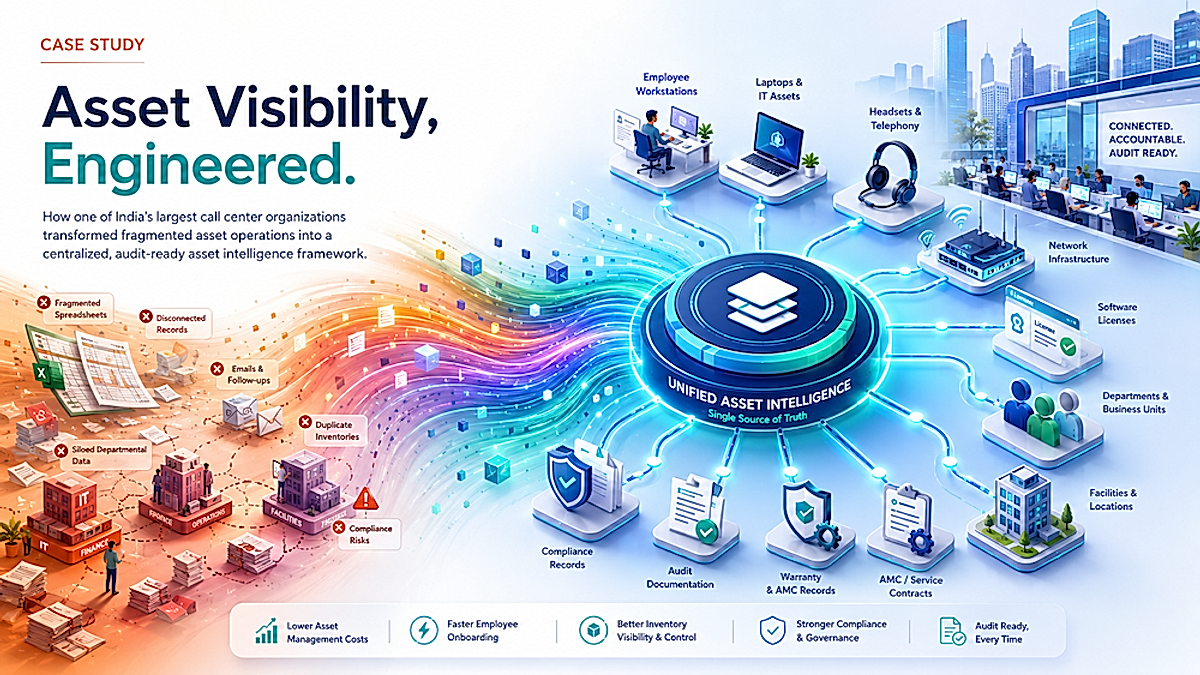
Asset visibility, engineered.
For large call center organizations, operational performance depends on thousands of physical and digital assets working together seamlessly. Workstations, laptops, networking equipment, telephony systems, software licenses, peripherals, and facility infrastructure all play a critical role in maintaining service continuity.
Yet as organizations scale, asset management often becomes fragmented.
Different departments maintain separate records. Asset ownership becomes difficult to track. Software licenses are managed through spreadsheets. Audit preparation turns into a manual exercise. Employee onboarding requires coordination across multiple teams. This was the reality faced by one of India's largest call center organizations.
Despite managing a vast technology infrastructure supporting thousands of employees, the organization lacked a centralized system capable of providing complete visibility into its asset ecosystem. The result was growing operational complexity, increasing administrative costs, and limited confidence in the accuracy of asset information.
The organization partnered with Inflewz to establish a unified asset management framework capable of delivering operational visibility, accountability, and compliance readiness at enterprise scale.
The operational challenge
The organization's asset landscape had evolved over many years. As business units expanded and new facilities were added, asset information became distributed across multiple systems, spreadsheets, and departmental records.
What appeared to be an asset management challenge was actually a visibility challenge. Teams could not confidently answer fundamental operational questions:
Where is a particular asset located? Who is responsible for it? Is it under warranty? Does it have an active AMC? Is the software license still valid? Has it been transferred, repaired, or replaced?
Without reliable answers to these questions, operational decisions became increasingly dependent on manual verification.
Operational excellence begins with asset visibility.
Fragmented asset information
Asset records existed in multiple locations across the organization. Procurement teams maintained purchase information. IT teams tracked deployment records. Finance managed depreciation schedules. Operations teams maintained separate inventories.
As a result, there was no single source of truth. Asset histories were incomplete, duplicate records existed, and ownership information was frequently outdated. When teams needed information, they often relied on emails, spreadsheets, or direct communication with other departments. This created delays, increased administrative effort, and introduced unnecessary risk.
High administrative overhead
Routine asset management activities required significant manual intervention. Simple processes such as assigning a laptop to a new employee, tracking a warranty renewal, or identifying unused assets involved multiple stakeholders and disconnected systems. Teams spent considerable time locating information rather than acting on it. The operational cost of managing assets continued to rise as the organization expanded.
Limited real-time visibility
Management lacked a consolidated view of enterprise assets. There was no easy way to determine:
- Which assets were actively being used.
- Which assets were sitting idle.
- Which assets were approaching end-of-life.
- Which software licenses required renewal.
- Which employees were assigned specific devices.
The absence of real-time visibility limited operational agility and reduced confidence in reporting.
Better visibility leads to better decisions.
Lengthy audit preparation cycles
Audit preparation had become a recurring operational challenge. Each audit required teams to gather records from multiple departments and reconcile information manually. Documentation relating to warranties, software licenses, asset transfers, purchase records, and compliance requirements had to be collected individually.
What should have been a verification process had become a documentation recovery exercise.
Compliance and governance risks
The organization also faced increasing pressure to maintain compliance across software licensing, warranty management, AMC contracts, and asset lifecycle documentation. Because information was distributed across different repositories, maintaining consistent governance became increasingly difficult. Leadership recognized that continued growth would require a fundamentally different approach to asset operations.
The Inflewz approach
Rather than treating the initiative as a technology deployment, Inflewz approached it as an operational transformation project. The objective was not simply to digitize records. The objective was to create a connected asset intelligence framework capable of supporting the complete asset lifecycle. The implementation focused on five operational pillars:
- Asset visibility.
- Ownership and accountability.
- Workflow automation.
- Compliance management.
- Audit readiness.
Creating a centralized asset intelligence layer
The first step involved establishing a unified asset repository. Assets from multiple systems, spreadsheets, and departmental records were consolidated into a single operational platform. Every asset was mapped with structured information including:
Asset category, Unique identification, Ownership details, Department allocation, Location, Lifecycle stage.,Warranty status.,Vendor information,Service history.
The organization moved from fragmented records to a centralized asset intelligence environment. For the first time, stakeholders across departments were working from the same operational dataset.
Establishing ownership and accountability
One of the most significant operational gaps was the absence of clear asset ownership. Inflewz introduced a structured accountability model that linked every asset to the appropriate employee, department, location, and cost center. This ensured complete traceability throughout the asset lifecycle. Whenever employees transferred between teams, relocated to different facilities, or exited the organization, associated assets could be identified and reassigned immediately.
Asset accountability was no longer dependent on spreadsheets or manual tracking. It became part of the operational workflow itself.
Visibility creates accountability, and accountability drives performance.
Automating employee onboarding workflows
Employee onboarding represented one of the highest-volume asset processes within the organization. Provisioning equipment for new employees previously required coordination across multiple stakeholders and systems. Inflewz digitized the complete workflow. Asset requests, approvals, assignments, acknowledgements, and handovers were managed through a standardized process. The result was faster onboarding, reduced administrative effort, and improved operational consistency.
Every assignment became fully traceable, creating a permanent record of ownership and responsibility.
Centralizing license and compliance management
Software licensing represented another critical area of operational risk. The organization managed a large portfolio of enterprise applications, vendor contracts, warranty agreements, and AMC relationships.
Inflewz established centralized visibility across all compliance-related assets and obligations. Automated alerts notified stakeholders before licenses, warranties, or contracts approached expiration. Instead of reacting to compliance events, teams could proactively manage them. This reduced operational risk while strengthening governance across the enterprise.
Building audit-ready operations
One of the most valuable outcomes of the project was the creation of audit-ready asset operations. Every asset became associated with its complete operational history. Supporting documentation such as purchase records, warranty certificates, service reports, license agreements, transfer logs, and compliance records became accessible from a single interface.
When audits occurred, teams no longer needed to spend weeks collecting documentation. The information already existed within the operational workflow. Audit readiness became a continuous operational state rather than a periodic project.
Results
The transformation delivered measurable operational improvements across multiple business functions.
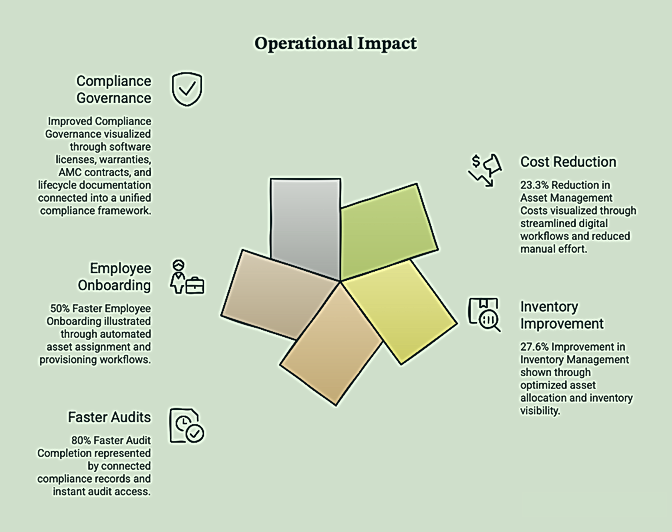
23.3% reduction in asset management costs
By eliminating manual processes and reducing administrative effort, the organization achieved significant cost savings across asset operations. Teams spent less time searching for information and more time executing value-generating activities.
27.6% improvement in inventory management
Centralized visibility improved inventory accuracy and asset utilization. Management gained a clearer understanding of asset allocation, availability, and ownership across facilities. This enabled more effective planning and resource utilization.
80% faster audit completion
Audit preparation cycles were dramatically reduced. Because asset documentation, compliance records, and ownership histories were already connected to individual assets, audit teams could access information immediately. What previously required weeks of preparation could now be completed in a fraction of the time.
50% faster employee onboarding
Automated asset assignment workflows accelerated employee onboarding while maintaining complete accountability and traceability. New employees received required equipment faster, enabling quicker operational readiness.
Improved compliance governance
The organization achieved stronger visibility across software licenses, warranty management, AMC contracts, and asset lifecycle documentation. Compliance became embedded within day-to-day operations rather than managed through periodic reviews.
Operational impact
The most important outcome was not the software implementation itself. It was the creation of operational trust. Leadership gained confidence in asset data. Teams gained confidence in ownership records. Auditors gained confidence in compliance documentation. Employees gained confidence in onboarding processes.
Asset information transitioned from a collection of disconnected records to a strategic operational asset. The organization now operates with complete visibility across its asset ecosystem, enabling faster decisions, stronger governance, and scalable operational growth.
Conclusion
Organizations rarely struggle with asset management because they lack technology. They struggle because asset information becomes disconnected from operational reality. When ownership is unclear, records are fragmented, and visibility is limited, every operational decision becomes a manual investigation.
By implementing a centralized asset intelligence platform, this leading call center organization transformed asset operations from a reactive administrative function into a connected, accountable, and audit-ready system. The result was not simply better asset tracking. It was complete operational control across the entire asset lifecycle.