
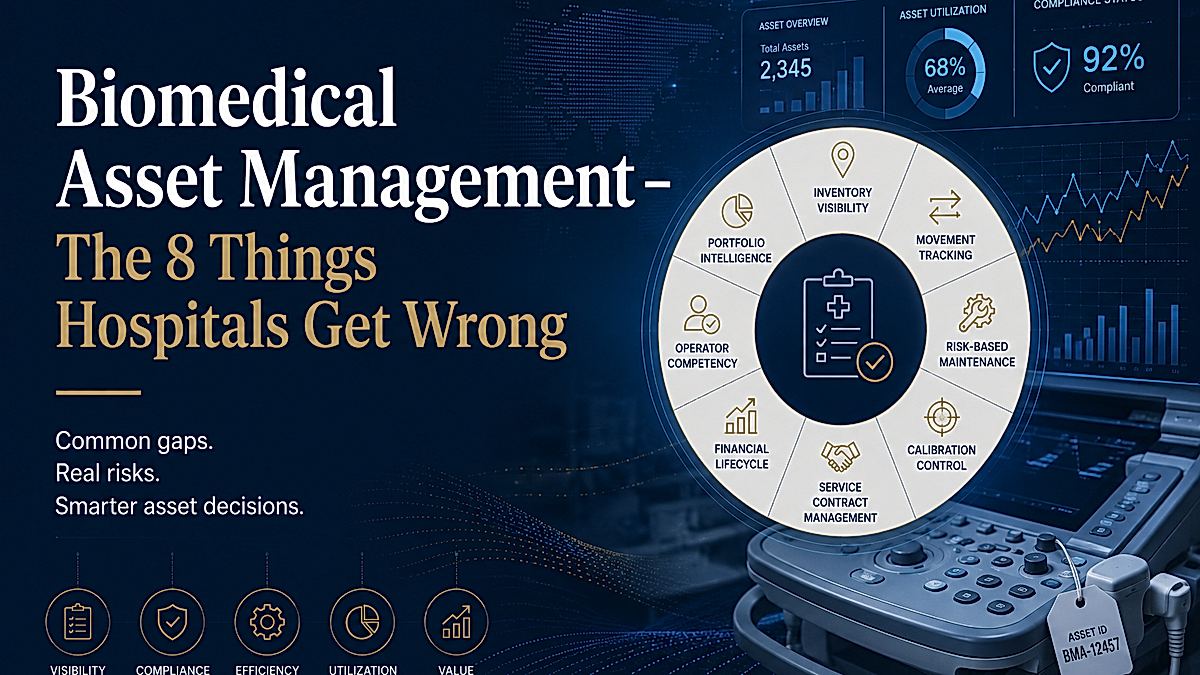
Biomedical Asset Management – The 8 Things Hospitals Get Wrong

Dhananjay Chandra Kulal
Author
Hospitals invest millions in medical equipment, from imaging systems and ventilators to infusion pumps, patient monitors, laboratory analyzers, surgical equipment, and specialized diagnostic devices.
Yet owning the equipment is only one part of the challenge.
The bigger challenge is knowing where every asset is, whether it is safe to use, when it was last serviced, who is qualified to operate it, what it costs to maintain, and when it should be replaced.
That is where biomedical asset management becomes critical.
For many hospitals, biomedical asset management is still treated as an administrative function: maintain an equipment register, schedule preventive maintenance, store calibration certificates, and raise service requests when something breaks. That approach is no longer sufficient.
A modern hospital needs to manage medical equipment as a connected asset lifecycle — from procurement and commissioning through deployment, maintenance, compliance, utilization, financial management, and eventual retirement.The problem is that hospitals often get the fundamentals wrong.
Here are eight of the most common gaps.
1. Treating the Asset Register as a Static Spreadsheet
The first problem is deceptively simple: hospitals often do not have a reliable, continuously updated view of their biomedical assets.
An asset register may contain the equipment name, manufacturer, model, serial number, department, and purchase date. But that information quickly becomes outdated.
- Equipment moves between wards.
- Devices are sent for repair.
- Loaner equipment enters the hospital.
- Assets are transferred between departments.
- Older devices are retired but remain on records.
- New equipment is commissioned but not immediately added to the system.
The result is a gap between what the hospital thinks it owns and what is actually operating across the facility.
A useful biomedical asset management system should provide more than an inventory list. It should establish a complete digital identity for every asset.
That identity can include:
- Asset ID and serial number
- Manufacturer and model
- Location and department
- Purchase and commissioning dates
- Warranty information
- Service history
- Calibration history
- Maintenance schedules
- Certificates and documentation
- Current operational status
- Assigned users or operators
- Movement history
- Replacement and depreciation information
The goal is simple: one reliable source of truth for every biomedical asset. Without that foundation, everything else becomes harder.
2. Losing Track of Where Equipment Actually Is
A medical device can have a perfectly maintained asset record and still become difficult to manage if nobody knows its current location. This is especially common in large hospitals.
A patient monitor may move from the emergency department to an intensive care unit. A ventilator may be transferred to another floor. Portable ultrasound equipment may be shared between departments.
Over time, manual movement records become unreliable. This creates more than an administrative inconvenience.
When equipment cannot be located quickly, staff may:
- Purchase unnecessary duplicate equipment
- Waste time searching across departments
- Miss scheduled maintenance
- Delay repairs
- Lose visibility into utilization
- Create inaccurate departmental inventories
Movement tracking should therefore be treated as part of asset management rather than a separate operational activity.
Every movement should create a traceable event: where the asset was, where it moved, when it moved, and who authorized or recorded the movement.
For high-value or critical equipment, hospitals can go further by using barcode, QR, RFID, or location technologies to improve visibility. The objective is not simply to "find equipment."
It is to understand how equipment moves through the hospital and how that movement affects availability, maintenance, and utilization.
3. Managing Maintenance as a Calendar Instead of a Risk Function
Preventive maintenance is often managed through a schedule:
"Device A is due for service in September." But a date alone does not tell the hospital how important that service is.
Biomedical equipment has different levels of clinical criticality, utilization, failure risk, and regulatory requirements.
A ventilator supporting critical care patients should not necessarily be managed in the same way as a low-risk administrative device.
A stronger maintenance approach considers factors such as:
- Clinical criticality
- Manufacturer recommendations
- Usage intensity
- Historical failure rates
- Environmental conditions
- Equipment age
- Previous maintenance findings
- Regulatory requirements
- Warranty and service agreements
This shifts the conversation from "What is due this month?" to "What presents the greatest operational or patient-safety risk?" That distinction matters.
Maintenance data can also reveal patterns that are invisible in a basic schedule.
If a particular equipment model repeatedly requires repairs shortly after preventive maintenance, that deserves investigation.
If one asset consistently generates unusually high service costs, replacement may make more economic sense than continued maintenance.
Biomedical asset management becomes much more valuable when maintenance information is used to support decisions rather than simply record completed tasks.
4. Treating Calibration Certificates as Documents, Not Evidence
Calibration is another area where hospitals can have a large amount of documentation but limited visibility.
A calibration certificate stored in a folder does not automatically mean the hospital has effective calibration control.
The critical questions are:
- Which assets require calibration?
- When was each asset last calibrated?
- When is the next calibration due?
- Is the certificate valid and traceable?
- What happens when calibration expires?
For measurement-dependent medical equipment, the certificate trail is part of the asset's operational history.
A strong system should connect the certificate directly to the asset record rather than storing it somewhere separate.
That makes it possible to see the complete history of the equipment in one place. It also makes audits significantly easier.
Instead of searching through emails, shared drives, paper files, and departmental folders, teams can retrieve the asset record and access its supporting documentation.
The important principle is that documentation should be connected to the asset lifecycle.
A certificate without context is just a file.
A certificate linked to an asset, calibration event, technician, date, result, and next due date becomes useful operational data.
5. Letting Service Contracts Become "Set and Forget"
Hospitals often manage expensive biomedical equipment through manufacturer or third-party service contracts. But simply having a contract does not mean the hospital is optimizing it.
Service contracts can contain important information about:
- Covered equipment
- Contract duration
- Preventive maintenance commitments
- Response-time commitments
- Parts coverage
- Labor coverage
- Exclusions
- Renewal dates
- Service-level obligations
When these details are tracked manually, organizations can miss renewal deadlines, pay for unnecessary coverage, or fail to recognize when service performance is falling short.
The asset and the service contract should therefore be connected. A hospital should be able to answer:
- Which assets are covered?
- By whom?
- Until when?
- At what cost?
- What services are included?
- How often has the vendor actually performed?
This creates an opportunity to evaluate vendors based on evidence rather than perception.
If a service provider consistently misses response-time commitments or a particular asset generates repeated service events despite contract coverage, the hospital has data to support a better decision.
6. Ignoring the Financial Lifecycle of Biomedical Equipment
Biomedical asset management is not only about engineering and maintenance. It is also a financial discipline.
A medical device has an economic lifecycle that begins at procurement and continues through deployment, maintenance, depreciation, utilization, and replacement.
Yet operational and financial data are often managed separately. The engineering team knows the asset's service history. Finance knows its purchase value and depreciation. Procurement knows the contract.
The department knows how heavily the equipment is used. But nobody necessarily has the complete picture. That creates a missed opportunity.
Consider two imaging devices with similar purchase prices.
One is heavily utilized, has low downtime, predictable maintenance costs, and several years of useful life remaining.
The other is underutilized, approaching the end of its expected lifecycle, and generating increasingly expensive repairs.
Purchase price alone does not tell the story. Hospitals need to understand total cost of ownership.
That can include:
- Acquisition cost
- Installation and commissioning
- Service contracts
- Preventive maintenance
- Corrective repairs
- Replacement parts
- Calibration
- Downtime
- Training
- Software or licensing costs
- Energy and operating costs
- Depreciation
- Disposal or replacement costs
When these elements are connected, hospitals can make better capital planning decisions.
The question becomes not simply "Should we replace this asset?"
It becomes:
"What is the economic and operational case for keeping, repairing, relocating, upgrading, or replacing it?"
7. Forgetting That Operator Competency Is Part of Asset Management
A technically perfect medical device can still create operational risk if the people using it are not appropriately trained.
This is why operator competency should be connected to biomedical asset management.
Hospitals should know which equipment requires specific training and whether the relevant users have completed it.
This becomes particularly important for complex or high-risk equipment. Training records should ideally connect:
Person → Equipment → Training → Competency → Validity
That creates visibility into whether an operator is authorized or competent to use a particular type of equipment. It can also help identify broader patterns.
For example, if equipment-related incidents or operational issues are concentrated around a particular department, the solution may not be another maintenance intervention. It could be a training gap.
Likewise, if a hospital purchases advanced equipment but utilization remains low, operator competency may be one of the factors limiting adoption.
Asset performance is therefore influenced by more than the condition of the machine.
It is influenced by the people, processes, and environment surrounding the machine.
8. Measuring Individual Assets Instead of the Entire Asset Portfolio
The final mistake is perhaps the biggest. Hospitals often manage assets one at a time.
- Device due for maintenance? Schedule it.
- Device broken? Repair it.
- Certificate expiring? Renew it.
- Contract ending? Extend it.
But individual actions do not necessarily produce portfolio-level visibility. Hospital leadership needs answers to larger questions.
- How much biomedical equipment do we have?
- How much of it is operational?
- Which assets are approaching end of life?
- Which departments have the highest downtime?
- Which equipment categories consume the most maintenance spend?
- Which assets are underutilized?
- Where are service contracts delivering value?
- Which assets should be replaced in the next one, three, or five years?
- Where are compliance risks concentrated?
These questions require aggregation. The value of biomedical asset management emerges when individual asset records become portfolio intelligence.
That is where digital systems can make a significant difference.
From Asset Register to Asset Intelligence
The future of biomedical asset management is not another spreadsheet. It is a connected asset intelligence layer that brings together operational, engineering, compliance, financial, and human data.
Imagine selecting a single asset and immediately seeing:
- Its current location
- Operational status
- Utilization
- Maintenance history
- Upcoming maintenance
- Calibration status
- Service contract
- Warranty
- Certificates
- Repair costs
- Depreciation
- Assigned users
- Training requirements
- Movement history
- Replacement recommendation
Now imagine being able to aggregate that information across thousands of assets. That changes the role of asset management.
Instead of reacting to individual maintenance events, hospitals can identify patterns.
Instead of searching for certificates, teams can see compliance status. Instead of discovering equipment shortages after they occur, leaders can analyze utilization.
Instead of replacing equipment based only on age, organizations can consider condition, cost, criticality, utilization, and risk.
The result is a shift from biomedical asset administration to biomedical asset intelligence.
What Good Biomedical Asset Management Looks Like
A mature approach does not necessarily mean buying more equipment or creating more processes. It means connecting the information that already exists.
At a minimum, hospitals should aim for five capabilities:
1. Complete asset visibility
Every biomedical asset should have a reliable digital identity and current location.
2. Lifecycle traceability
Procurement, commissioning, maintenance, calibration, movement, service, and retirement should form one continuous record.
3. Compliance visibility
Certificates, calibration records, service requirements, and other compliance-related information should be easy to retrieve and monitor.
4. Financial intelligence
Maintenance costs, depreciation, utilization, contracts, and replacement planning should be considered together.
5. Decision-ready analytics
Leaders should be able to move from individual asset records to portfolio-level insights.
These capabilities create something more valuable than a clean inventory.
They create confidence in the decisions being made about the hospital's equipment estate.
The Real Cost of Getting It Wrong
Poor biomedical asset management rarely appears as one dramatic failure.
Instead, the cost accumulates quietly. An unnecessary equipment purchase here. An overdue calibration there. A missed service contract renewal.
A device sitting unused in one department while another department struggles with availability.
A repair that costs more than the equipment is worth. A certificate that takes hours to locate during an audit. A critical device that cannot be located quickly.
A training gap that nobody identified. Individually, these may seem like small operational problems. At the scale of a hospital network, they can become significant.
The opportunity is to connect these seemingly separate issues into one view of the asset lifecycle.
Conclusion: Every Device Has a Story
Every biomedical asset has a story.
It has a purchase date, a location, a user, a maintenance history, a cost profile, a compliance record, and eventually a replacement decision.
The challenge is that many hospitals keep those pieces of the story in different places. Biomedical asset management brings them together.
The hospitals that get it right will not simply know how many devices they own.
They will know which assets are performing, which are creating risk, which are costing too much, which are underutilized, which require attention, and where investment will have the greatest impact. That is the real purpose of biomedical asset management.
Not more records. Better decisions.
For hospitals operating thousands of high-value and high-criticality assets, that difference can translate into greater equipment availability, stronger compliance, better resource utilization, and a more predictable path from asset acquisition to retirement.
The future of healthcare asset management is therefore not about managing equipment harder.
It is about managing it intelligently, continuously, and across its entire lifecycle. And the first step is recognizing the eight things that are getting in the way.