
The Asset Data Model Behind Inflewz: A Deep Dive into Schema, Relationships, and APIs

Dhananjay Chandra Kulal
Author
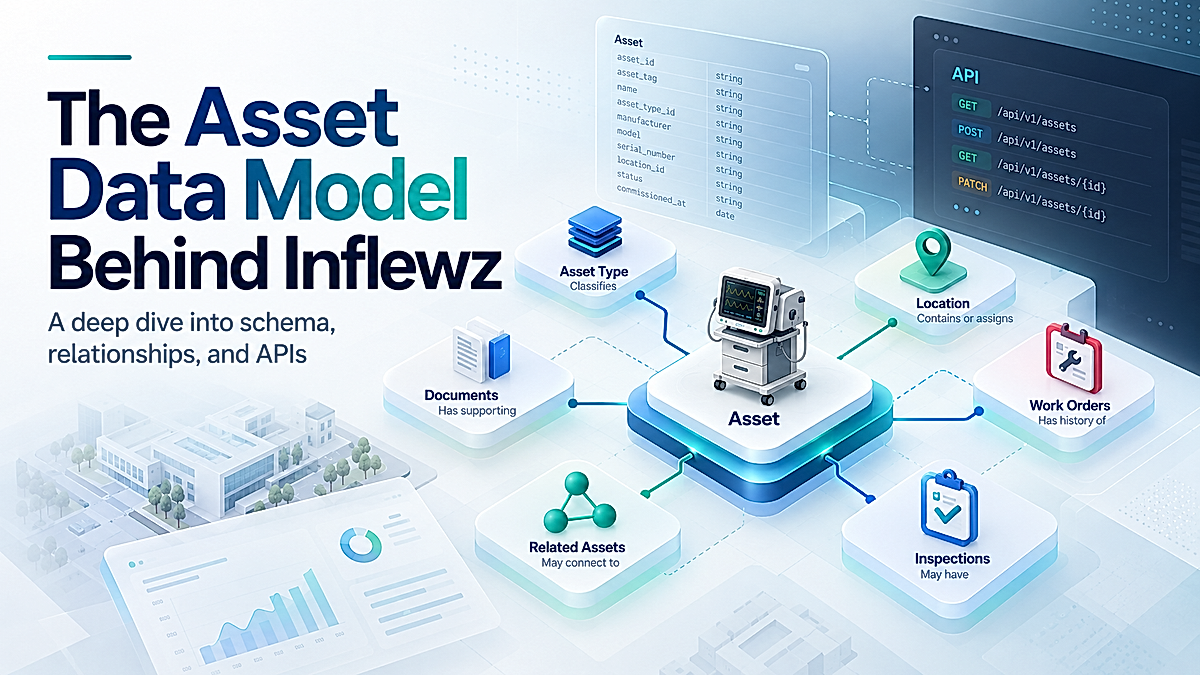
Modern asset management is not simply about maintaining an inventory. It is about understanding how assets are connected to locations, people, maintenance activities, documents, operational processes, and business decisions.
A piece of equipment has an identity. It belongs somewhere, serves a purpose, follows a lifecycle, and generates information throughout its useful life. When these details exist in disconnected spreadsheets, maintenance systems, and document repositories, organisations struggle to build a reliable picture of their assets.
This is where the asset data model becomes fundamental.
An asset data model defines how asset information is structured, how different records relate to one another, and how applications access and update that information. It provides the underlying framework that turns individual records into connected operational intelligence.
For enterprise asset management platforms such as Inflewz, this is an important engineering consideration. The quality of the data model influences how effectively an organisation can track assets, manage maintenance, establish traceability, integrate business systems, and make decisions using consistent information.
In this deep dive, we examine the architectural principles behind a robust asset data model, including its core entities, relationships, schema design, API considerations, and implications for enterprise-scale operations.
1. What Is an Asset Data Model?
An asset data model is a structured representation of the information associated with physical or operational assets and the relationships between that information.
At its simplest, it answers five questions:
- What is the asset?
- Where is it located?
- Who is responsible for it?
- What has happened to it throughout its lifecycle?
- How does it relate to other assets, systems, and business processes?
Consider a manufacturing facility with several production machines. Each machine has an identifier, manufacturer, model, installation date, current location, maintenance schedule, and operational status.
That information describes individual attributes of the asset. However, the machine also has maintenance work orders, inspection records, associated documents, spare parts, and potentially relationships with a production line or another machine.
A useful asset data model connects these records rather than treating them as independent entries.
This distinction matters because enterprise asset management requires more than retrieving a machine's name and serial number. It requires the ability to understand its history, identify outstanding work, retrieve supporting evidence, and establish how it fits into the wider operational environment.
A well-designed model therefore serves three purposes:
Structure: It defines how information is organised and validated.
Relationships: It establishes how assets connect to operational records and other entities.
Interoperability: It provides a consistent foundation for exchanging information between applications and business systems.
The result is a more dependable representation of the asset lifecycle.
2. The Core Entities Behind an Asset Data Model
The first architectural decision is determining which entities the model must represent.
An entity is a distinct object or concept about which the system stores information. The exact structure depends on business requirements, but a comprehensive enterprise asset model commonly needs several interconnected entities.
Asset
The asset is the central record.
It represents the individual equipment item, machine, vehicle, instrument, infrastructure component, or other object being managed.
A conceptual asset record might include:
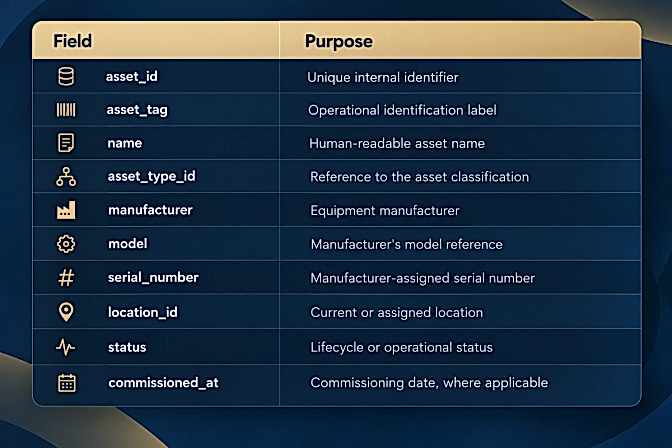
These fields are illustrative rather than a representation of Inflewz's actual database schema.
The most important design choice is the use of a stable internal identifier. Names, locations, and asset tags may change during an asset's lifetime. A stable identifier allows associated records to remain connected even when descriptive attributes change.
The model should also distinguish between identity and classification. Two machines may share the same model and manufacturer but remain separate assets with different service histories, locations, and responsibilities.
Asset Type and Classification
Asset classification provides a consistent way to group assets according to their characteristics and intended use.
Examples include:
- Biomedical equipment
- Manufacturing machinery
- Electrical infrastructure
- Vehicles and mobile equipment
- IT hardware
- Building systems
A separate asset type entity can define standard attributes, required fields, or applicable management procedures.
For example, a biomedical monitor may require calibration-related information, whereas a vehicle may require registration and inspection information.
This structure helps avoid creating a single, oversized asset record filled with fields that are irrelevant to most equipment categories.
Location
Location represents where an asset is installed, stored, or assigned.
A location model may include facilities, buildings, floors, departments, rooms, production lines, or storage areas.
Locations can also have hierarchical relationships. A room belongs to a department, which belongs to a building, which belongs to a facility.
This hierarchy enables users to move from an individual asset to a broader operational view.
For example, a maintenance manager could identify assets assigned to a particular production line or review equipment distributed across multiple facilities.
Location history may also matter. If an asset moves between departments, retaining the relevant historical information can help explain past maintenance activities and responsibility changes.
Maintenance Work Orders
Maintenance records capture work that has been requested, planned, assigned, performed, or reviewed.
A work order commonly includes a unique identifier, associated asset, work type, priority, status, assigned personnel, relevant dates, and completion details.
The relationship between assets and work orders is particularly important: one asset may accumulate many work orders throughout its lifetime.
Separating work orders from the asset record prevents the asset entity from becoming a continually expanding collection of maintenance fields.
It also supports independent tracking of maintenance status, assignment, completion, and historical reporting.
Documents and Evidence
Asset management often depends on supporting documentation, including manuals, warranties, inspection reports, calibration certificates, compliance records, and service reports.
A document entity can represent metadata about each record, such as its identifier, document type, version, creation date, storage reference, and associated asset or activity.
The actual file may be stored in a separate document repository or object-storage service. The data model can retain the reference and relevant metadata without placing large file contents directly inside the asset record.
This separation supports more flexible document management and makes it easier to associate one document with the appropriate asset, work order, inspection, or other relevant record.
3. Understanding Relationships: Where the Model Becomes Useful
Entities establish the individual building blocks. Relationships explain how those blocks work together.
A simple inventory might store an asset's name and location. A connected asset data model can link the asset to its maintenance history, documents, assigned responsibilities, and associated equipment.
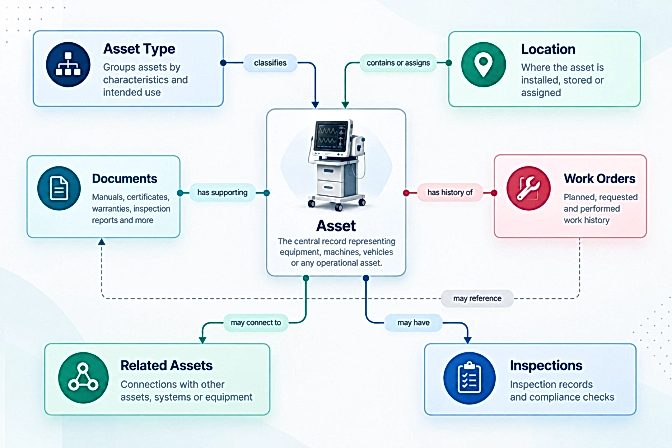
A conceptual relationship structure could look like this:
The Asset Data Model Behind Inflewz: A Deep Dive into Schema, Relationships, and APIs
Modern asset management is not simply about maintaining an inventory. It is about understanding how assets are connected to locations, people, maintenance activities, documents, operational processes, and business decisions.
A piece of equipment has an identity. It belongs somewhere, serves a purpose, follows a lifecycle, and generates information throughout its useful life. When these details exist in disconnected spreadsheets, maintenance systems, and document repositories, organisations struggle to build a reliable picture of their assets.
This is where the asset data model becomes fundamental.
An asset data model defines how asset information is structured, how different records relate to one another, and how applications access and update that information. It provides the underlying framework that turns individual records into connected operational intelligence.
For enterprise asset management platforms such as Inflewz, this is an important engineering consideration. The quality of the data model influences how effectively an organisation can track assets, manage maintenance, establish traceability, integrate business systems, and make decisions using consistent information.
In this deep dive, we examine the architectural principles behind a robust asset data model, including its core entities, relationships, schema design, API considerations, and implications for enterprise-scale operations.
1. What Is an Asset Data Model?
An asset data model is a structured representation of the information associated with physical or operational assets and the relationships between that information.
At its simplest, it answers five questions:
- What is the asset?
- Where is it located?
- Who is responsible for it?
- What has happened to it throughout its lifecycle?
- How does it relate to other assets, systems, and business processes?
Consider a manufacturing facility with several production machines. Each machine has an identifier, manufacturer, model, installation date, current location, maintenance schedule, and operational status.
That information describes individual attributes of the asset. However, the machine also has maintenance work orders, inspection records, associated documents, spare parts, and potentially relationships with a production line or another machine.
A useful asset data model connects these records rather than treating them as independent entries.
This distinction matters because enterprise asset management requires more than retrieving a machine's name and serial number. It requires the ability to understand its history, identify outstanding work, retrieve supporting evidence, and establish how it fits into the wider operational environment.
A well-designed model therefore serves three purposes:
Structure: It defines how information is organised and validated.
Relationships: It establishes how assets connect to operational records and other entities.
Interoperability: It provides a consistent foundation for exchanging information between applications and business systems.
The result is a more dependable representation of the asset lifecycle.
2. The Core Entities Behind an Asset Data Model
The first architectural decision is determining which entities the model must represent.
An entity is a distinct object or concept about which the system stores information. The exact structure depends on business requirements, but a comprehensive enterprise asset model commonly needs several interconnected entities.
Asset
The asset is the central record.
It represents the individual equipment item, machine, vehicle, instrument, infrastructure component, or other object being managed.
A conceptual asset record might include:
Field
Purpose
asset_id
Unique internal identifier
asset_tag
Operational identification label
name
Human-readable asset name
asset_type_id
Reference to the asset classification
manufacturer
Equipment manufacturer
model
Manufacturer's model reference
serial_number
Manufacturer-assigned serial number
location_id
Current or assigned location
status
Lifecycle or operational status
commissioned_at
Commissioning date, where applicable
These fields are illustrative rather than a representation of Inflewz's actual database schema.
The most important design choice is the use of a stable internal identifier. Names, locations, and asset tags may change during an asset's lifetime. A stable identifier allows associated records to remain connected even when descriptive attributes change.
The model should also distinguish between identity and classification. Two machines may share the same model and manufacturer but remain separate assets with different service histories, locations, and responsibilities.
Asset Type and Classification
Asset classification provides a consistent way to group assets according to their characteristics and intended use.
Examples include:
- Biomedical equipment
- Manufacturing machinery
- Electrical infrastructure
- Vehicles and mobile equipment
- IT hardware
- Building systems
A separate asset type entity can define standard attributes, required fields, or applicable management procedures.
For example, a biomedical monitor may require calibration-related information, whereas a vehicle may require registration and inspection information.
This structure helps avoid creating a single, oversized asset record filled with fields that are irrelevant to most equipment categories.
Location
Location represents where an asset is installed, stored, or assigned.
A location model may include facilities, buildings, floors, departments, rooms, production lines, or storage areas.
Locations can also have hierarchical relationships. A room belongs to a department, which belongs to a building, which belongs to a facility.
This hierarchy enables users to move from an individual asset to a broader operational view.
For example, a maintenance manager could identify assets assigned to a particular production line or review equipment distributed across multiple facilities.
Location history may also matter. If an asset moves between departments, retaining the relevant historical information can help explain past maintenance activities and responsibility changes.
Maintenance Work Orders
Maintenance records capture work that has been requested, planned, assigned, performed, or reviewed.
A work order commonly includes a unique identifier, associated asset, work type, priority, status, assigned personnel, relevant dates, and completion details.
The relationship between assets and work orders is particularly important: one asset may accumulate many work orders throughout its lifetime.
Separating work orders from the asset record prevents the asset entity from becoming a continually expanding collection of maintenance fields.
It also supports independent tracking of maintenance status, assignment, completion, and historical reporting.
Documents and Evidence
Asset management often depends on supporting documentation, including manuals, warranties, inspection reports, calibration certificates, compliance records, and service reports.
A document entity can represent metadata about each record, such as its identifier, document type, version, creation date, storage reference, and associated asset or activity.
The actual file may be stored in a separate document repository or object-storage service. The data model can retain the reference and relevant metadata without placing large file contents directly inside the asset record.
This separation supports more flexible document management and makes it easier to associate one document with the appropriate asset, work order, inspection, or other relevant record.
3. Understanding Relationships: Where the Model Becomes Useful
Entities establish the individual building blocks. Relationships explain how those blocks work together.
A simple inventory might store an asset's name and location. A connected asset data model can link the asset to its maintenance history, documents, assigned responsibilities, and associated equipment.
One-to-Many Relationships
A one-to-many relationship occurs when one record is associated with multiple records of another entity.
For example:
- One asset can have many work orders.
- One asset can have many inspection records.
- One asset can have multiple supporting documents.
- One facility can contain many locations or assets.
Typically, the associated record stores a reference to its parent record. A work order might contain an asset_id that identifies the asset it concerns.
This avoids duplicating the complete asset record in every work order.
Many-to-Many Relationships
Some relationships cannot be represented accurately using a single reference.
For instance, one spare part type may be compatible with several asset models, and one asset model may use multiple spare part types.
A many-to-many relationship can be represented using a linking entity, such as an asset-part compatibility record.
The linking entity can also contain information specific to the relationship, such as compatibility notes, approved alternatives, or effective dates.
This pattern is useful when relationships have their own attributes or require independent validation.
Historical Relationships
Current-state information is not always sufficient.
Suppose an asset moves from one department to another. Updating its location field identifies where it is now, but it does not necessarily explain where it was during a previous maintenance activity.
A historical assignment model can preserve the asset, location, effective dates, and relevant responsibility information.
This is important for traceability, operational reporting, and understanding past events.
The broader principle is that an asset model should distinguish between what is true now and what was true at a particular point in time.
4. Designing the Schema: Structure Without Unnecessary Complexity
The schema defines how the data model is implemented in a database or another persistence system.
For a relational database, this typically means tables, columns, primary keys, foreign keys, constraints, and indexes.
Its purpose is to demonstrate a basic architectural principle: separate entities should have clear identities, and relationships should be represented explicitly.
Normalisation and Data Integrity
Database normalisation helps reduce unnecessary duplication and update anomalies.
Imagine storing an asset's location name, manufacturer details, and asset classification repeatedly in every maintenance record. If the location name changes, multiple records may need updating. Inconsistent updates can create conflicting information.
Separating the relevant entities reduces this duplication and creates clearer ownership of individual data elements.
However, normalisation is not the only consideration. Enterprise applications also need efficient reporting, search, and API responses.
Some systems use carefully selected denormalised fields, materialised views, or read-optimised models to improve performance. These decisions should be based on actual access patterns and measured requirements rather than applied indiscriminately.
Identifiers and Constraints
Reliable relationships depend on reliable identifiers.
Primary keys uniquely identify records. Foreign keys, where supported, help enforce relationships between records.
Other constraints can prevent invalid or incomplete information from entering the system.
For example, a work order should not reference a nonexistent asset. A mandatory asset identifier should not be left empty, and status values should follow a defined set of permitted states.
Business rules may require additional validation beyond database constraints.
The objective is to prevent inconsistencies as early as possible, rather than relying on users or reporting processes to discover them later.
5. Asset Data Models and APIs: Making the Information Accessible
A well-structured data model is only part of an enterprise architecture.
Applications also need a reliable way to read, create, update, and exchange information. This is where application programming interfaces, or APIs, become relevant.
An API provides a defined interface through which another application can interact with a system without needing direct access to its internal database.
For an asset management platform, possible API resources might include assets, locations, work orders, documents, inspections, and maintenance schedules.
A conceptual REST API could expose operations such as:
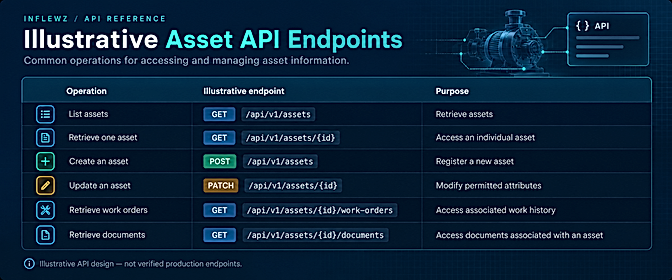
Find associated document metadata
These endpoint patterns are examples only. They should not be interpreted as actual Inflewz API routes or a claim that these endpoints are currently available.
Consistent Resource Design
API resources should reflect clear business concepts and maintain predictable naming conventions.
An asset identifier should remain stable across related API operations. A client should not need to guess whether a maintenance record refers to an asset by its name, serial number, or an inconsistent internal label.
Where relationships are exposed through the API, the contract should explain how associated resources are represented and retrieved.
Validation and Error Handling
An API should define what happens when a request contains invalid data, references an unknown asset, conflicts with an existing record, or attempts an unauthorised operation.
Clear validation errors help integrators identify and resolve problems without repeatedly submitting the same incorrect request.
Consistent error formats, appropriate HTTP status codes, and useful diagnostic information improve integration reliability.
Pagination and Filtering
Enterprise asset inventories can contain substantial numbers of records.
Returning every asset in a single response is often impractical. Pagination allows clients to retrieve manageable portions of a dataset, while filtering and sorting help them find the records they need.
For example, a maintenance application might request assets at a particular facility with a specific operational status.
The exact query parameters depend on the API contract, but the design goal is consistent: make data retrieval predictable and efficient as the volume of information grows.
Authentication and Authorisation
Not every integration should have unrestricted access to every asset or operation.
Authentication establishes the identity of the caller. Authorisation determines which resources and actions that identity is permitted to access.
A well-designed enterprise API should apply appropriate access controls, validate incoming requests, protect sensitive information, and record relevant activities according to the organisation's security and audit requirements.
6. Connecting the Asset Data Model to Enterprise Systems
Assets rarely exist in isolation from the rest of the business.
Procurement systems may contain purchase orders and supplier information. Enterprise resource planning platforms may hold financial and inventory records. Maintenance applications may manage work orders, while identity systems control user access.
Integrating these systems requires more than connecting two endpoints.
The underlying data must have compatible meanings, identifiers, and lifecycle rules.
Master Data and System Ownership
One of the first integration questions is determining which system owns each piece of information.
For example, a procurement system might be authoritative for purchase orders, while an asset management platform maintains operational asset records.
If both systems independently update the same fields without clear ownership rules, conflicting values can emerge.
A master data strategy establishes which system is responsible for creating and maintaining particular records, how identifiers are mapped, and how changes are synchronised.
Data Mapping and Transformation
Different applications may use different names or structures for equivalent concepts.
One system might call a field asset_tag, while another uses equipment_number. One may represent a location using a hierarchy, while another uses a flat location code.
An integration layer can map these representations into the receiving system's expected format.
However, syntactic compatibility is not enough. The systems must also agree on business meaning, permitted values, time conventions, and status transitions.
Event-Driven Integration
Some integrations benefit from notifying other systems when important events occur.
Examples include an asset being commissioned, a work order being completed, or a maintenance status changing.
An event-driven approach can reduce the need for frequent polling, provided that the architecture supports reliable event delivery, retry handling, and reconciliation.
Not every workflow needs event-driven infrastructure. Scheduled synchronisation may be sufficient for less time-sensitive exchanges.
The appropriate approach depends on the integration's latency requirements, complexity, reliability expectations, and operational cost.
7. Data Quality, Governance, and Traceability
A technically sound schema cannot compensate for unreliable source data.
Duplicate assets, inconsistent classifications, missing identifiers, and outdated location records can undermine the value of even a well-designed system.
Data governance defines how these problems are prevented, detected, and corrected.
Establishing Data Ownership
Each important data domain should have a clear owner.
That includes responsibility for asset creation, classification, location changes, record correction, and retirement.
Ownership should also define who can approve changes to critical fields and how disputed or incomplete information is resolved.
Maintaining Data Lineage
Data lineage helps explain where information originated and how it changed as it moved between systems.
For enterprise asset management, this can include identifying the source of an imported asset record, the system that updated a field, and the relevant integration or business process.
Where required, change history should capture the relevant actor, timestamp, previous value, new value, and reason for change.
The level of detail should reflect operational, contractual, regulatory, and audit requirements.
Managing the Full Asset Lifecycle
The asset data model should support changes across the asset's lifetime.
An asset may progress through acquisition, commissioning, operation, maintenance, relocation, refurbishment, and retirement.
These transitions should be represented using defined states and controlled processes rather than relying on free-text descriptions alone.
Retirement, for example, should not automatically mean deleting every historical record. Organisations may need to retain service history, financial information, inspection evidence, or other records according to applicable retention policies.
A lifecycle-aware model preserves context while ensuring that the current operational status remains accurate.
8. Designing for Scale Without Losing Clarity
Enterprise asset data models must support changing business requirements, increasing record volumes, and additional integrations.
However, adding complexity prematurely can make the model harder to understand and maintain.
A practical architecture begins with the entities, relationships, and queries required by actual workflows.
Performance should then be evaluated against expected workloads.
Indexes can improve retrieval for frequently used queries. Pagination can limit response sizes. Caching may help for appropriate read-heavy workloads. Reporting databases or analytical pipelines can separate complex reporting from transactional operations when justified.
For multi-site organisations, tenant isolation and access boundaries may also be important architectural requirements.
The design must ensure that users and integrations access only the records they are authorised to see.
Schema evolution deserves equal attention. New asset categories, fields, relationships, and API versions should be introduced in a way that minimises disruption to existing integrations.
Backward compatibility, migration planning, validation, and clear versioning policies help keep the platform maintainable as requirements change.
The objective is not to build the most complicated model possible. It is to build a model that remains understandable, dependable, and adaptable as the organisation grows.
9. What Technical Buyers Should Evaluate
For enterprise buyers, an asset data model is not merely a backend implementation detail. It affects integration effort, reporting quality, governance, and the ability to support operational workflows.
When evaluating an asset management platform, technical and operational teams should examine several areas.
Schema clarity: Are core entities and relationships understandable and documented?
Data integrity: How does the system prevent duplicate records, invalid references, and inconsistent values?
Lifecycle support: Can the model represent commissioning, relocation, maintenance, and retirement without losing historical context?
API documentation: Are available resources, request formats, authentication requirements, error responses, and versioning policies clearly defined?
Integration readiness: Can the platform exchange information with the organisation's existing systems using supported interfaces?
Access control: Can permissions be applied appropriately to users, integrations, and relevant data?
Traceability: Can authorised users understand important record changes and retrieve the evidence required by their workflows?
Scalability: Has the architecture been evaluated against realistic record volumes, concurrency, and reporting requirements?
These questions help distinguish a system that simply stores asset information from one designed to support connected enterprise operations.
The answers should be established through product documentation, architecture discussions, demonstrations, and technical validation rather than assumed from feature descriptions alone.
Conclusion: The Data Model Is the Foundation of Asset Intelligence
An effective asset data model brings structure to the information that accumulates throughout an asset's lifecycle.
It defines asset identity, establishes relationships with locations and maintenance records, connects supporting documents, and provides a foundation for APIs and enterprise integrations.
Its value extends beyond database design. Consistent identifiers, clear ownership, reliable relationships, appropriate access controls, and traceable changes help organisations build a more dependable operational picture.
For Inflewz, the broader architectural conversation is about how asset lifecycle management can be supported by structured information and connected workflows.
The most useful technical questions are not simply how many fields a platform stores or how many endpoints it exposes. They concern whether the model accurately represents the organisation's assets, preserves the relationships that matter, and makes information accessible to the systems and people that need it.
The principle is simple: asset intelligence begins with structured data, becomes useful through relationships, and becomes operationally valuable when that information can be accessed, trusted, and acted upon.
That is the role of the asset data model: providing the foundation on which connected asset management can be built.
This diagram illustrates a possible enterprise asset model. It is not a verified diagram of Inflewz's internal database.
One-to-Many Relationships
A one-to-many relationship occurs when one record is associated with multiple records of another entity.
For example:
- One asset can have many work orders.
- One asset can have many inspection records.
- One asset can have multiple supporting documents.
- One facility can contain many locations or assets.
Typically, the associated record stores a reference to its parent record. A work order might contain an asset_id that identifies the asset it concerns.
This avoids duplicating the complete asset record in every work order.
Many-to-Many Relationships
Some relationships cannot be represented accurately using a single reference.
For instance, one spare part type may be compatible with several asset models, and one asset model may use multiple spare part types.
A many-to-many relationship can be represented using a linking entity, such as an asset-part compatibility record.
The linking entity can also contain information specific to the relationship, such as compatibility notes, approved alternatives, or effective dates.
This pattern is useful when relationships have their own attributes or require independent validation.
Historical Relationships
Current-state information is not always sufficient.
Suppose an asset moves from one department to another. Updating its location field identifies where it is now, but it does not necessarily explain where it was during a previous maintenance activity.
A historical assignment model can preserve the asset, location, effective dates, and relevant responsibility information.
This is important for traceability, operational reporting, and understanding past events.
The broader principle is that an asset model should distinguish between what is true now and what was true at a particular point in time.
4. Designing the Schema: Structure Without Unnecessary Complexity
The schema defines how the data model is implemented in a database or another persistence system.
For a relational database, this typically means tables, columns, primary keys, foreign keys, constraints, and indexes.
A conceptual relational schema might include the following entities:
This is an illustrative schema, not executable production DDL or a disclosure of Inflewz's actual tables.
Its purpose is to demonstrate a basic architectural principle: separate entities should have clear identities, and relationships should be represented explicitly.
Normalisation and Data Integrity
Database normalisation helps reduce unnecessary duplication and update anomalies.
Imagine storing an asset's location name, manufacturer details, and asset classification repeatedly in every maintenance record. If the location name changes, multiple records may need updating. Inconsistent updates can create conflicting information.
Separating the relevant entities reduces this duplication and creates clearer ownership of individual data elements.
However, normalisation is not the only consideration. Enterprise applications also need efficient reporting, search, and API responses.
Some systems use carefully selected denormalised fields, materialised views, or read-optimised models to improve performance. These decisions should be based on actual access patterns and measured requirements rather than applied indiscriminately.
Identifiers and Constraints
Reliable relationships depend on reliable identifiers.
Primary keys uniquely identify records. Foreign keys, where supported, help enforce relationships between records.
Other constraints can prevent invalid or incomplete information from entering the system.
For example, a work order should not reference a nonexistent asset. A mandatory asset identifier should not be left empty, and status values should follow a defined set of permitted states.
Business rules may require additional validation beyond database constraints.
The objective is to prevent inconsistencies as early as possible, rather than relying on users or reporting processes to discover them later.
5. Asset Data Models and APIs: Making the Information Accessible
A well-structured data model is only part of an enterprise architecture.
Applications also need a reliable way to read, create, update, and exchange information. This is where application programming interfaces, or APIs, become relevant.
An API provides a defined interface through which another application can interact with a system without needing direct access to its internal database.
For an asset management platform, possible API resources might include assets, locations, work orders, documents, inspections, and maintenance schedules.
A conceptual REST API could expose operations such as:
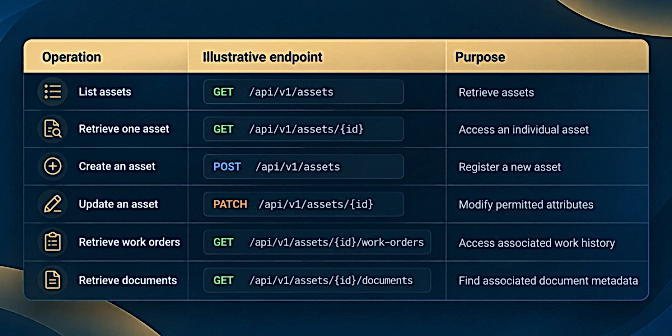
These endpoint patterns are examples only. They should not be interpreted as actual Inflewz API routes or a claim that these endpoints are currently available.
Consistent Resource Design
API resources should reflect clear business concepts and maintain predictable naming conventions.
An asset identifier should remain stable across related API operations. A client should not need to guess whether a maintenance record refers to an asset by its name, serial number, or an inconsistent internal label.
Where relationships are exposed through the API, the contract should explain how associated resources are represented and retrieved.
Validation and Error Handling
An API should define what happens when a request contains invalid data, references an unknown asset, conflicts with an existing record, or attempts an unauthorised operation.
Clear validation errors help integrators identify and resolve problems without repeatedly submitting the same incorrect request.
Consistent error formats, appropriate HTTP status codes, and useful diagnostic information improve integration reliability.
Pagination and Filtering
Enterprise asset inventories can contain substantial numbers of records.
Returning every asset in a single response is often impractical. Pagination allows clients to retrieve manageable portions of a dataset, while filtering and sorting help them find the records they need.
For example, a maintenance application might request assets at a particular facility with a specific operational status.
The exact query parameters depend on the API contract, but the design goal is consistent: make data retrieval predictable and efficient as the volume of information grows.
Authentication and Authorisation
Not every integration should have unrestricted access to every asset or operation.
Authentication establishes the identity of the caller. Authorisation determines which resources and actions that identity is permitted to access.
A well-designed enterprise API should apply appropriate access controls, validate incoming requests, protect sensitive information, and record relevant activities according to the organisation's security and audit requirements.
6. Connecting the Asset Data Model to Enterprise Systems
Assets rarely exist in isolation from the rest of the business.
Procurement systems may contain purchase orders and supplier information. Enterprise resource planning platforms may hold financial and inventory records. Maintenance applications may manage work orders, while identity systems control user access.
Integrating these systems requires more than connecting two endpoints.
The underlying data must have compatible meanings, identifiers, and lifecycle rules.
Master Data and System Ownership
One of the first integration questions is determining which system owns each piece of information.
For example, a procurement system might be authoritative for purchase orders, while an asset management platform maintains operational asset records.
If both systems independently update the same fields without clear ownership rules, conflicting values can emerge.
A master data strategy establishes which system is responsible for creating and maintaining particular records, how identifiers are mapped, and how changes are synchronised.
Data Mapping and Transformation
Different applications may use different names or structures for equivalent concepts.
One system might call a field asset_tag, while another uses equipment_number. One may represent a location using a hierarchy, while another uses a flat location code.
An integration layer can map these representations into the receiving system's expected format.
However, syntactic compatibility is not enough. The systems must also agree on business meaning, permitted values, time conventions, and status transitions.
Event-Driven Integration
Some integrations benefit from notifying other systems when important events occur.
Examples include an asset being commissioned, a work order being completed, or a maintenance status changing.
An event-driven approach can reduce the need for frequent polling, provided that the architecture supports reliable event delivery, retry handling, and reconciliation.
Not every workflow needs event-driven infrastructure. Scheduled synchronisation may be sufficient for less time-sensitive exchanges.
The appropriate approach depends on the integration's latency requirements, complexity, reliability expectations, and operational cost.
7. Data Quality, Governance, and Traceability
A technically sound schema cannot compensate for unreliable source data.
Duplicate assets, inconsistent classifications, missing identifiers, and outdated location records can undermine the value of even a well-designed system.
Data governance defines how these problems are prevented, detected, and corrected.
Establishing Data Ownership
Each important data domain should have a clear owner.
That includes responsibility for asset creation, classification, location changes, record correction, and retirement.
Ownership should also define who can approve changes to critical fields and how disputed or incomplete information is resolved.
Maintaining Data Lineage
Data lineage helps explain where information originated and how it changed as it moved between systems.
For enterprise asset management, this can include identifying the source of an imported asset record, the system that updated a field, and the relevant integration or business process.
Where required, change history should capture the relevant actor, timestamp, previous value, new value, and reason for change.
The level of detail should reflect operational, contractual, regulatory, and audit requirements.
Managing the Full Asset Lifecycle
The asset data model should support changes across the asset's lifetime.
An asset may progress through acquisition, commissioning, operation, maintenance, relocation, refurbishment, and retirement.
These transitions should be represented using defined states and controlled processes rather than relying on free-text descriptions alone.
Retirement, for example, should not automatically mean deleting every historical record. Organisations may need to retain service history, financial information, inspection evidence, or other records according to applicable retention policies.
A lifecycle-aware model preserves context while ensuring that the current operational status remains accurate.
8. Designing for Scale Without Losing Clarity
Enterprise asset data models must support changing business requirements, increasing record volumes, and additional integrations.
However, adding complexity prematurely can make the model harder to understand and maintain.
A practical architecture begins with the entities, relationships, and queries required by actual workflows.
Performance should then be evaluated against expected workloads.
Indexes can improve retrieval for frequently used queries. Pagination can limit response sizes. Caching may help for appropriate read-heavy workloads. Reporting databases or analytical pipelines can separate complex reporting from transactional operations when justified.
For multi-site organisations, tenant isolation and access boundaries may also be important architectural requirements.
The design must ensure that users and integrations access only the records they are authorised to see.
Schema evolution deserves equal attention. New asset categories, fields, relationships, and API versions should be introduced in a way that minimises disruption to existing integrations.
Backward compatibility, migration planning, validation, and clear versioning policies help keep the platform maintainable as requirements change.
The objective is not to build the most complicated model possible. It is to build a model that remains understandable, dependable, and adaptable as the organisation grows.
9. What Technical Buyers Should Evaluate
For enterprise buyers, an asset data model is not merely a backend implementation detail. It affects integration effort, reporting quality, governance, and the ability to support operational workflows.
When evaluating an asset management platform, technical and operational teams should examine several areas.
Schema clarity: Are core entities and relationships understandable and documented?
Data integrity: How does the system prevent duplicate records, invalid references, and inconsistent values?
Lifecycle support: Can the model represent commissioning, relocation, maintenance, and retirement without losing historical context?
API documentation: Are available resources, request formats, authentication requirements, error responses, and versioning policies clearly defined?
Integration readiness: Can the platform exchange information with the organisation's existing systems using supported interfaces?
Access control: Can permissions be applied appropriately to users, integrations, and relevant data?
Traceability: Can authorised users understand important record changes and retrieve the evidence required by their workflows?
Scalability: Has the architecture been evaluated against realistic record volumes, concurrency, and reporting requirements?
These questions help distinguish a system that simply stores asset information from one designed to support connected enterprise operations.
The answers should be established through product documentation, architecture discussions, demonstrations, and technical validation rather than assumed from feature descriptions alone.
Conclusion: The Data Model Is the Foundation of Asset Intelligence
An effective asset data model brings structure to the information that accumulates throughout an asset's lifecycle.
It defines asset identity, establishes relationships with locations and maintenance records, connects supporting documents, and provides a foundation for APIs and enterprise integrations.
Its value extends beyond database design. Consistent identifiers, clear ownership, reliable relationships, appropriate access controls, and traceable changes help organisations build a more dependable operational picture.
For Inflewz, the broader architectural conversation is about how asset lifecycle management can be supported by structured information and connected workflows.
The most useful technical questions are not simply how many fields a platform stores or how many endpoints it exposes. They concern whether the model accurately represents the organisation's assets, preserves the relationships that matter, and makes information accessible to the systems and people that need it.
The principle is simple: asset intelligence begins with structured data, becomes useful through relationships, and becomes operationally valuable when that information can be accessed, trusted, and acted upon.
That is the role of the asset data model: providing the foundation on which connected asset management can be built.