
Why most audits become expensive projects

Dhananjay Chandra Kulal
Author
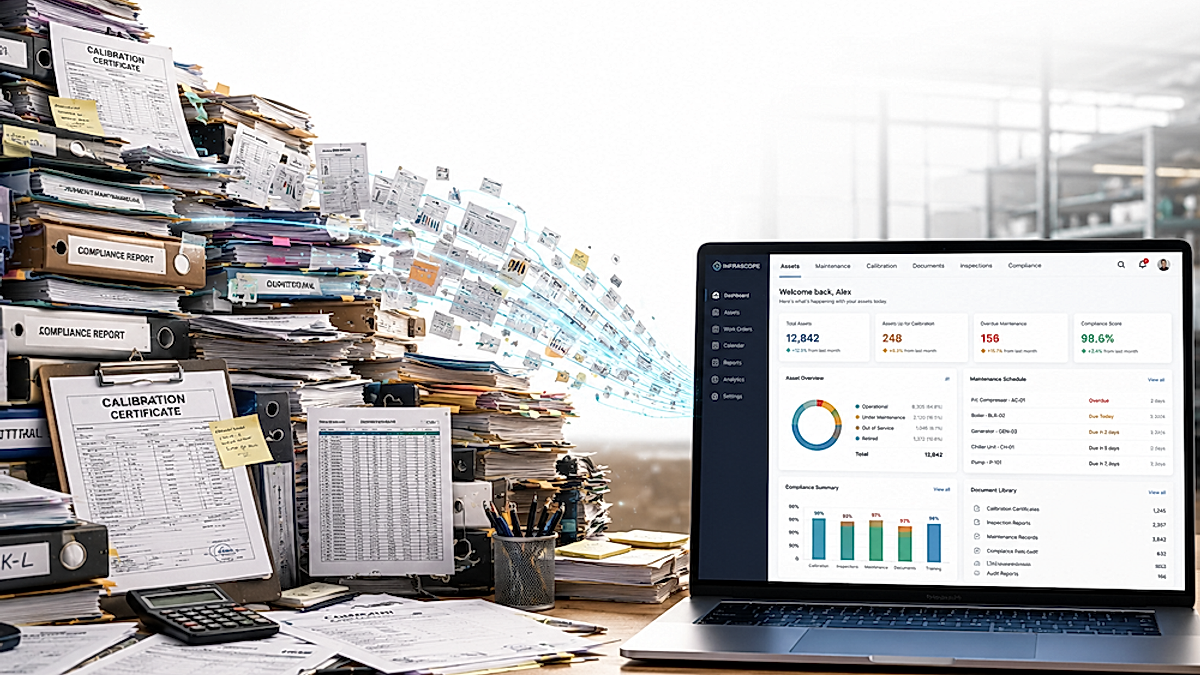
Every audit starts with the same request: "Show us maintenance records."
Then comes:
- Calibration certificates
- Inspection reports
- Asset movement history
- Equipment ownership
- Service logs
- Training records
- Approval history
- Supporting documents
For many organizations, this triggers weeks of manual work. Maintenance teams search through folders. Quality teams chase certificates. Operations teams verify asset locations. Engineering teams reconstruct maintenance history. Compliance teams compile evidence from multiple systems. The audit itself isn't consuming the time. Finding the evidence is. This is exactly the operational problem Inflewz positions itself to solve under its Compliance, Audit & Operational Visibility pillar: compliance should emerge naturally from everyday operations rather than being treated as a separate exercise.
Audit readiness is an operational outcome
The biggest misconception is that audit readiness is another project. It isn't. Audit readiness is the natural outcome of disciplined operational execution.
If every maintenance activity...If every inspection...If every calibration...If every document...If every asset movement...
...is recorded as part of normal operations, then an audit becomes a reporting exercise—not a reconstruction exercise.
Operational visibility creates audit readiness automatically.
The five capabilities that eliminate audit panic
Most successful organizations have these five operational capabilities embedded into their asset management process.
1. Complete calibration history
Calibration failures rarely happen because equipment wasn't calibrated. They happen because nobody can prove it. Auditors typically ask:
- When was this instrument calibrated?
- Who performed it?
- Which standard was used?
- Where is the certificate?
- When is the next calibration due?
If answers exist across Excel sheets, email attachments, and physical files, the audit slows immediately. Instead, every calibrated asset should maintain:
- Calibration schedule
- Certificate history
- Technician details
- Due dates
- Approval records
- Previous calibration cycles
Healthcare laboratories, manufacturing plants, and quality-controlled industries particularly depend on maintaining continuous calibration traceability rather than searching for certificates during audits.
2. Inspection trails with proof
Inspection checklists alone aren't enough. Auditors increasingly expect evidence. Every inspection should answer:
- Who inspected it?
- When?
- What was observed?
- Were defects identified?
- Were corrective actions raised?
- Were photographs attached?
- Was the issue closed?
Without this chain, inspections become difficult to verify. With timestamped records, digital approvals, and photographic evidence, inspections become fully traceable. The inspection record becomes its own audit evidence.
3. Asset movement history
One common audit question sounds simple: "Where has this asset been?"
For many organizations, that's surprisingly difficult to answer. Assets move between:
- Plants
- Warehouses
- Departments
- Production lines
- Laboratories
- Contractors
- Service vendors
If movement isn't recorded continuously, organizations lose:
- accountability
- utilization history
- maintenance context
- ownership records
Movement history should show:
- Previous locations
- Current location
- Transfer approvals
- Custodian changes
- Time stamps
- Responsible personnel
This creates complete operational traceability instead of relying on memory.
4. Documents linked directly to assets
One of the largest audit delays comes from disconnected documentation. Documents often live inside:
- Shared drives
- Email attachments
- Filing cabinets
- ERP folders
- Local desktops
Finding them becomes a separate investigation. Instead, every asset should maintain its own operational record with linked documentation such as:
- User manuals
- Warranty documents
- AMC contracts
- Inspection reports
- Calibration certificates
- Purchase records
- SOPs
- Risk assessments
- Compliance approvals
When documentation is linked directly to the asset, retrieving evidence becomes immediate rather than manual. Inflewz's document management approach emphasizes centralized repositories where operational documents remain attached to lifecycle records rather than existing as isolated files.
5. Operator competency and training records
Compliance isn't only about equipment. It's also about people. Auditors frequently verify:
- Who operated this equipment?
- Were they trained?
- When was the last certification?
- Was refresher training completed?
- Are operator approvals current?
Many organizations maintain training records inside HR systems that never connect with operational assets. The result is fragmented evidence. Linking operators, certifications, and assets provides a complete operational picture. Every maintenance action, inspection, and operation becomes attributable to qualified personnel. That dramatically improves accountability.
Why audits fail before they even begin
Most audit delays don't occur inside the meeting room. They occur weeks before. Common patterns include:
Spreadsheet-driven asset registers
Different departments maintain different versions. Nobody knows which one is correct.
Manual document collection
Certificates arrive from vendors through email. Service reports remain in folders. Approvals stay inside WhatsApp conversations.
Disconnected maintenance systems
Maintenance records exist separately from inspections. Inspection records exist separately from calibration. Calibration exists separately from compliance. The auditor has to connect them manually.
Missing ownership
Assets often have:
- no assigned custodian
- outdated department mapping
- unknown location
- unclear responsibility
Ownership gaps become audit findings.
No historical visibility
Many systems only show today's status. Auditors need historical evidence. Operational history matters just as much as operational status.
Audit readiness starts long before the audit
Organizations often prepare for audits like preparing for an exam. The better approach is maintaining operational discipline every day. When maintenance is documented immediately... When inspections close with evidence... When calibration certificates are automatically linked... When documents stay attached to assets... When ownership changes are recorded...
...the audit becomes largely automatic.
Audit readiness is simply operational visibility accumulated over time.
A practical audit-readiness checklist
Use this five-point checklist to assess whether your organization is genuinely audit-ready.
Calibration certificates linked to every regulated asset □
Complete inspection history with approvals and evidence □
Timestamped movement history for every asset □
All compliance documents attached to asset records □
Operator training and competency linked to equipment □
If multiple boxes remain unchecked, your next audit will probably require significant manual preparation.
What audit-ready organizations do differently
High-performing operations teams don't maintain compliance as a separate function. Instead, they integrate compliance directly into everyday operational workflows. Maintenance creates evidence. Inspections create evidence. Calibration creates evidence. Document approvals create evidence. Task completion creates evidence.
By the time an auditor arrives, the evidence already exists. Nothing needs to be reconstructed. That's why some organizations complete audits in days while others spend weeks preparing. The difference isn't the auditor. It's the quality of operational visibility.
Final thought
Organizations don't become audit-ready during audit season. They become audit-ready every time an inspection is completed, a calibration certificate is uploaded, a maintenance task is closed, or an asset changes hands. When operational records are connected, traceable, and continuously maintained, audit readiness stops being a project and becomes a natural byproduct of how the business operates every day.