
Asset register inaccuracies: The hidden cost of operational blind spots

Dhananjay Chandra Kulal
Author
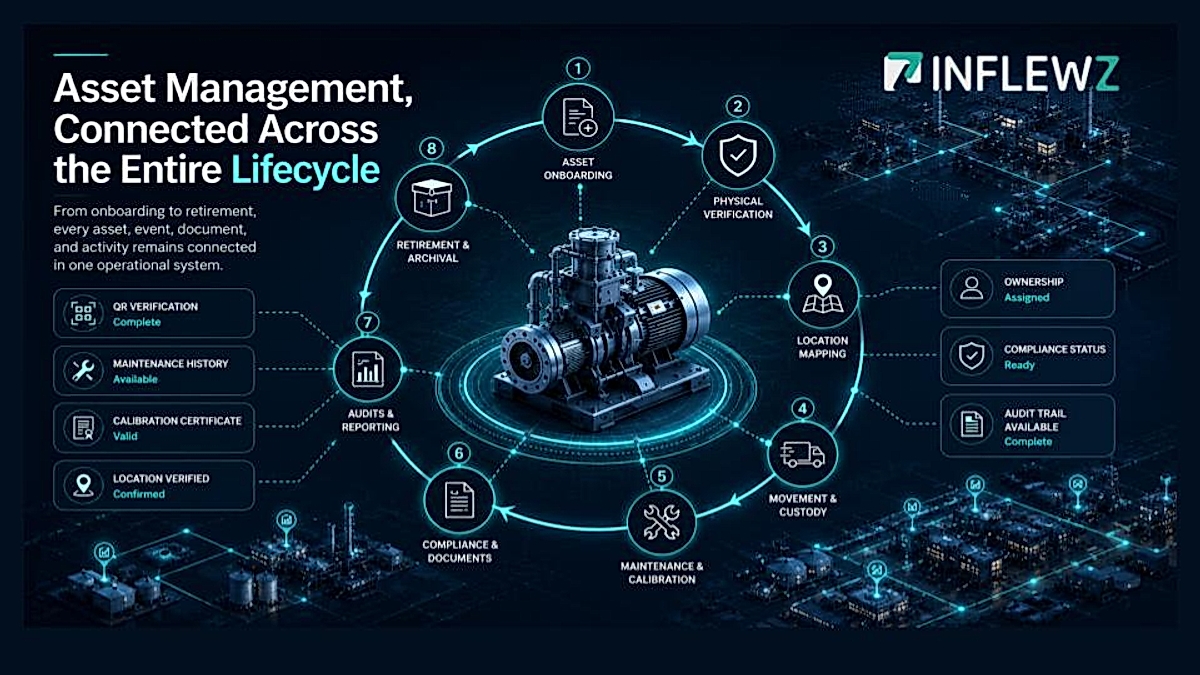
Most organizations don't have an asset problem. They have an asset visibility problem.
A maintenance manager at a manufacturing facility recently described a familiar situation: the asset register showed 1,247 active assets. A physical verification exercise found only 1,131. Some assets had been relocated without documentation. Others had been retired but remained on the books. Several critical assets existed on the shop floor but never appeared in the register at all.
The gap wasn't caused by theft or negligence. It was the result of years of disconnected processes, manual updates, spreadsheet dependencies, and fragmented ownership.
When the asset register stops reflecting operational reality, every decision built on that data becomes less reliable. Maintenance planning, compliance reporting, capital budgeting, audits, and operational forecasting all begin with an inaccurate foundation.
The real cost is not the missing assets themselves. The real cost is the operational uncertainty they create.
The asset register is supposed to be the source of truth
Every enterprise relies on an asset register to answer a few basic operational questions:
- What assets do we own?
- Where are they located?
- Who is responsible for them?
- What condition are they in?
- What maintenance or compliance activities are due?
The problem is that many organizations treat the asset register as an administrative record rather than a living operational system.
Over time, assets move between locations. Departments change ownership structures. Equipment is upgraded, replaced, or retired. Contractors perform work that never gets reflected in central records. Temporary fixes become permanent workarounds. The result is gradual data drift.
What begins as a small discrepancy eventually becomes a significant operational blind spot.
In manufacturing environments, this can lead to maintenance teams servicing equipment based on outdated information. In healthcare environments, calibration records may no longer align with actual equipment deployments. In logistics operations, assets can become effectively invisible despite still being operational.
The asset register still exists.
It simply no longer reflects reality.
The hidden consequences of asset register inaccuracies
Most organizations only discover asset register issues when a major event forces verification, such as:
- An audit
- A compliance inspection
- A maintenance shutdown
- A capital expenditure review
- A merger or acquisition
By that point, the consequences have already accumulated.
1. Maintenance becomes reactive
Preventive maintenance depends on accurate asset records. When asset locations, ownership details, or service histories become unreliable, maintenance schedules become difficult to execute consistently. Technicians spend time searching for equipment rather than servicing it. Work orders are assigned to the wrong teams. Critical assets miss inspection cycles.
What appears to be a maintenance problem is often a visibility problem.
2. Compliance risk increases
Many industries require documented evidence of inspections, calibrations, certifications, and maintenance activities. If asset records are incomplete or inaccurate, generating audit-ready documentation becomes difficult. Teams begin assembling evidence manually. Spreadsheets replace traceable workflows. Documentation gaps emerge. Audit preparation becomes a project instead of a routine process.
3. Capital planning becomes unreliable
Asset replacement decisions depend on understanding utilization, condition, age, and performance. When asset records are inaccurate, organizations often make investment decisions using incomplete information. Some assets are replaced too early. Others remain in service long after they should have been retiredBudget allocation becomes less precise.
4. Operational accountability weakens
When ownership is unclear, accountability disappears. Without reliable records showing who owns an asset, where it is located, and what activities have been completed, operational issues become difficult to resolve. Problems remain unresolved because nobody has a complete picture.
Asset visibility breaks down when systems don't talk to each other
Most asset register inaccuracies do not originate from missing assets. They originate from disconnected information. As organizations grow, asset data becomes scattered across multiple systems, teams, and workflows. A spreadsheet tracks inventory. A maintenance platform manages work orders. An ERP stores procurement records. A document repository holds compliance certificates. Operations teams maintain local records and site-level updates. Each system captures part of the asset lifecycle. None captures the entire lifecycle. As a result, asset information gradually falls out of sync.
An asset may be relocated without the register being updated. A maintenance activity may be completed without being reflected in compliance records. Equipment may be retired in one system while remaining active in another.
Over time, these small discrepancies accumulate into significant visibility gaps. The challenge is not a lack of data. The challenge is the absence of a connected operational environment where asset information, maintenance activities, compliance records, ownership, and documentation remain synchronized throughout the asset lifecycle.
Without that connection, organizations are left managing multiple versions of reality. And when every system tells a different story, operational teams spend more time validating information than acting on it.
The organizations with the highest asset visibility are not necessarily the ones with the most technology.
They are the ones that establish a single operational system where asset information, maintenance activities, compliance records, inspections, ownership, and documentation remain connected throughout the asset lifecycle.
A practical framework for restoring asset register accuracy
Organizations that successfully improve asset visibility typically follow five steps.
1. Establish a verified baseline
Before improving asset intelligence, organizations must first verify physical reality.
Conduct a structured asset verification exercise.
Confirm:
- Asset existence
- Asset location
- Asset condition
- Ownership
- Operational status
This creates a reliable starting point.
2. Create a centralized asset registry
Asset information should not be distributed across multiple disconnected records.
A centralized registry becomes the operational system of record. Every asset should have:
- Unique identification
- Ownership assignment
- Location context
- Maintenance history
- Compliance documentation
- Lifecycle status
3. Connect operational workflows
Asset records should update automatically as operational activities occur.
- Maintenance activities
- Inspections
- Calibrations
- Approvals
- Transfers
- Retirements
The asset register should evolve alongside operations.
4. Build accountability into the process
- Every asset requires ownership
- Every activity requires verification
- Every change requires traceability
Without accountability, data drift eventually returns
5. Continuously validate asset reality
Asset visibility is not a one-time project. Organizations should implement recurring verification processes supported by
- Digital records, inspections
- Mobile workflows
- Location intelligence
The objective is simple:
Ensure the system always reflects operational reality.
What operationally mature organizations do differently
Organizations with strong asset governance approach asset visibility differently. They treat the asset register as an operational platform rather than a compliance document.
Asset data is connected to:
- Maintenance workflows
- Compliance activities
- Inspection schedules
- Calibration records
- Location intelligence
- Document control
- Operational accountability
This creates a living operational system instead of a static database.
As a result:
- Audits become faster
- Maintenance becomes more predictable
- Compliance becomes easier to manage
- Capital planning becomes more accurate
- Operational decisions become more confident
Most importantly, teams regain trust in the data they use every day.
From records to operational intelligence
The goal is not simply to maintain an accurate asset register. The goal is to create complete operational visibility. An accurate asset register provides the foundation. Operational intelligence is what sits on top of it. Organizations that understand this distinction move beyond basic asset tracking and gain the ability to manage maintenance, compliance, utilization, and performance from a single source of truth.
An asset register records assets. Operational intelligence creates visibility, accountability, and traceability.
If your team is still relying on spreadsheets, WhatsApp, disconnected systems, and manual verification exercises to manage assets, book a 30-minute demo to see how a unified operational platform improves asset visibility, compliance readiness, and lifecycle traceability without the inefficiencies of fragmented operations.