
63% Less downtime through connected asset visibility

Dhananjay Chandra Kulal
Author
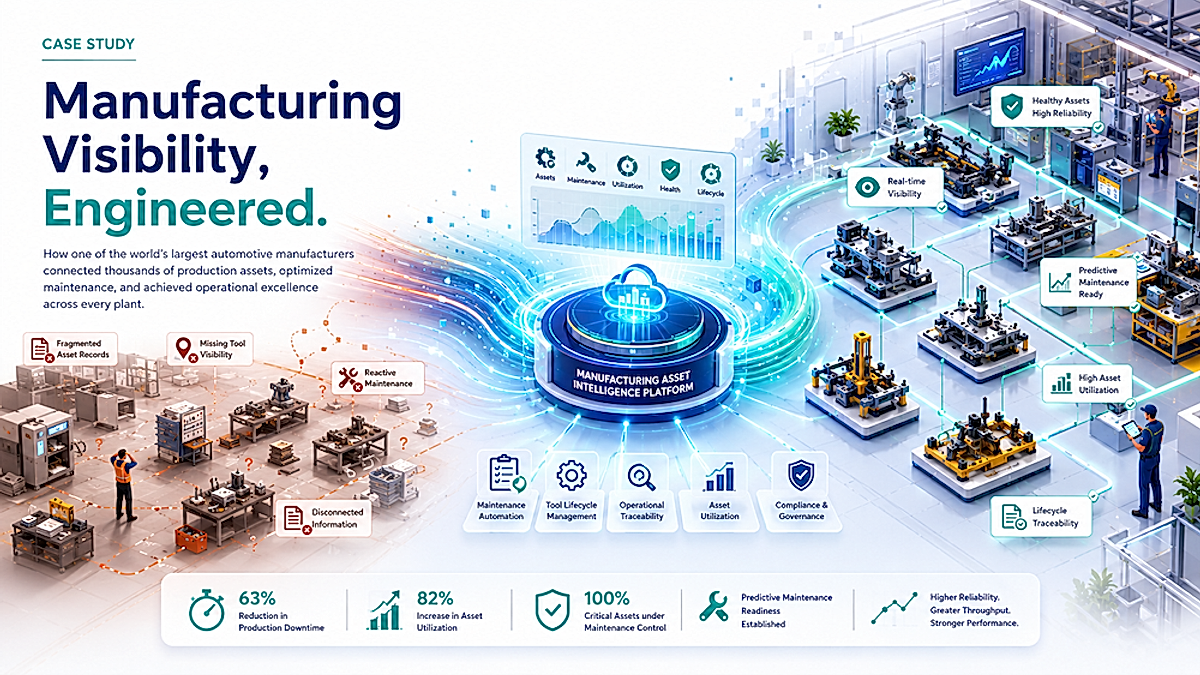
Manufacturing visibility, engineered.
In automotive manufacturing, production efficiency depends on far more than machines alone.
Behind every production line is an ecosystem of high-value tools, jigs, fixtures, dies, gauges, and manufacturing assets that must be available, maintained, and operational at precisely the right time. When visibility into these assets is lost, production schedules become vulnerable.
A missing tool can delay an assembly line. An overdue maintenance activity can create unexpected downtime. A failed jig can impact quality, throughput, and delivery commitments simultaneously. This was the challenge faced by one of the world's largest automotive manufacturers.
Operating at enormous production scale, the organization required complete visibility into thousands of manufacturing assets distributed across multiple production environments. Despite significant operational maturity, the company struggled with disconnected asset information, manual maintenance processes, and limited visibility into the condition and availability of critical manufacturing tools.
To address these challenges, the organization partnered with Inflewz to establish a centralized asset management and maintenance platform designed specifically for tool-intensive manufacturing operations.
The objective was simple:
Create a single operational system capable of connecting asset visibility, maintenance management, utilization monitoring, and lifecycle traceability.
The challenge
Automotive manufacturing environments are highly dependent on specialized production assets. Unlike standard enterprise equipment, these assets directly influence production output, quality performance, and operational continuity. Every minute of downtime carries measurable financial consequences.
As production volumes increased, the organization encountered several operational bottlenecks that limited efficiency and reduced visibility into asset performance.
Limited visibility into high-value tools and jigs
Thousands of manufacturing tools were being used across multiple production areas. Although these assets were critical to production, visibility into their status and location was fragmented.
Production teams frequently struggled to determine:
- Where a specific tool was located.
- Whether it was available for use.
- Its maintenance history. I
- Its calibration status.
- Its current operational condition.
Without centralized visibility, locating assets often required manual verification. The result was unnecessary delays and operational inefficiencies.
When every asset is visible, every operation becomes more predictable.
Production downtime caused by unavailable assets
Production schedules depend on the availability of the correct tooling at the correct time.
When tools were unavailable, misplaced, undergoing maintenance, or not returned to their designated locations, production activities were delayed. These delays had a direct impact on:
- Production throughput.
- Shift productivity.
- Resource utilization.
- Manufacturing efficiency.
As the organization expanded operations, the cost of downtime became increasingly significant.
No real-time insight into asset health
Maintenance teams lacked a consolidated view of equipment condition and service history. Information relating to inspections, repairs, maintenance activities, and operational performance was spread across multiple systems and records.
This created challenges when attempting to identify:
- Assets approaching failure.
- Frequently repaired tools.
- Recurring maintenance issues.
- Equipment requiring replacement.
- Assets operating beyond recommended service intervals.
As a result, maintenance activities were often reactive rather than preventive.
Delays in preventive maintenance execution
Preventive maintenance scheduling relied heavily on manual processes. Technicians used spreadsheets, records, and periodic reviews to determine service requirements. This created multiple challenges. Maintenance schedules were difficult to manage at scale. Service activities could be missed. Maintenance planning lacked operational visibility. Asset health assessments were often based on incomplete information. The organization recognized that maintenance needed to become data-driven rather than schedule-driven.
The Inflewz approach
Inflewz approached the project as an operational visibility initiative rather than a traditional software deployment.
The objective was not simply to digitize asset records. The objective was to create a connected manufacturing asset intelligence system capable of supporting production operations, maintenance teams, and plant leadership simultaneously. The deployment focused on five strategic areas:
- Asset visibility.
- Tool lifecycle management.
- Maintenance automation.
- Operational traceability.
- Continuous asset health monitoring.
Establishing a centralized manufacturing asset registry
The first phase involved creating a unified repository for all manufacturing assets. Critical tools, jigs, fixtures, gauges, production equipment, and supporting manufacturing assets were onboarded into a centralized system.
Each asset was assigned structured operational information including:
- Asset identity.
- Tool classification.
- Ownership.
- Location.
- Production area.
- Maintenance history.
- Service records.
- Lifecycle status.
- Utilization information.
The organization now had a single source of truth across its manufacturing operations. Instead of relying on spreadsheets and departmental records, every stakeholder could access the same asset intelligence platform.
Creating real-time operational visibility
Once assets were digitized, the next objective was operational visibility. Production teams required immediate access to asset availability and status. Maintenance teams required insight into equipment condition. Plant leadership required visibility into utilization and performance trends. Inflewz connected asset records, operational activities, and maintenance information into a unified environment.
For the first time, stakeholders could understand not only where assets existed but also how effectively they were being utilized. Asset management shifted from record keeping to operational decision-making.
Digitizing maintenance operations
Maintenance management became a core component of the implementation. Preventive maintenance schedules were configured based on operational requirements, usage patterns, and service intervals. Instead of relying on manual reminders and spreadsheets, maintenance workflows became structured and automated.
- Service activities were planned proactively.
- Work orders were generated automatically.
- Maintenance histories were recorded digitally.
- Technicians gained complete visibility into pending, active, and completed maintenance activities.
This created a consistent maintenance process across production environments.
Introducing lifecycle traceability
Manufacturing assets generate significant operational data throughout their lifecycle.
Maintenance events—>Repair—>Inspections—>Utilization patterns—>Service history—>Ownership changes.
Inflewz connected these activities into a complete asset lifecycle record. Every interaction with an asset became traceable. When teams needed information, they no longer searched through historical records. The information already existed within the operational workflow. This improved both decision-making and compliance readiness.
Building the foundation for predictive maintenance
One of the most important outcomes of the deployment was the creation of a maintenance intelligence foundation.
By centralizing maintenance history, utilization patterns, service activities, and asset condition information, the organization established the operational groundwork required for predictive maintenance initiatives.
The recommendation from the project was clear.
Move beyond calendar-based maintenance.
Use asset data, utilization trends, and IoT-enabled monitoring to predict failures before they affect production.
This would further improve reliability while reducing maintenance costs.
The difference between reactive operations and reliable production is visibility.
Results
The deployment delivered measurable operational improvements across manufacturing operations.
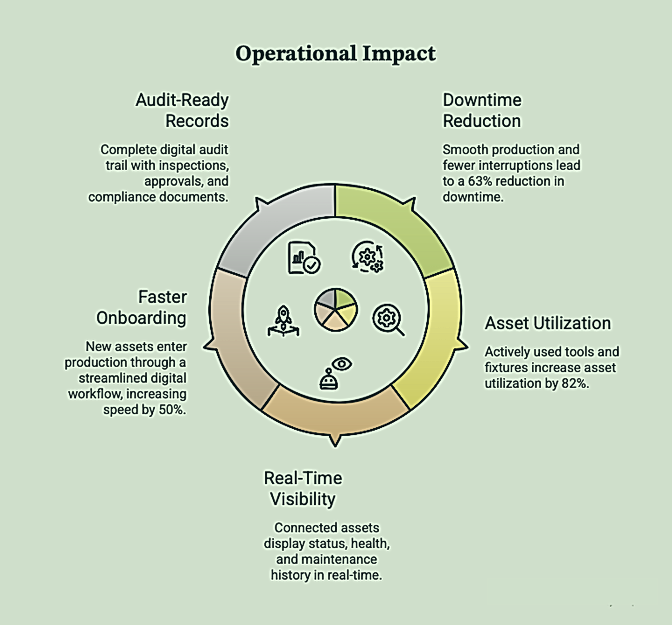
63% reduction in downtime
The combination of improved visibility, structured maintenance workflows, and better asset availability significantly reduced production interruptions. Maintenance teams could identify and resolve issues before they escalated into operational failures. Production teams experienced greater consistency and reliability.
82% increase in asset utilization
Centralized visibility allowed the organization to maximize the use of existing manufacturing assets.
Instead of purchasing additional tooling due to limited visibility, teams could identify available resources and allocate them effectively.
Utilization improved dramatically across production environments.
Real-time visibility across asset operations
The organization gained immediate access to:
- Asset status.
- Asset health.
- Service history.
- Maintenance records.
- Operational availability.
This visibility improved planning, coordination, and operational decision-making across departments.
50% faster onboarding of manufacturing assets
New tools and production assets could be onboarded into operations significantly faster.
Standardized processes reduced administrative effort while improving data accuracy and lifecycle traceability.
100% audit-ready asset records
Every maintenance activity, inspection, approval, and service event became digitally documented.Audit preparation no longer required manual collection of records. The organization could demonstrate complete traceability across the manufacturing asset lifecycle at any time.
Preventive maintenance established as standard practice
Maintenance operations shifted from reactive interventions to planned asset care. Instead of waiting for failures to occur, teams could proactively maintain assets based on operational requirements and service history. This reduced risk while extending asset lifespan.
Business impact
The most significant outcome was not simply improved maintenance performance. It was operational predictability. Production teams gained confidence in asset availability. Maintenance teams gained confidence in equipment health. Leadership gained confidence in operational reporting. Asset information became connected to manufacturing performance.
What had previously been isolated operational data became actionable intelligence.
Conclusion
Manufacturing downtime is rarely caused by a single equipment failure. More often, it is the result of limited visibility, fragmented maintenance processes, and disconnected operational data. For this global automotive manufacturer, solving those challenges required more than tracking assets. It required creating a connected system that linked visibility, maintenance, utilization, and lifecycle intelligence.
By implementing a centralized manufacturing asset management platform, the organization achieved real-time visibility, significantly reduced downtime, improved asset utilization, and established the operational foundation for predictive maintenance. The result was not simply better asset tracking. It was a more reliable, efficient, and data-driven manufacturing operation.