
Returnable Assets Are a Logistics Problem Hiding in Plain Sight

Dhananjay Chandra Kulal
Author
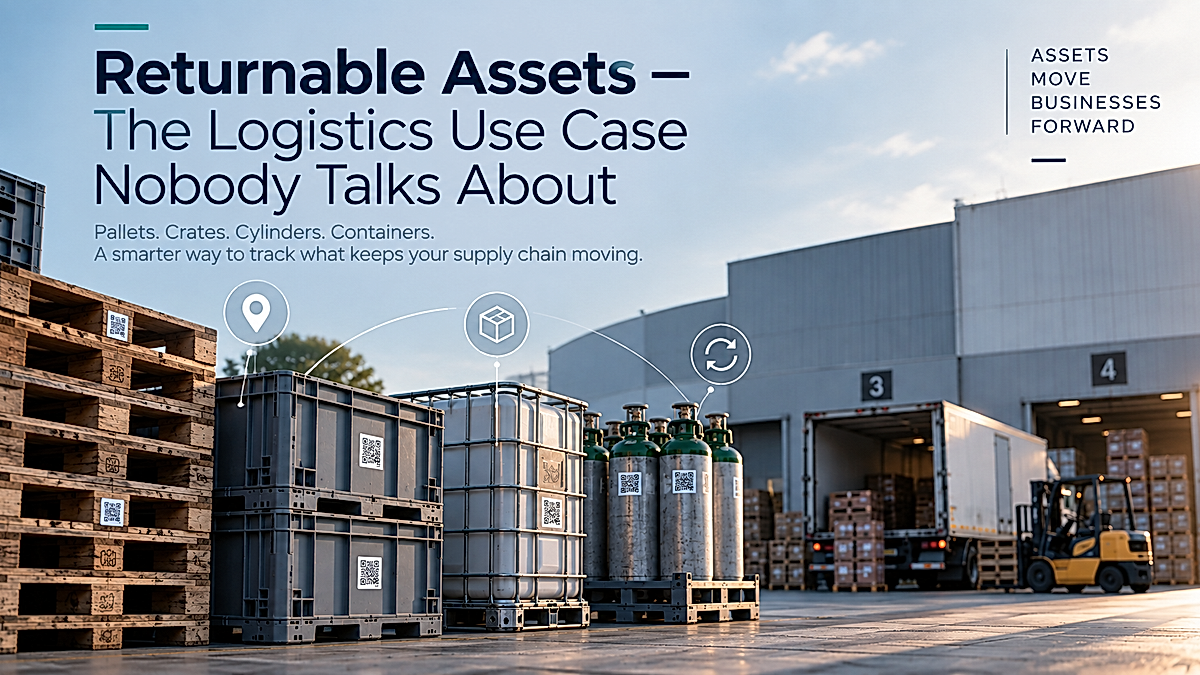
Logistics conversations usually focus on the movement of goods.
Where is the shipment?
Has it reached the customer?
When will it arrive?
Is the delivery on schedule?
But there is another category of movement that often receives far less attention: the movement of the assets used to move the goods themselves.
Pallets. Crates. Containers. Gas cylinders. IBCs. Trolleys. Drums. Reusable packaging. Industrial handling equipment.
These assets leave one location, travel through multiple points in a supply chain, reach a customer or downstream facility, and are expected to come back.
That makes them returnable assets.
Unlike disposable packaging, returnable assets have a continuing economic life. The same pallet may be used dozens of times. A cylinder can circulate between a manufacturer, distributor and customer repeatedly. A reusable crate can move between warehouses and production facilities for months or years.
The problem is simple:
Companies often know where their products are, but not where their reusable logistics assets are.
That gap creates a surprisingly large operational challenge.
This is where returnable asset tracking becomes important.
What Are Returnable Assets?
A returnable asset is a physical item designed to be used repeatedly within a supply chain or operating network.
Common examples include:
- Pallets
- Plastic crates
- Metal crates
- Gas cylinders
- Reusable containers
- IBC tanks
- Drums
- Roll cages
- Industrial bins
- Reusable packaging
- Transport racks
- Material-handling equipment
The defining characteristic is not simply that the item is valuable. It is that the asset is expected to return and circulate.
A basic flow may look like this:
Manufacturer → Warehouse → Distributor → Customer → Collection → Manufacturer
Every movement creates another opportunity for the asset to become delayed, misplaced, retained, damaged or incorrectly recorded.
When the network contains thousands of assets moving across multiple locations, manual tracking becomes increasingly difficult.
Why Returnable Assets Are Different From Inventory
Inventory tracking and returnable asset tracking are related, but they are not the same problem.
Inventory is generally tracked because the company needs to know how much stock it has, where that stock is, and when it needs replenishment.
Returnable assets require another layer of visibility.
The business needs to understand:
- Where is the asset?
- Who currently has custody of it?
- When did it leave the previous location?
- How long has it remained there?
- When is it expected to return?
- Has it completed its expected cycle?
- Is it available for another trip?
- Is it damaged or under maintenance?
- How many assets are currently outside the company's control?
This makes returnable assets fundamentally circulation-based. The asset is not simply sitting in a warehouse waiting to be sold or consumed.
It is continuously moving through a network.
The Recovery Economics of Returnable Assets
The economics of returnable assets are built around repeated use.
A company may invest significantly in a fleet of pallets, cylinders, containers or crates because each asset is expected to support multiple operating cycles.
The economic value therefore comes from utilisation over time.
Consider a simplified example.
A company owns 10,000 reusable containers.
If each container completes several cycles every year, the same asset base can support a much larger volume of movement than a single-use packaging model.
But that only works when the containers actually return.
If assets remain with customers for longer than expected, disappear from the network or become unusable, the company may need to purchase additional assets to maintain operational capacity.
The result is a hidden cost.
Instead of asking only:
"How many assets do we own?"
operations teams also need to ask:
"How many assets are actively circulating, where are they, and how efficiently are they completing their cycles?"
That is the foundation of returnable asset management.
The Pallet Problem
Pallets are one of the clearest examples.
A pallet can move from a manufacturing facility to a distributor, then to a retailer or customer. Once the goods are unloaded, the pallet is expected to return or enter another controlled cycle.
But the physical reality can be different. A pallet may remain at a customer location.
It may be transferred to another warehouse. It may be stacked with other pallets. It may be damaged. It may be sent back without the correct documentation.
Or nobody may know exactly where it is.
When this happens across hundreds or thousands of pallets, the organisation can lose visibility without necessarily recognising the problem immediately.
The operational question changes from "Where is my shipment?" to:
"Where is my asset after the shipment has been delivered?"
That is a different tracking requirement.
Crates and Reusable Packaging Have the Same Challenge
Reusable crates are common in manufacturing, automotive, retail, food distribution and other supply chains.
They are particularly useful because they can reduce repeated packaging consumption and standardise material handling.
But their usefulness depends on circulation. Imagine a company supplying components to multiple manufacturing facilities.
Each delivery sends hundreds of reusable crates downstream.
Those crates eventually need to return so they can be used for the next production cycle.
Without visibility, the company may face three problems simultaneously:
- Assets are sitting outside the expected network.
- New assets are being purchased despite existing assets being unavailable.
- Operations teams cannot easily identify where the delay is occurring.
This is why tracking the asset lifecycle matters as much as tracking the shipment lifecycle.
Gas Cylinders: A Higher-Visibility Use Case
Gas cylinders demonstrate another dimension of returnable asset tracking.
A cylinder can move between filling facilities, distributors, industrial customers, hospitals, laboratories or other users.
The cylinder itself remains an asset even after the gas has been consumed.
Its lifecycle may therefore include:
Filling → Dispatch → Customer → Empty → Collection → Inspection → Refill → Dispatch
Each stage matters.
A cylinder that remains at a customer site longer than expected affects asset availability. A cylinder awaiting inspection affects operational capacity.
A cylinder that cannot be located creates both financial and operational uncertainty.
For such assets, knowing the current status and lifecycle stage can be just as important as knowing the physical location.
Containers Are More Than Boxes
Industrial containers can carry significantly more value than ordinary packaging.
They may be designed for specific products, dimensions or handling requirements.
A container can therefore represent both:
- a physical investment, and
- a component of the operating system.
When containers are unavailable, companies may have to use alternatives, delay dispatches or acquire additional containers.
This is why returnable asset tracking should not be viewed simply as a location-tracking exercise. It is about understanding the complete asset lifecycle.
The Cost of Poor Asset Recovery
Poor recovery creates several types of cost.
1. Replacement cost
If assets cannot be recovered, additional assets may need to be purchased.
2. Working capital
Capital remains tied up in assets that are outside the expected operating cycle.
3. Lower utilisation
An asset sitting unused at the wrong location is not generating operational value.
4. Operational delays
A shortage of available pallets, crates or containers can affect dispatch and production schedules.
5. Manual reconciliation
Teams may spend significant time calling customers, checking spreadsheets, reconciling records and searching for missing assets.
6. Poor accountability
Without a reliable movement history, it becomes difficult to determine where an asset was transferred or where a delay occurred. The individual losses may appear small.
Across a large asset fleet, however, they can accumulate.
Why Spreadsheets Struggle at Scale
Many organisations start with simple tracking systems.
An Excel sheet might contain:
| Asset ID | Location | Customer | Dispatch Date | Expected Return |
| A1023 | Customer A | Customer A | 10 Sept | 17 Sept |
| A1024 | Customer B | Customer B | 11 Sept | 18 Sept |
This can work when the asset fleet is small.
The challenge begins when assets move frequently between multiple locations. The spreadsheet becomes dependent on manual updates.
- One missed transaction can create an inaccurate record.
- One delayed return can remain invisible.
- One asset transferred between facilities can create a discrepancy.
At scale, the problem is not the spreadsheet itself.
The problem is that the physical world is continuously changing while the record is updated intermittently.
What Returnable Asset Tracking Should Provide
A practical returnable asset tracking system should create visibility across the asset lifecycle.
At a minimum, organisations should be able to understand:
Asset identity
Each asset should have a unique identity that allows its movements and history to be associated with it.
Location
The organisation should be able to identify the asset's current or latest known location.
Custody
The system should indicate which customer, facility, transporter or operating unit currently holds the asset.
Movement history
Every important transfer should contribute to a traceable history.
Cycle time
Businesses should be able to understand how long assets remain within different stages of their journey.
Exceptions
Assets that remain outside expected timelines should be identifiable.
Availability
Operations teams should know how many assets are available for use and how many are currently circulating, under maintenance or awaiting recovery.
This transforms asset tracking from a static register into an operational system.
Inflewz: Tracking the Asset, Not Just the Shipment
This is where Inflewz approaches the problem from an asset lifecycle perspective.
The objective is not simply to record that an asset exists.
The more useful question is:
What is happening to the asset throughout its lifecycle?
For returnable assets, that means creating a structured view of movement, custody, utilisation and recovery.
A tracking model can help organisations connect the different stages:
Asset Creation → Deployment → Movement → Custody → Return → Inspection → Redeployment
Instead of treating every movement as an isolated transaction, the asset becomes a continuous record.
This provides a clearer operational picture.
For example, a business could identify assets that have:
- remained at a customer location beyond an expected period,
- not completed a return cycle,
- moved through an unexpected location,
- been inactive for an extended period,
- entered maintenance,
- become available for redeployment.
The value is not simply knowing the location.
It is knowing what that location means within the asset's lifecycle.
From Tracking to Recovery
The real objective of returnable asset tracking is not to create another dashboard.
It is to improve recovery and utilisation. Consider a company with a large fleet of reusable containers.
Without visibility, the company may respond to shortages by purchasing more containers.
With lifecycle visibility, the company may discover that a significant number of containers are already deployed but sitting outside the expected return cycle.
That changes the operational response. Instead of immediately adding more assets, the organisation can investigate:
Where are the assets?
Why have they not returned?
Who currently holds them?
How long have they been there?
Can they be recovered and redeployed?
This is where tracking becomes an economic tool.
The Bigger Logistics Picture
Returnable assets sit between several operational functions.
They touch:
- Logistics
- Warehouse operations
- Procurement
- Supply chain
- Customer operations
- Finance
- Maintenance
- Asset management
That is why the problem can easily fall between departments.
Logistics may focus on deliveries.
Warehouses may focus on inventory.
Finance may focus on asset value.
Customers may focus on receiving goods.
But the returnable asset moves across all of them.
A lifecycle approach creates a shared operational view.
The Future of Returnable Asset Management
As supply chains become more distributed, asset circulation is becoming harder to manage manually.
Businesses are increasingly looking for better visibility into physical assets without adding unnecessary operational complexity.
The direction is clear:
Track the asset. Understand the lifecycle. Identify exceptions. Improve recovery. Increase utilisation.
The technology behind this can vary depending on the asset, environment and business requirement. Identification technologies, location data, scanning, IoT connectivity and enterprise systems can all contribute to the larger picture.
But technology alone is not the objective. The objective is operational control.
Returnable Assets Deserve Their Own Logistics Strategy
Returnable assets are easy to overlook because they are not always the primary product being transported.
Yet they can directly influence the economics of the logistics network.
A pallet that does not return affects availability.
A crate sitting at the wrong location affects circulation.
A cylinder that cannot be accounted for affects asset utilisation.
A container stuck outside the expected cycle can create unnecessary replacement requirements.
The common thread is simple:
A returnable asset only creates its full value when the organisation can manage its lifecycle.
That requires more than knowing that the asset exists.
It requires visibility into where the asset is, who has it, how long it has been there, what stage it is in, and whether it is ready for its next cycle.
That is the role of returnable asset tracking.
For logistics teams, the next question may not be:
"Where is my shipment?"
It may be:
"Where are all the assets that make my shipments possible?"
And for organisations operating large fleets of reusable logistics assets, that question can be worth asking much earlier.