
Calibration Tracking: The Silent Killer of Biomedical Audits

Dhananjay Chandra Kulal
Author
Biomedical calibration tracking is more than a maintenance task. It is a critical part of equipment reliability, patient safety, and hospital audit readiness. When calibration records are incomplete, certificates are difficult to locate, or service schedules are missed, hospitals can face avoidable documentation gaps precisely when they need to demonstrate control over their medical equipment.
A biomedical engineering team may maintain hundreds or thousands of devices across intensive care units, operating theatres, laboratories, emergency departments, and diagnostic facilities. Each device has its own maintenance history, calibration requirements, service provider, and operational importance. Managing this information manually can quickly become difficult to sustain.
The challenge is not simply getting equipment calibrated. It is ensuring that every relevant record is accurate, current, traceable, and accessible when required.
For hospitals preparing for audits, the difference between having completed the work and being able to demonstrate that work can be significant.
Why Biomedical Calibration Tracking Matters in Healthcare
Medical equipment must perform within its intended specifications to support reliable clinical decisions and safe patient care. Depending on the device, calibration helps establish confidence that measurements and outputs are accurate within defined tolerances.
Consider patient monitors, infusion pumps, defibrillators, ventilators, thermometers, and laboratory instruments. Their performance requirements differ, but they share an important operational need: hospitals must know which devices require calibration, when that work is due, and whether the necessary checks have been completed.
The World Health Organization identifies inspection, preventive maintenance, and performance checks as important components of medical equipment maintenance programmes. India's National Health Systems Resource Centre also publishes guidance covering equipment maintenance, calibration, testing, and asset management.
Sources: WHO medical equipment maintenance guidance and NHSRC biomedical equipment management resources.
Biomedical calibration tracking brings these activities into a coordinated process.
Without a reliable tracking system, teams may struggle to answer basic operational questions:
- Which devices have calibration due dates approaching?
- Which certificates are missing, expired, or awaiting review?
- Which assets are overdue for calibration?
- Which devices require follow-up with an external service provider?
- Can the team retrieve the complete service and calibration history of a specific asset?
- Has equipment that failed a check been appropriately assessed before returning to service?
These are not merely administrative questions. They determine whether equipment records can support day-to-day operations and audit preparation.
Calibration Certificates: A Frequently Overlooked Audit Gap
A calibration activity is only one part of the evidence trail. The associated documentation must also be maintained in a way that allows the hospital to verify what was done, when it was completed, and which equipment was covered.
A calibration certificate may exist somewhere within the organisation without being readily available to the person responsible for the audit. It may be stored in an email attachment, a technician's folder, a vendor's service report, or a spreadsheet that is no longer updated.
This creates a gap between operational completion and documented proof.
A well-maintained calibration record should generally be linked to the relevant equipment asset and include applicable information such as:
- Asset identification number and equipment details.
- Calibration date and next scheduled due date.
- Certificate or service report reference.
- Service provider and relevant traceability details.
- Calibration outcome and any reported deviations.
- Corrective actions or follow-up requirements, where applicable.
- Record location, review status, and responsible personnel.
The precise documentation requirements depend on the applicable regulations, accreditation framework, equipment type, and hospital procedures. A certificate should not be treated as sufficient evidence in every situation without considering those requirements.
The objective is straightforward: every required calibration should have a corresponding, retrievable, and appropriately reviewed record.
This is particularly important when auditors ask teams to demonstrate the maintenance history of a selected asset rather than simply present a general maintenance schedule.
The Four Patterns Behind Calibration Chaos
Calibration problems rarely emerge from a single failure. More often, they develop through a combination of disconnected records, unclear responsibilities, inconsistent follow-up, and limited visibility across the equipment lifecycle.
1. The Spreadsheet Trap
Spreadsheets are often a practical starting point for equipment management. They provide a simple way to list assets, assign dates, and track service activities.
However, problems can emerge when several departments maintain separate versions of the same information. One team updates the calibration date, another stores the certificate, and a third maintains the equipment inventory.
Over time, discrepancies become harder to identify. An asset may appear current in one file but overdue in another. A certificate may be available, yet disconnected from the asset record it supports.
Spreadsheets can remain useful for smaller or controlled workflows. The risk increases when the volume of equipment, number of contributors, or complexity of documentation exceeds the process's ability to maintain consistent information.
What helps: Establish a clearly governed equipment register, standardise asset identifiers, define ownership for updates, and maintain a reliable link between each asset and its supporting records.
2. The Missed-Due-Date Pattern
Calibration schedules are often created well in advance. The difficulty lies in keeping them current as equipment moves between departments, service appointments change, and external providers face scheduling constraints.
A due date recorded months earlier does not automatically ensure that the activity will happen on time.
When reminders depend on individual memory or periodic spreadsheet reviews, competing operational priorities can push scheduled work aside.
The problem becomes more difficult when teams cannot distinguish between upcoming calibration, work in progress, overdue activities, and completed work awaiting documentation.
What helps: Use a forward-looking schedule with configurable reminders, clear escalation rules, and status tracking. Prioritise follow-up according to equipment criticality, applicable requirements, and the hospital's risk-management procedures.
3. The Missing-Certificate Pattern
A technician may complete a calibration visit, but the certificate may arrive later. Alternatively, a service report may be uploaded without the correct asset reference, or a document may remain in an employee's inbox.
The work has happened, but the evidence trail remains incomplete.
During audit preparation, staff may need to contact service providers, search old emails, or reconcile multiple files. This consumes time and increases the possibility of overlooked records.
What helps: Introduce a standard process for receiving, checking, linking, and storing calibration documentation. Track documentation status separately from service completion so that pending certificates remain visible until the record is complete.
4. The Ownership Gap
Biomedical engineering teams, clinical departments, procurement teams, and external service providers may all contribute to equipment management. Yet responsibility for individual steps is not always clearly defined.
Who schedules the next calibration? Who confirms that the certificate has arrived? Who reviews an out-of-tolerance result? Who updates the asset record? Who authorises the return of affected equipment to service?
When these responsibilities are unclear, tasks can remain unresolved even when the people involved are working diligently.
What helps: Define roles, approval points, escalation paths, and record-update responsibilities. Every critical activity should have an accountable owner and a clear completion criterion.
From Reactive Documentation to Audit Readiness
A reliable calibration process should make evidence available throughout the year, rather than treating audit preparation as a separate exercise.
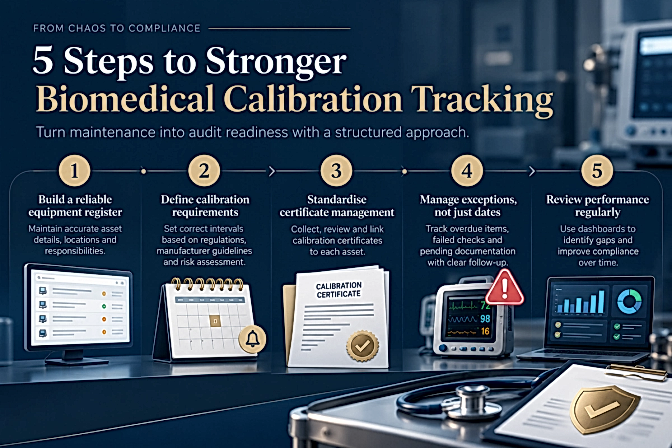
Hospitals can build this capability through five practical steps.
Step 1: Establish a Reliable Equipment Register
Begin with a structured inventory of relevant biomedical equipment. Capture consistent asset identifiers, equipment type, manufacturer, model, serial number, department, location, service responsibility, and applicable maintenance or calibration requirements.
Validate existing records before transferring them into a new system. Duplicate entries, retired assets, incomplete identifiers, and outdated locations can undermine every subsequent tracking activity.
Step 2: Define Calibration Requirements and Schedules
Determine the appropriate calibration requirements and intervals for each relevant asset using applicable regulations, manufacturer instructions, risk assessments, and the hospital's approved procedures.
Avoid applying one interval indiscriminately across different equipment types. Requirements can vary significantly depending on intended use, measurement characteristics, service history, and applicable standards.
Maintain a schedule that identifies upcoming activities, overdue items, planned service dates, and any required follow-up.
Step 3: Standardise Certificate Management
Create a consistent method for receiving and reviewing calibration certificates and associated service reports.
Confirm that the documentation corresponds to the correct asset, records the relevant activity and date, and contains the information required by the hospital's procedures.
Store records in an organised repository with appropriate access controls and a clear connection to the equipment register. Where corrections or replacements are necessary, preserve the required record history.
Step 4: Manage Exceptions, Not Just Dates
A tracking system should do more than display whether a calibration date has passed.
Teams also need visibility into failed checks, out-of-tolerance results, incomplete certificates, postponed appointments, and equipment awaiting assessment.
When a calibration result raises concerns, the hospital should follow its documented process to assess the potential impact on equipment performance, determine any necessary corrective action, and evaluate whether previously obtained measurements or affected activities require review.
Decisions about continued use, restriction, repair, and return to service should follow applicable procedures and be made by authorised personnel.
Step 5: Review Performance Regularly
Use periodic reviews to identify recurring gaps and improve the process before an audit exposes them.
Useful measures include:
- Percentage of applicable calibration activities completed by their due dates.
- Number of overdue calibration activities.
- Percentage of required certificates available and verified.
- Average time taken to close documentation gaps.
- Number of unresolved calibration exceptions.
- Repeat issues associated with specific assets, departments, or service providers.
These measures should have clear definitions, reporting periods, and accountable owners. A dashboard is useful only when the information behind it is accurate and the team acts on the findings.
How Inflewz Supports Better Calibration Visibility
Effective biomedical calibration tracking requires connected information, defined processes, and dependable records. When these elements are distributed across disconnected tools, teams may spend more time reconciling information than acting on it.
Inflewz approaches asset lifecycle management through structured visibility into assets, work, and supporting information.
For a healthcare equipment workflow, the objective is to make it easier to establish a consistent view of asset records, scheduled activities, outstanding work, and the documentation associated with each asset. The specific workflow should be configured around the hospital's requirements, existing processes, and applicable compliance obligations.
A well-structured digital workflow can help teams:
- Maintain a consistent view of relevant equipment records.
- Improve visibility into scheduled and outstanding activities.
- Associate supporting documentation with the appropriate asset.
- Identify exceptions that require attention.
- Establish clearer responsibility for follow-up.
- Make equipment histories easier to retrieve during internal reviews and audits.
The value lies not simply in replacing paper or spreadsheets with software. It lies in creating a process where information remains connected, responsibilities are visible, and gaps can be identified early.
Technology should support the hospital's approved maintenance and calibration procedures, not replace technical judgement, qualified service personnel, or regulatory requirements.
Building a More Reliable Biomedical Equipment Programme
Calibration tracking is one component of a broader equipment management programme. It works best alongside preventive maintenance, performance verification, equipment inventory management, service history, and appropriate controls for equipment that fails inspection or requires repair.
The World Health Organization's medical equipment maintenance guidance emphasises the importance of planning maintenance programmes around equipment inventories, appropriate methods, and available resources.
For hospital leaders, the practical lesson is that documentation should be part of the process from the beginning, not an activity added at the end.
A calibration appointment should lead to an updated record. A completed service activity should have the required supporting evidence. An exception should trigger the appropriate review. An upcoming due date should have a clear owner.
When these activities operate as a connected workflow, teams can spend less time searching for information and more time managing equipment effectively.
Conclusion: Make Every Calibration Record Accountable
Biomedical calibration tracking is easy to underestimate because many of its failures remain invisible until someone needs the evidence.
A missing certificate, an overlooked due date, or an unresolved exception can reveal weaknesses in the wider equipment management process. Addressing these weaknesses requires more than an annual audit checklist. It requires reliable asset records, clear ownership, structured documentation, and consistent follow-through.
Hospitals do not need to wait until an audit is approaching to establish this discipline.
By connecting calibration schedules, equipment histories, certificates, and corrective actions, healthcare organisations can build a more transparent and manageable approach to biomedical equipment oversight.
The goal is not simply to complete calibration on time. It is to know what has been completed, prove it with the right records, and act when something needs attention.
That is the foundation of dependable biomedical calibration tracking.
About Inflewz
Inflewz focuses on asset lifecycle management, helping organisations bring greater structure and visibility to the processes, information, and work associated with their assets. Explore how a more connected approach to asset management can support operational control and documentation readiness.