
The Sensor Strategy Nobody Talks About — Coverage, Cost, and Cadence

Dhananjay Chandra Kulal
Author
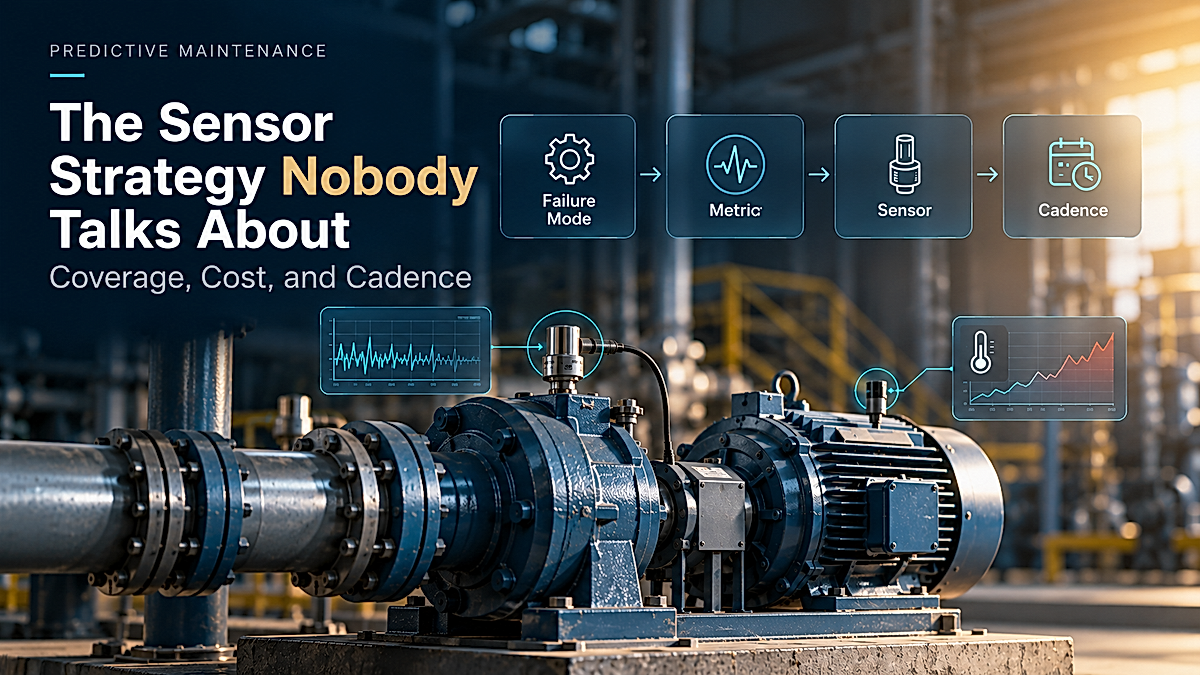
Predictive maintenance is often treated as a sensor problem.
Which sensor should you buy? How many assets should you monitor? Should you use vibration, temperature, pressure, current, ultrasound, or another measurement method? And how frequently should that data be collected?
These are important questions. But they are not the first questions teams should answer.
A stronger industrial sensor strategy starts with a different sequence:
Failure Mode → Metric → Sensor → Cadence
The order matters.
A sensor creates value only when it can detect a meaningful change associated with a specific failure mode—and detect it early enough for the maintenance team to act.
An organisation can install hundreds of sensors and still have poor predictive maintenance coverage. Another organisation may monitor fewer assets but generate significantly more value because every measurement is tied to a defined failure mode, appropriate monitoring cadence, and clear maintenance response.
The objective is not maximum sensor coverage.
It is useful coverage.
Why Sensor Strategy Should Start With Failure Modes
A common approach to predictive maintenance starts with the asset:
“We have 500 motors. Which sensors should we install?”
That question starts too late in the decision process.
A motor can experience multiple failure modes, including:
- Bearing degradation
- Misalignment
- Imbalance
- Lubrication problems
- Electrical faults
- Overheating
- Insulation degradation
- Coupling problems
These failure modes do not necessarily produce the same physical signals.
Vibration may help identify bearing degradation, imbalance, or misalignment. Temperature can reveal abnormal thermal behaviour. Electrical measurements may provide indications of certain electrical or mechanical conditions. Lubricant condition can provide another source of evidence where wear or lubrication contributes to equipment degradation.
So the decision should not simply be:
Asset → Sensor
It should be:
Asset → Failure Mode → Metric → Sensor → Cadence
This failure-mode-first approach helps teams select sensing technologies based on an engineering requirement rather than technology availability.
The Right Sequence: Failure Mode → Metric → Sensor → Cadence
A practical industrial sensor strategy can be structured around four connected decisions.
1. Identify the Failure Mode
Start with a simple question:
What can actually go wrong?
For a centrifugal pump, relevant failure modes might include:
- Bearing degradation
- Shaft misalignment
- Imbalance
- Cavitation
- Lubrication problems
- Seal deterioration
The objective is not to create the longest possible list of theoretical failures.
The objective is to identify failure modes that matter operationally.
Teams should consider factors such as:
- Frequency of failure
- Cost of failure
- Safety implications
- Compliance implications
- Production impact
- Detectability
- Speed of degradation
- Repair lead time
A high-consequence failure that provides an identifiable early warning signal may be a strong candidate for predictive monitoring.
A low-impact failure with little or no detectable warning may require a different maintenance strategy.
Predictive maintenance therefore begins with understanding failure—not selecting hardware.
2. Define the Metric
Once the failure mode is understood, the next question becomes:
What measurable change indicates that this failure may be developing?
Different failure modes require different metrics.
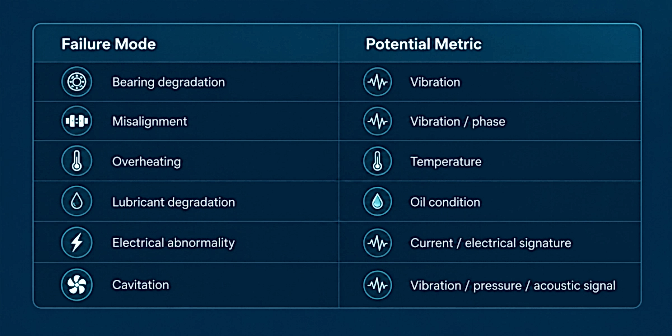
The relationship between the failure mode and the metric should be clear.
Collecting more data does not automatically create better predictive maintenance.
Every metric should answer a practical question:
What is changing, and why does that change matter?
Without that connection, sensor data can quickly become another stream of information that teams collect but struggle to use.
3. Select the Sensor
Only after the failure mode and metric are understood should the team select the sensor.
Different monitoring technologies have different strengths, limitations, installation requirements, and costs.
There is no universal “best” predictive maintenance sensor.
The appropriate choice depends on factors such as:
- Failure mode
- Measurement requirement
- Measurement location
- Required sensitivity
- Operating environment
- Asset criticality
- Installation constraints
- Connectivity
- Data requirements
- Maintenance requirements
- Cost
A technically sophisticated sensor is not automatically the right sensor.
The right sensor is the one that provides the required measurement reliably enough to support a maintenance decision.
4. Determine the Monitoring Cadence
The fourth decision is frequently overlooked:
How often should the measurement be taken?
Continuous monitoring may sound ideal, but not every asset or failure mode requires continuous data.
Some degradation processes develop gradually over weeks or months. Periodic measurements may provide sufficient warning.
Other failure modes can progress rapidly and may require much more frequent monitoring.
Consider two simplified situations.
Slow Degradation
A bearing condition deteriorates gradually over several weeks.
Periodic measurements may provide enough information to identify the trend, validate the condition, and schedule corrective maintenance.
Rapid Degradation
A critical condition can progress from detectable deterioration to functional failure within hours.
A reading collected once every 24 hours may provide insufficient protection, regardless of the quality of the sensor.
The monitoring cadence should therefore reflect:
How quickly the condition can change + how quickly the organisation can respond.
Coverage Is Not the Same as Sensor Count
One of the easiest ways to misjudge a predictive maintenance programme is to measure its maturity by the number of sensors installed.
1,000 sensors may sound more advanced than 100 sensors.
But sensor count does not tell you whether the important failure modes are actually covered.
A more useful question is:
What percentage of our important and detectable failure modes have an appropriate monitoring method?
That changes the conversation from hardware deployment to engineering coverage.
Match Coverage to Asset Criticality
Imagine a facility with 1,000 assets.
Installing the same monitoring technology on every asset may not be economically or operationally justified.
Instead, assets can be evaluated using criteria such as:
- Operational criticality
- Failure consequence
- Failure frequency
- Detectability
- Cost of downtime
- Safety implications
- Existing maintenance strategy
- Required response time
The resulting strategy could differ by asset category.
Critical Assets
Use continuous or high-frequency condition monitoring where the potential consequence and failure behaviour justify it.
Important Assets
Use periodic connected sensing, route-based condition monitoring, or a combination of automated and manual inspection.
Lower-Criticality Assets
Preventive maintenance, routine inspection, or run-to-failure strategies may remain appropriate depending on the application.
Not every asset requires the same monitoring intensity. The goal is to place sensing effort where it can meaningfully influence reliability outcomes.
Build a Failure-Mode Coverage Map
A useful way to structure an industrial sensor strategy is through a failure-mode coverage matrix.
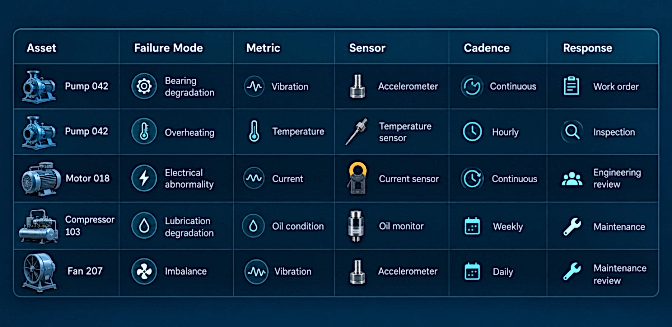
This type of matrix exposes gaps that a simple sensor inventory cannot.
For example:
Sensor installed: Yes
Important failure mode covered: No
That distinction matters.
An asset can be heavily instrumented and still have poor monitoring coverage if the installed sensors do not address the failure modes that create the greatest operational risk.
The Cost Question: More Sensors vs. Better Coverage
Sensor strategy also needs to account for total cost.
The cost of condition monitoring is not limited to the purchase price of the sensor.
A connected monitoring programme may involve:
- Sensor hardware
- Installation
- Connectivity
- Gateways
- Power or battery management
- Data storage
- Analytics
- Integration
- Calibration
- Sensor maintenance
- Engineering time
- Alert investigation
Adding more sensors therefore creates both technical capability and operational overhead.
The objective should not be:
“How cheaply can we collect more data?”
A more useful question is:
“What is the lowest-cost monitoring approach that gives us sufficient detection capability for this failure mode?”
That creates a better balance between engineering requirements and financial reality.
Cadence Should Follow Degradation, Not Convenience
Another common mistake is applying the same monitoring cadence across an entire asset class.
For example:
“Every machine gets one reading per day.”
It is operationally simple, but degradation does not necessarily follow a standard timetable.
Questions to Ask Before Setting Cadence
Before choosing the monitoring frequency, teams should ask:
- How quickly can the condition deteriorate?
- How much warning is required?
- How long does validation take?
- How long does maintenance planning take?
- How long does repair or replacement take?
- What happens if the condition is missed?
The cadence should provide enough opportunities to detect meaningful deterioration while there is still time to respond.
Put simply:
Detection must come before decision.
Decision must come before failure.
Don't Ignore Sensor Data Quality
An industrial sensor strategy does not end when the device begins transmitting data.
The information also needs to remain trustworthy.
Common data-quality issues can include:
- Missing readings
- Incorrect timestamps
- Sensor drift
- Poor installation
- Signal noise
- Communication failures
- Incorrect asset association
- Changing operating conditions
- Sensor replacement without correct configuration
A sensor may be functioning correctly while still producing data that is difficult to interpret operationally.
Context Makes Sensor Data Useful
Consider a vibration reading.
Its value increases significantly when the organisation can also determine:
- Which asset generated it
- Where the sensor is installed
- Which component is being monitored
- What operating condition existed at the time
- What the normal range is
- When the asset was last maintained
- Whether the sensor was recently replaced
- Whether similar alerts occurred previously
A sensor reading without asset context is simply a measurement.
A sensor reading connected to the asset lifecycle becomes operational information.
The Sensor Is Only One Part of the Workflow
Predictive maintenance creates value when a signal leads to an appropriate action.
A practical chain might look like:
Sensor → Data → Condition → Alert → Validation → Work Order → Maintenance → Finding → Learning
If the process stops at the alert, the predictive maintenance workflow is incomplete.
A “high vibration” alert alone does not solve a maintenance problem.
The team still needs to understand:
- Which asset generated the alert?
- What changed?
- How significant is the change?
- Which failure mode could it indicate?
- Who owns the asset?
- What should be inspected?
- How urgent is the response?
- What maintenance action is required?
- What was discovered after inspection?
- Was the predicted condition actually present?
This is why predictive maintenance must connect sensing with maintenance execution.
Avoid the Dashboard Problem
A dashboard filled with green, yellow, and red indicators can create the appearance of control.
But the most important question often comes after the alert:
What happened next?
A mature predictive maintenance programme should therefore measure more than sensor availability.
Metrics That Matter
Useful measures can include:
- Failure-mode coverage
- Sensor availability
- Data completeness
- Data quality
- Alert volume
- False-alert rate
- Warning time
- Inspection findings
- Work orders generated
- Corrective actions completed
- Avoided downtime
- Repeat failures
These metrics move the focus from data collection toward maintenance outcomes.
The goal is not to generate more alarms.
The goal is to enable better maintenance decisions.
A Practical Industrial Sensor Strategy Framework
Before approving a new sensor deployment, teams can work through seven questions.
1. What Failure Mode Are We Monitoring?
Be specific.
“Machine health” is too broad.
“Bearing degradation on Pump 042” creates a clearer engineering objective.
2. What Metric Indicates the Failure?
Identify the physical parameter that provides evidence of deterioration.
3. Can the Metric Detect the Failure Early Enough?
A condition may be measurable but still provide too little warning to support an effective intervention.
4. What Sensor Is Appropriate?
Evaluate the sensor based on the measurement requirement, environment, installation, connectivity, reliability, and cost.
5. What Cadence Is Required?
Match the measurement frequency to the expected degradation rate and required response time.
6. What Happens When the Condition Changes?
Define:
Alert → Owner → Validation → Action → Closure
There should be a clear response path before the alert is generated.
7. Where Does the Information Live?
Sensor information should remain connected to the relevant:
- Asset record
- Location
- Ownership
- Failure mode
- Maintenance history
- Inspection history
- Work orders
- Supporting documentation
This becomes increasingly important as sensor deployments scale across plants, equipment types, and operational teams.
Start Small, But Design for Scale
A predictive maintenance programme does not need to begin with every asset.
A more practical starting point is a defined group of high-value failure modes.
Choose a Focused Pilot
A pilot might focus on:
- One production line
- One asset class
- A small group of critical assets
- A recurring equipment failure
- A high-cost downtime problem
The pilot should validate the complete workflow:
Failure Mode → Metric → Sensor → Cadence → Detection → Action → Outcome
This allows the organisation to learn not only whether the sensor works, but whether the entire maintenance process works.
Once that workflow is reliable, the programme can expand.
Scaling a proven monitoring model is more valuable than installing a large sensor network without a defined operational response.
What Good Sensor Strategy Looks Like
A mature industrial sensor strategy should make five questions easy to answer.
What Can Fail?
The relevant failure modes are understood and prioritised.
What Tells Us It Is Failing?
The metrics associated with those failure modes are defined.
How Do We Measure It?
The sensor or inspection method is appropriate for the required measurement.
How Often Do We Measure It?
The cadence reflects degradation behaviour and response requirements.
What Happens Next?
The resulting signal is connected to a defined maintenance workflow.
That is the difference between sensor deployment and predictive maintenance capability.
From Sensors to an Asset Intelligence Layer
As organisations deploy more connected assets, the challenge begins to shift.
Collecting data is no longer the only problem.
The bigger challenge becomes maintaining the relationships between that data and the physical asset lifecycle.
A sensor reading needs to belong to an asset.
That asset needs an owner.
The asset needs maintenance history.
The maintenance history needs to connect to work orders.
The failure mode needs to connect to the metric.
The metric needs to connect to the sensor.
And an actionable condition needs to connect to a response.
The resulting chain looks like:
Asset → Failure Mode → Metric → Sensor → Condition → Alert → Action → Outcome
This is where predictive maintenance becomes operationally useful rather than simply data-rich.
For large and distributed asset environments, these relationships may exist across different asset registers, maintenance systems, IoT platforms, engineering records, documents, and operational workflows.
The challenge is therefore not only sensing equipment condition.
It is maintaining the context required to turn that condition into action.
Final Takeaway
The sensor strategy nobody talks about is not really about sensors.
It is about making deliberate decisions around coverage, cost, and cadence.
Instead of starting with:
“Which sensor should we buy?”
Start with:
“Which failure mode are we trying to detect?”
Then follow the sequence:
Failure Mode → Metric → Sensor → Cadence
From there, connect the detected condition to the maintenance workflow.
The strongest predictive maintenance programmes are not necessarily those with the most sensors.
They are the ones where every important measurement has a reason, every meaningful signal has context, and every actionable alert has a path to response.
Better sensing starts with better questions.
Inflewz Perspective
For organisations managing large and distributed asset environments, predictive maintenance becomes harder when sensor information, asset records, maintenance history, ownership, documentation, and workflows exist in separate places.
Inflewz can serve as the orchestration layer around this asset lifecycle—helping connect asset context, operational records, documentation, and workflows so that sensor-driven insights can be understood within the broader lifecycle of the asset.
The objective is not simply to know that a condition has changed.
It is to understand:
What asset changed → Why it matters → Who owns the response → What happens next.
That is how sensor data moves closer to operational action.
Asset Lifecycle, Engineered.